


Estimates of Cases and Hospitalizations Averted by COVID-19 Case Investigation and Contact Tracing in 14 Health Jurisdictions in the United States
- PMID: 34534993
- PMCID: PMC11334148
- DOI: 10.1097/PHH.0000000000001420
Estimates of Cases and Hospitalizations Averted by COVID-19 Case Investigation and Contact Tracing in 14 Health Jurisdictions in the United States
Abstract
Context: The implementation of case investigation and contact tracing (CICT) for controlling COVID-19 (caused by SARS-CoV-2 virus) has proven challenging due to varying levels of public acceptance and initially constrained resources, especially enough trained staff. Evaluating the impacts of CICT will aid efforts to improve such programs.
Objectives: Estimate the number of COVID-19 cases and hospitalizations averted by CICT and identify CICT processes that could improve overall effectiveness.
Design: We used data on the proportion of cases interviewed, contacts notified or monitored, and days from testing to case and contact notification from 14 jurisdictions to model the impact of CICT on cumulative case counts and hospitalizations over a 60-day period. Using the Centers for Disease Control and Prevention's COVIDTracer Advanced tool, we estimated a range of impacts by assuming either contacts would quarantine only if monitored or would do so upon notification of potential exposure. We also varied the observed program metrics to assess their relative influence.
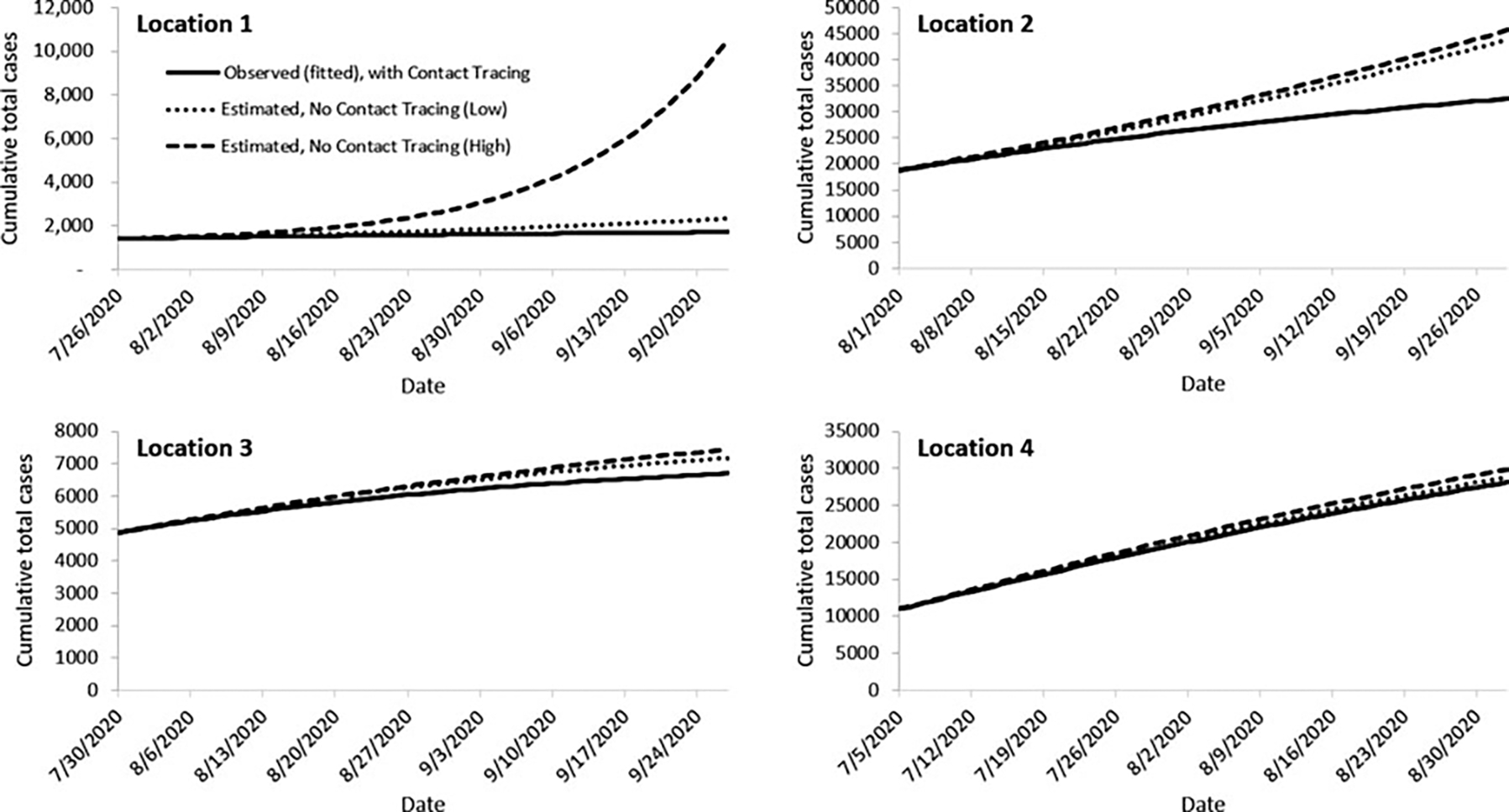
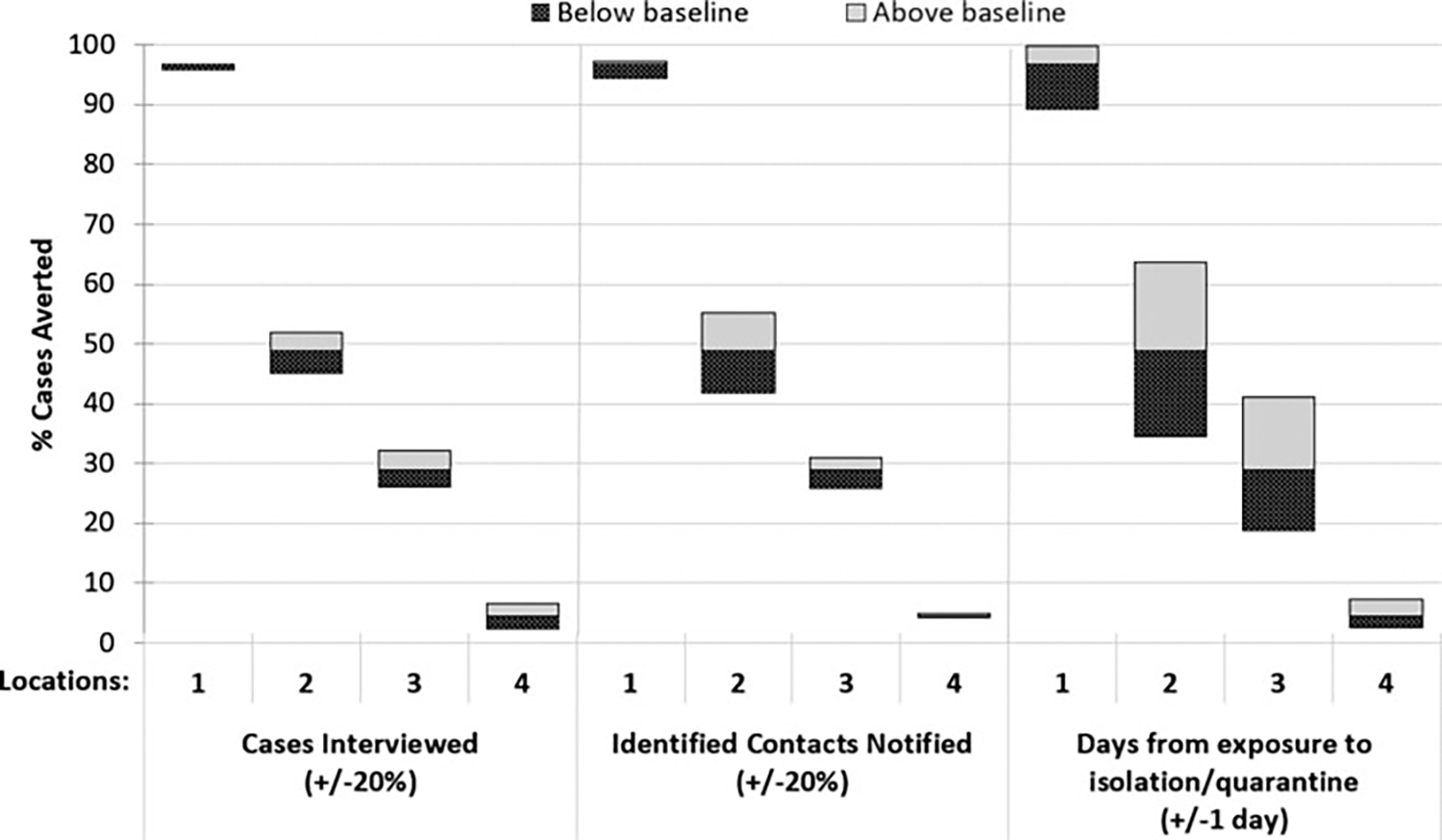
Results: Performance by jurisdictions varied widely. Jurisdictions isolated between 12% and 86% of cases (including contacts that became cases) within 6 to 10 days after infection. We estimated that CICT-related reductions in transmission ranged from 0.4% to 32%. For every 100 remaining cases after other nonpharmaceutical interventions were implemented, CICT averted between 4 and 97 additional cases. Reducing time to case isolation by 1 day increased averted case estimates by up to 15 percentage points. Increasing the proportion of cases interviewed or contacts notified by 20 percentage points each resulted in at most 3 or 6 percentage point improvements in averted cases.
Conclusions: We estimated that CICT reduced the number of COVID-19 cases and hospitalizations among all jurisdictions studied. Reducing time to isolation produced the greatest improvements in impact of CICT.
Conflict of interest statement
No conflicts of interest to report.
Figures
References
-
- Center for Health Security, Johns Hopkins Bloomberg School of Public Health. A national plan to enable comprehensive COVID-19 case finding and contact tracing in the US. https://www.centerforhealthsecurity.org/our-work/pubs_archive/pubs-pdfs/.... Published 2020. Accessed May 1, 2021.
-
- Ruebush E, Fraser MR, Poulin A, Allen M, Lane JT, Blumenstock JS. COVID-19 case investigation and contact tracing: early lessons learned and future opportunities. J Public Health Manag Pract. 2021;27(suppl 1):S87–S97. - PubMed
-
- Lash RR, Donovan CV, Fleischauer AT, et al. COVID-19 contact tracing in two counties—North Carolina, June-July 2020. MMWR Morb Mortal Wkly Rep. 2020;69(38):1360–1363. https://www.cdc.gov/mmwr/volumes/69/wr/mm6938e3.htm. Accessed May 1, 2021. - PMC - PubMed
Publication types
MeSH terms
Grants and funding
LinkOut - more resources
Full Text Sources
Medical
Miscellaneous
