


Incidence and risk factors of female urinary incontinence: a 4-year longitudinal study among 24 985 adult women in China
- PMID: 34536320
- PMCID: PMC9298368
- DOI: 10.1111/1471-0528.16936
Incidence and risk factors of female urinary incontinence: a 4-year longitudinal study among 24 985 adult women in China
Abstract
Objective: To estimate the incidence of urinary incontinence (UI), including its subtypes stress UI (SUI), urgency UI (UUI) and mixed UI (MUI), and to examine risk factors for de novo SUI and UUI in Chinese women.
Design: Nationwide longitudinal study.
Setting: Six geographic regions of China.
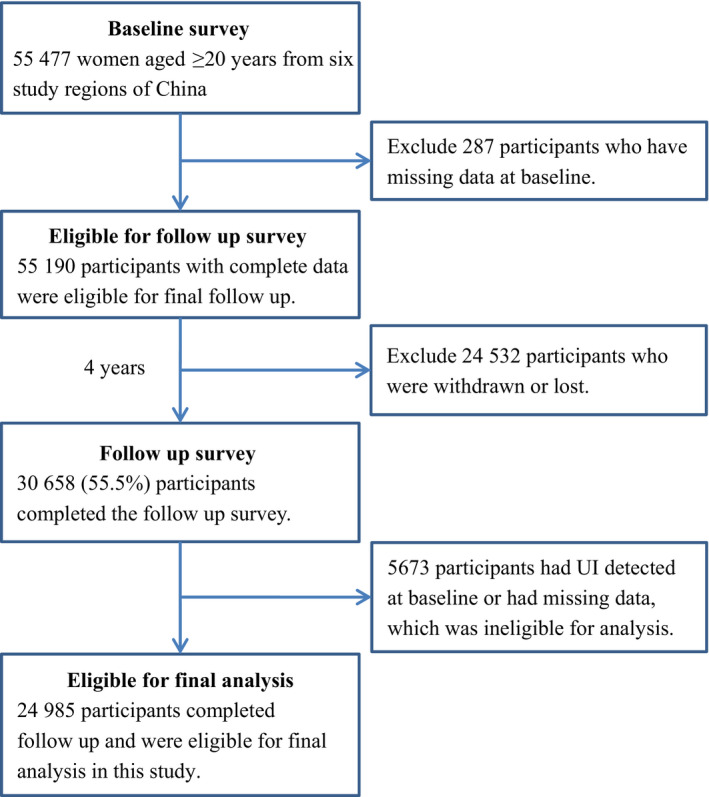
Participants: Women aged ≥20 years old were included using a multistage, stratified, cluster sampling method.
Methods: This study was conducted between May 2014 and March 2016, with follow up in 2018. Data on demographics, medical history, lifestyle and physiological and anthropometric information were collected.
Main outcome measurements: Incidence, rate ratio (RR).
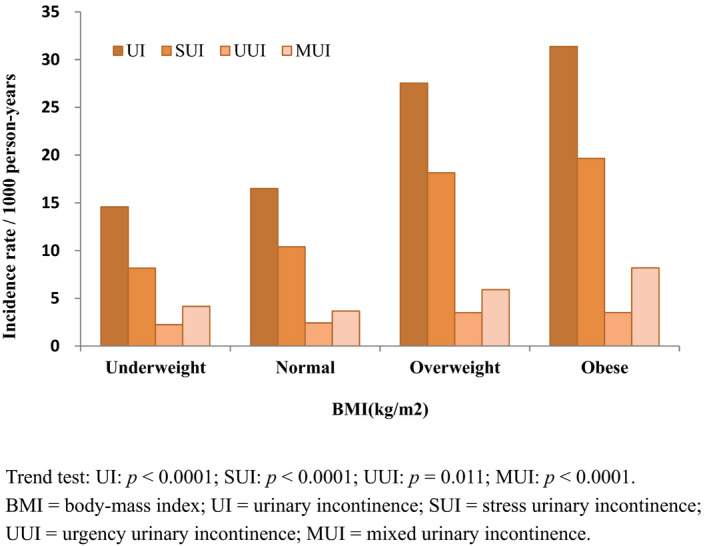
Results: Analyses included 24 985 women (mean age 41.9 years).The follow-up response rate was 55.5%, median follow-up time was 3.7 years. The standardised incidences of UI, SUI, UUI and MUI were 21.2, 13.1, 3.0 and 5.1 per 1000 person-years, respectively. Risk factors for de novo SUI included delivery pattern (vaginal spontaneous delivery RR 2.12, 95% CI 1.62-2.78 and instrumental delivery RR 3.30, 95% CI 1.99-5.45), high body mass index (BMI) (overweight RR 1.52, 95% CI 1.33-1.74 and obesity RR 1.67, 95% CI 1.32-2.11), cigarette smoking (RR 1.54, 95% CI 1.12-2.12), chronic cough (RR 1.44, 95% CI 1.17-1.76), diabetes (RR 1.33, 95% CI 1.10-1.60) and older age (50-59 years RR 1.49, 95% CI 1.16-1.90 and 60-69 years RR 1.61, 95% CI 1.22-2.13).The risk factors significantly associated with de novo UUI were age (RR increased from 1.21, 95% CI 0.74-1.99, at 30-39 years to 6.3, 95% CI 3.85-10.30, at >70 years) and diabetes (RR 1.48, 95% CI 1.05-2.09).
Conclusions: The incidence of female UI is 21.2 per 1000 person-years in China. Delivery (vaginal spontaneous delivery, instrumental delivery), high BMI, cigarette smoking, chronic cough, diabetes and older age were risk factors.
Tweetable abstract: The incidence of female urinary incontinence was 21.2 per 1000 person-years in China. Delivery, BMI, diabetes and old age are risk factors.
Keywords: Female urinary incontinence; incidence rate; mixed urinary incontinence; risk factors; stress urinary incontinence; urgency urinary incontinence.
© 2021 The Authors. BJOG: An International Journal of Obstetrics and Gynaecology published by John Wiley & Sons Ltd.
Figures
References
-
- Abrams P, Cardozo L, Fall M, Griffiths D, Rosier P, Ulmsten U, et al. The standardisation of terminology of lower urinary tract function: report from the Standardisation Sub‐committee of the International Continence Society. Neurourol Urodyn 2002;21:167–78. - PubMed
-
- Lukacz ES, Santiago‐Lastra Y, Albo ME, Brubaker L. Urinary incontinence in women: a review. JAMA 2017;318:1592–604. - PubMed
-
- Hu TW, Wagner TH, Bentkover JD, Leblanc K, Zhou SZ, Hunt T. Costs of urinary incontinence and overactive bladder in the United States: a comparative study. Urology 2004;63:461–5. - PubMed
-
- Smith K, Sutherland A, Hyde Z, Crawford R, Dwyer A, Malay R, et al. Assessment, incidence and factors associated with urinary incontinence in older Aboriginal Australians. Intern Med J 2019;49:1111–8. - PubMed
-
- Legendre G, Fritel X, Panjo H, Zins M, Ringa V. Incidence and remission of stress, urge, and mixed urinary incontinence in midlife and older women: a longitudinal cohort study. Neurourol Urodyn 2019;39:650–7. - PubMed
MeSH terms
Grants and funding
LinkOut - more resources
Full Text Sources
Medical
