


Importance of Dehydroepiandrosterone Sulfate Assessment with Special Attention for Adrenal Tumours and Arterial Hypertension
- PMID: 34539912
- PMCID: PMC8417495
- DOI: 10.4183/aeb.2021.68
Importance of Dehydroepiandrosterone Sulfate Assessment with Special Attention for Adrenal Tumours and Arterial Hypertension
Abstract
Objective: To investigate the significance of DHEAS assessment in males of different ages.
Methods: Retrospective cohort study of patients investigated in two large academic centres.
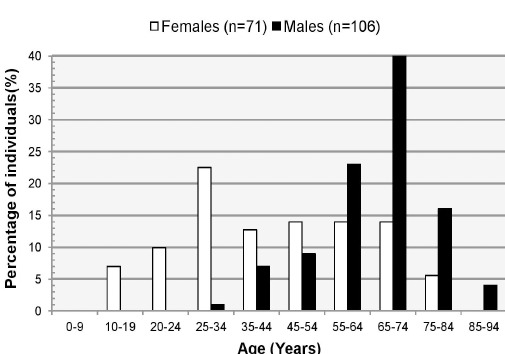
Results: The data of DHEAS assessment of 3533 patients (3013 females and 520 males) was analysed. DHEAS was 1.6 - 13.5 times more frequently investigated in women than in men. A peak of DHEAS evaluation test for women was at 25 years old and distribution was uniform in males over decades, excepting being lower in 0-9 and 75+ages. In the age group 10-24 years, DHEAS levels were higher in females. After 45 years, DHEAS was higher in men than in women. Analysis of 510 case records showed low DHEAS levels in boys (0-9 years) and in men aged 65 - 84+. Higher DHEAS levels were detected as a peak at 30 years old, but never after 55 years. In individuals with low DHEAS levels prevailed congenital adrenal hyperplasia (32%), adrenal tumours (30%) and primary or secondary adrenal insufficiency (19%). High DHEAS levels prevailed in patients with arterial hypertension (26%), overweight-obesity -(19%), non-toxic goiter (17%) and alopecia (9%). In the normal DHEAS miscellaneous diagnoses were met most frequently - 40%. Disorders exceeding 5% were non-toxic goiter (19%), adrenal tumours - 17%, overweight/obesity - 16% and arterial hypertension- 8%. In 71 women and 124 men adrenal neoplasms were detected. Higher frequency of these was observed in women in their 30s. A peak of adrenal neoplasms in men was at their 70s. This gender difference was not conditioned by earlier attempts to seek medical care by women. A significant correlation of DHEAS, weight, body mass index and systolic blood pressure with diastolic blood pressure was found.
Conclusion: Our study permits to determine which DHEAS secretion and clinical pattern might be associated in males of different ages.
Keywords: DHEAS; adrenal tumors; hypertension.
©by Acta Endocrinologica Foundation.
Figures



References
-
- Lopez SA. Metabolic and endocrine factors in aging Rothschild H Risk Factors for Senility. New York: Oxford University Press; 1984 205 219.
-
- Rudman D, Shetty KR, Mattson DE. Plasma dehydroepiandrosterone sulfate in nursing home men. J Am Geriatr Soc. 1990;38:421–427. - PubMed
-
- Jaroff L. New age therapy. Time. 1995;23:52.
-
- Traish AM, Paco Kang H, Saad F, Guay AT. Dehydroepiandrosterone (DHEA) – A Precursor Steroid or an Active hormone in Human Physiology. J Sex Med. 2011;8:2960–2982. - PubMed
LinkOut - more resources
Full Text Sources
Miscellaneous