doi: 10.21769/BioProtoc.2534.
Predator Odor-induced Freezing Test for Mice
Affiliations
- PMID: 34541190
- PMCID: PMC8413536
- DOI: 10.21769/BioProtoc.2534
Item in Clipboard
Predator Odor-induced Freezing Test for Mice
Bio Protoc.
.
Abstract
The innate fear response is an emotional response that does not require any previously acquired conditioning. One of the standard methods to analyze the innate fear response is a 2,4,5-trimethylthiazoline (TMT)-induced freezing test. TMT is an odor originally isolated from anal secretion of the red fox. Acute TMT exposure has been shown to induce robust freezing behavior in rats and mice (Wallace and Rosen, 2000; Galliot et al., 2012 ). Here, I show how to expose mice to TMT and how to analyze their freezing behavior.
Keywords: Fear; Freezing; Innate; Odor; Predator; TMT.
Copyright © 2017 The Authors; exclusive licensee Bio-protocol LLC.
Figures
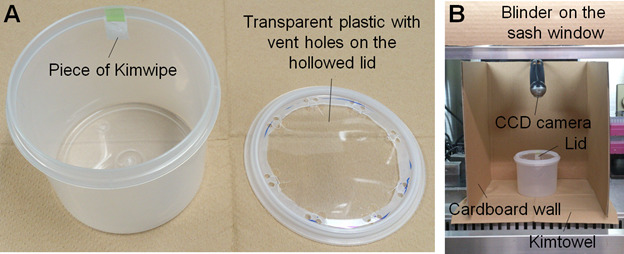
A. Disposable circular test chamber and lid; B. The placement of equipment. The chamber is placed at the center of the walled area and illuminated at 500 lux in my equipment.
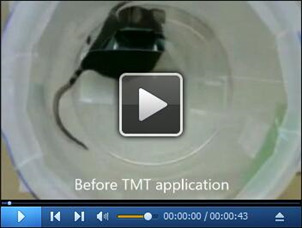
The mouse showed freezing behavior after the administration of TMT.
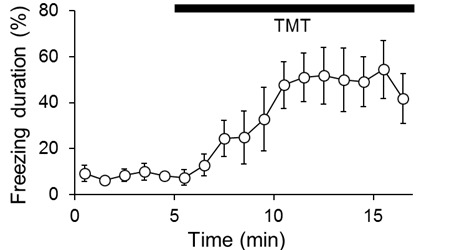
Each dot represents the percentage of average freezing duration of six female wild-types (C57BL/6J from Charles River Laboratories, 14 weeks old). Error bars show SEM. The mice were exposed to TMT for 5 min after the start of acclimation.
References
-
- Galliot E., Laurent L., Hacquemand R., Pourie G. and Millot J. L.(2012). Fear-like behavioral responses in mice in different odorant environments: Trigeminal versus olfactory mediation under low doses. Behav Processes 90(2): 161-166. - PubMed
-
- Johnston R., Müller-Schwarze D. and Sorenson P.(1999). Advances in Chemical Signals in Vertebrates. Springer.
-
- Müller M. and Fendt M.(2006). Temporary inactivation of the medial and basolateral amygdala differentially affects TMT-induced fear behavior in rats. Behav Brain Res 167(1): 57-62. - PubMed
LinkOut - more resources
Full Text Sources