. 2021 Dec 16;144(11):3451-3460.
doi: 10.1093/brain/awab326.

Predictors of functional outcomes in patients with facioscapulohumeral muscular dystrophy

Affiliations

Predictors of functional outcomes in patients with facioscapulohumeral muscular dystrophy

Natalie K Katz et al. Brain. .

Abstract

Facioscapulohumeral muscular dystrophy (FSHD) is one of the most prevalent muscular dystrophies characterized by considerable variability in severity, rates of progression and functional outcomes. Few studies follow FSHD cohorts long enough to understand predictors of disease progression and functional outcomes, creating gaps in our understanding, which impacts clinical care and the design of clinical trials. Efforts to identify molecularly targeted therapies create a need to better understand disease characteristics with predictive value to help refine clinical trial strategies and understand trial outcomes. Here we analysed a prospective cohort from a large, longitudinally followed registry of patients with FSHD in the USA to determine predictors of outcomes such as need for wheelchair use. This study analysed de-identified data from 578 individuals with confirmed FSHD type 1 enrolled in the United States National Registry for FSHD Patients and Family members. Data were collected from January 2002 to September 2019 and included an average of 9 years (range 0-18) of follow-up surveys. Data were analysed using descriptive epidemiological techniques, and risk of wheelchair use was determined using Cox proportional hazards models. Supervised machine learning analysis was completed using Random Forest modelling and included all 189 unique features collected from registry questionnaires. A separate medications-only model was created that included 359 unique medications reported by participants. Here we show that smaller allele sizes were predictive of earlier age at onset, diagnosis and likelihood of wheelchair use. Additionally, we show that females were more likely overall to progress to wheelchair use and at a faster rate as compared to males, independent of genetics. Use of machine learning models that included all reported clinical features showed that the effect of allele size on progression to wheelchair use is small compared to disease duration, which may be important to consider in trial design. Medical comorbidities and medication use add to the risk for need for wheelchair dependence, raising the possibility for better medical management impacting outcomes in FSHD. The findings in this study will require further validation in additional, larger datasets but could have implications for clinical care, and inclusion criteria for future clinical trials in FSHD.

Keywords: artificial intelligence; facioscapulohumeral muscular dystrophy; functional outcomes; machine learning; wheelchair use.


Figures

Figure 1
Figure 1
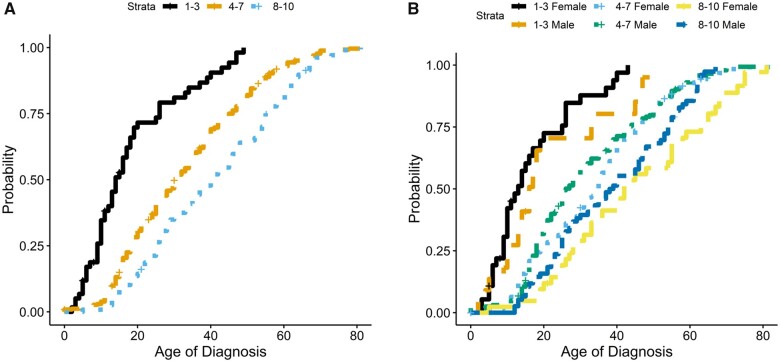
Repeat length, age at diagnosis and gender. Cumulative probability plots were used to compare repeat length and age at diagnosis (A), as well as repeat length and age at diagnosis with respect to gender (B). (A) A median age of diagnosis of 14 (95% CI: 11, 17) for all individuals with 1–3 repeats; 30 years (95% CI: 27, 34) for all individuals with 4–7 repeats; and 40 years (95% CI: 35, 46) for all individuals with 8–10 repeats. When separated by gender (B), there does appear to be a separation in the age at which males and females with 4–7 repeats were diagnosed. Males had a median age of diagnosis of 25 (95% CI: 24, 30) whereas females had a median age of diagnosis of 35 (95% CI: 30, 37). There is no difference in the median age at diagnosis for males and females with 1–3 or 8–10 repeats. Females in the 1–3 repeat category were diagnosed at a median age of 11 (95% CI: 10, 17) whereas males were diagnosed at a median age of 16 (95% CI: 13, 33). Females in the 8–10 repeat category were diagnosed at a median age of 42 (95% CI: 33, 55) whereas males were diagnosed at a median age of 38.5 (95% CI: 32, 47).
Figure 2
Figure 2
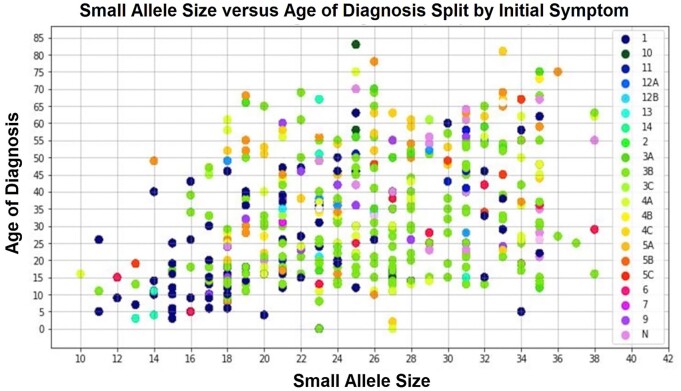
Small allele size (repeat length), age at diagnosis and initial symptoms. When comparing initial presenting symptoms to age at diagnosis and repeat length, we see a cluster of facial weakness (1 = dark blue dots) in individuals with the smallest repeat lengths (1–3 repeats = 10–18 kb allele size). We also see a cluster of proximal upper extremity weakness (3A = green dots) in individuals with medium (4–7 repeats; 18–30 kb allele size) repeat lengths. Right axis: 1 = facial weakness; 2 = trunk weakness; 3A = proximal upper extremity (UE) weakness; 3B = distal UE weakness; 3C = unspecified UE weakness; 4A = proximal lower extremity (LE) weakness; 4B = distal LE weakness; 4C = unspecified LE weakness; 5A = pain in the back/trunk; 5B = pain in the UE; 5C = pain in the LE; 6 = fatigue or generalized weakness; 7 = atrophy or loss of muscle mass; 8 = muscle cramps; 9 = abnormal laboratory values; 10 = family history of FSHD; 11 = no symptoms; 12A = injury due to falling; 12B = injury not due to falling; 13 = unable to classify; 14 = sensory changes; N = missing data.
Figure 3
Figure 3
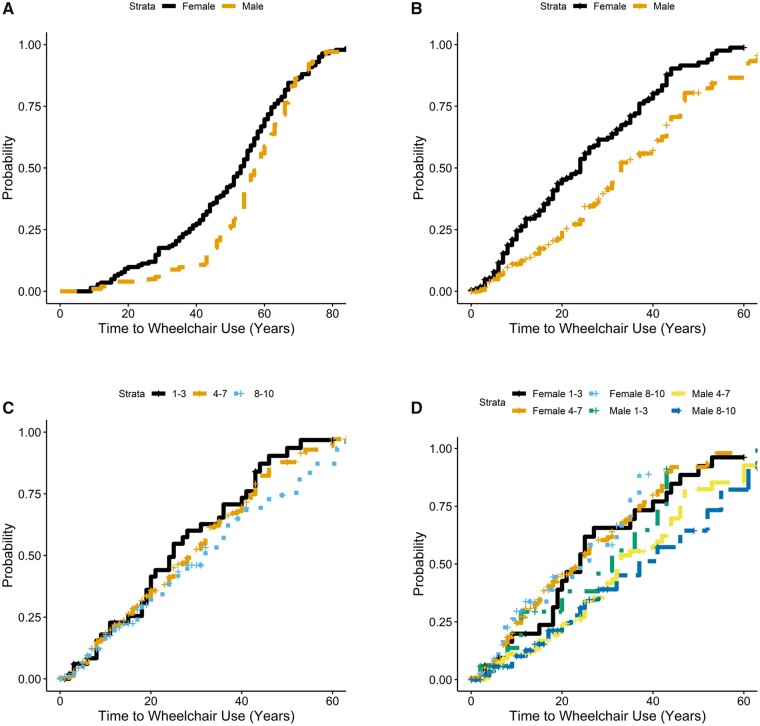
Females are more likely to progress to wheelchair use overall. Log-rank analysis of baseline and longitudinal data shows that (A) females were more likely at all ages to use a wheelchair compared to males, with a median age of wheelchair use of 59 (95% CI: 56, 62) whereas males had a median age of wheelchair use at 64 (95% CI: 62, 68). Females have a shorter length of time from age at diagnosis to age of wheelchair use (B), with a median difference of 23 years for females (95% CI: 19, 26) and 32 years for males (95% CI: 29, 37). There is no significant difference between D4Z4 repeat length and length of time form diagnosis to wheelchair use (P = 0.2) (C), but when separated by gender we again see that females were more likely than males to progress to wheelchair use (P = 4 × 10⁻⁴) (D). Females in the 1–3 D4Z4 repeat category have a median time of progression to wheelchair use of 23 years (95% CI: 15, 31) whereas males with 1–3 D4Z4 repeats have a median time of progression to wheelchair use of 28 years (95% CI: 20, n/a). Females in the 4–7 D4Z4 repeat category had a median time of progression to wheelchair use of 22 years (95% CI: 18, 27) whereas males had a median time of progression of 33 years (95% CI: 29, 40). Females in the 8–10 D4Z4 repeat category had a median time of progression to wheelchair use of 20 years (95% CI: 12, n/a) whereas males had a median time of progression of 28 years (95% CI: 18, 54).
Figure 4
Figure 4
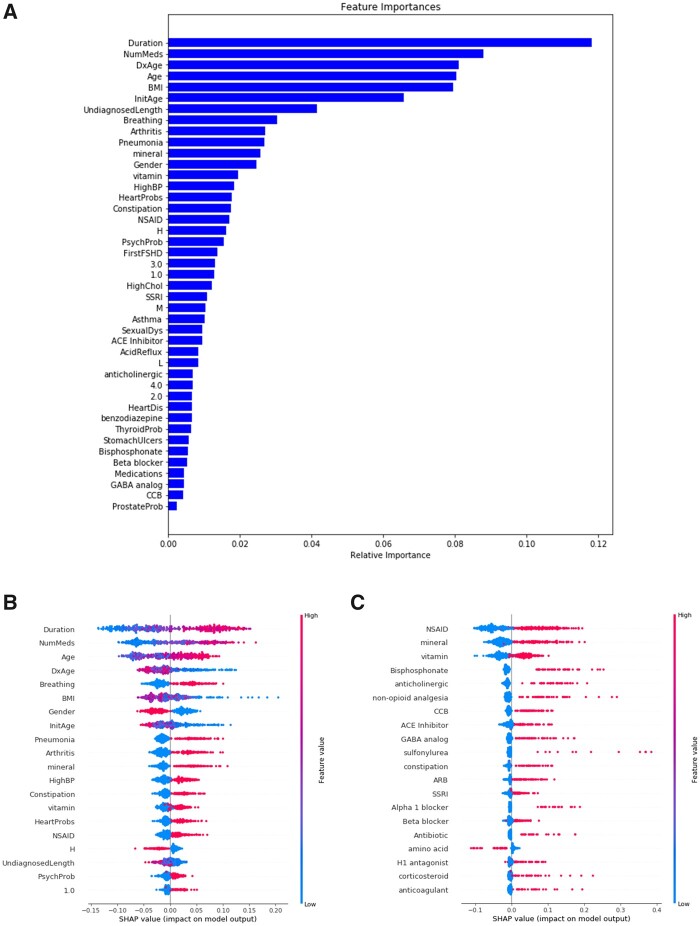
Feature importance predicted by the Random Forest machine learning model and SHAP analysis. The Random Forest machine learning model (A) and SHAP analysis (B) both identified disease duration and number of medications as the most important features influencing wheelchair use. Age-related features such as current age of the patient (Age), age at diagnosis (DxAge) were the next most important features. Female gender was found to influence likelihood of wheelchair use. Having a low BMI was found to influence towards wheelchair use. Comorbidities such as respiratory concerns (Breathing), arthritis, pneumonia, hypertension (HighBP) and constipation were all found to influence towards wheelchair use. Genetics (repeat length) and initial presenting symptoms were further down on the list of feature importance. A separate ‘medication-only’ model (C) found that all classes of medications influenced towards wheelchair use except for those classified as amino acids. Duration = disease duration; NumMeds = number of medications; Age = current age of the patient; DxAge = age at diagnosis; Breathing = Y/N respiratory difficulties; InitAge = initial age symptom onset; HighBP = hypertension; HeartProbs = heart problems; H = 8–10 D4Z4 repeat units; UndiagnosedLength = time spent undiagnosed (in years); PsychProb = psychiatric concerns; 1.0 = initial symptom facial weakness

Comment in

References

    1. Flanigan KM, Coffeen CM, Sexton L, Stauffer D, Brunner S, Leppert MF.. Genetic characterization of a large, historically significant Utah kindred with facioscapulohumeral dystrophy. Neuromuscul Disord. 2001;11(6-7):525–529. - PubMed
    1. Mostacciuolo ML, Pastorello E, Vazza G, et al.Facioscapulohumeral muscular dystrophy: Epidemiological and molecular study in a north-east Italian population sample. Clin Genet. 2009;75(6):550–555. - PubMed
    1. Padberg GW, Frants RR, Brouwer OF, Wijmenga C, Bakker E, Sandkuijl LA.. Facioscapulohumeral muscular dystrophy in the Dutch population. Muscle Nerve Suppl. 1995;2(2):S81–S84. - PubMed
    1. Deenen JC, Arnts H, van der Maarel SM, et al.Population-based incidence and prevalence of facioscapulohumeral dystrophy. Neurology. 2014;83(12):1056–1059. - PMC - PubMed
    1. Banerji CRS, Cammish P, Evangelista T, Zammit PS, Straub V, Marini-Bettolo C.. Facioscapulohumeral muscular dystrophy 1 patients participating in the UK FSHD registry can be subdivided into 4 patterns of self-reported symptoms. Neuromuscul Disord. 2020;30(4):315–328. - PubMed

Publication types