


This is a preprint.
An Open-Publishing Response to the COVID-19 Infodemic
- PMID: 34545336
- PMCID: PMC8452106
An Open-Publishing Response to the COVID-19 Infodemic
Update in
-
An Open-Publishing Response to the COVID-19 Infodemic.CEUR Workshop Proc. 2021 Sep;2976:29-38. CEUR Workshop Proc. 2021. PMID: 35558551 Free PMC article.
Abstract
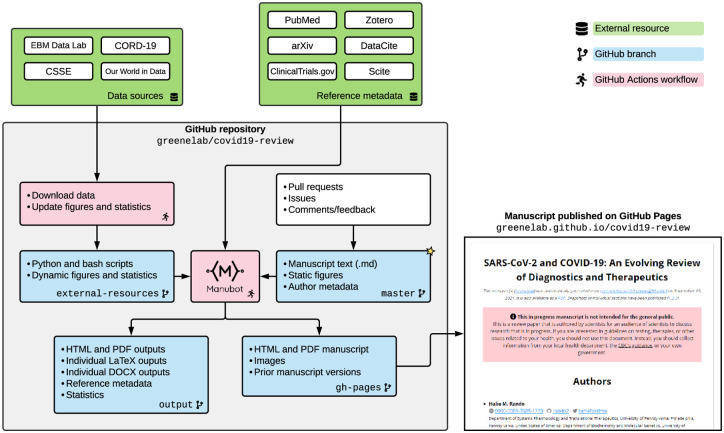
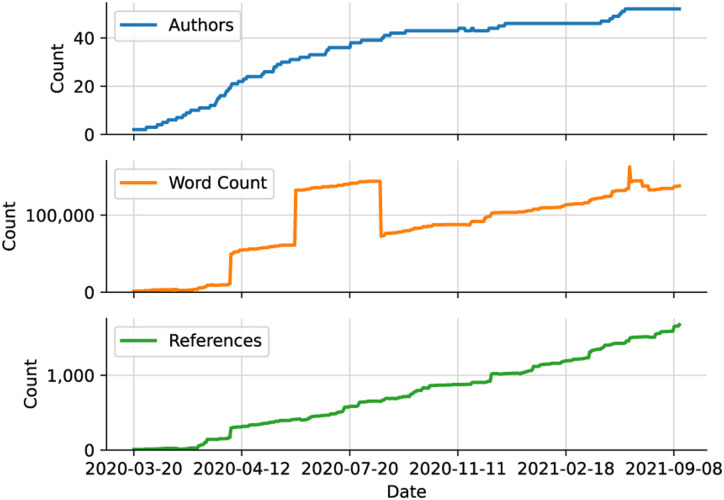
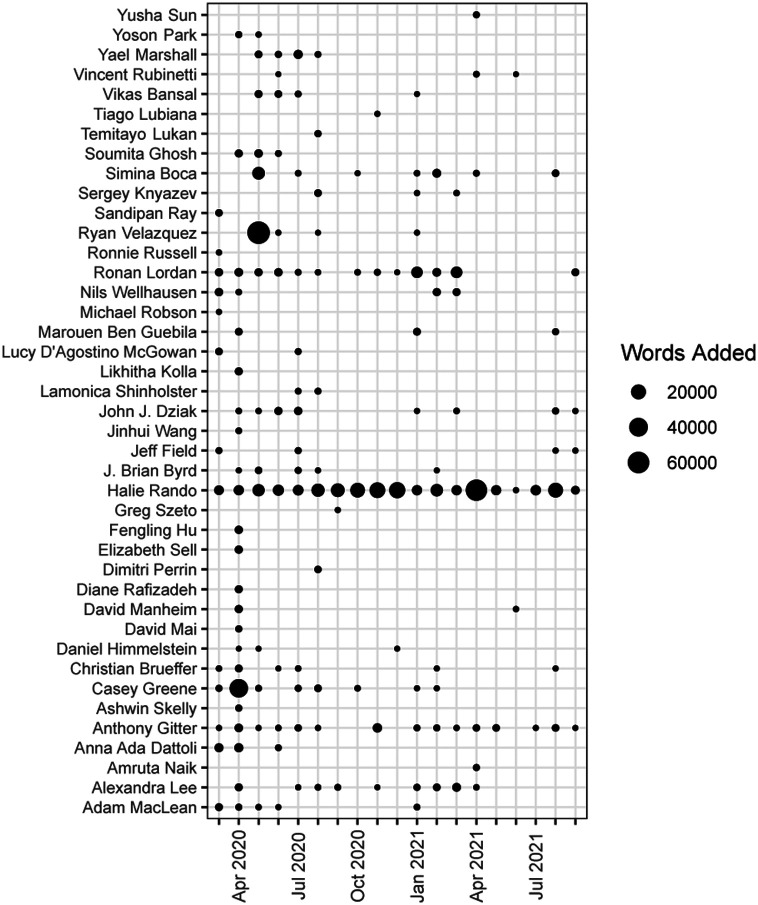
The COVID-19 pandemic catalyzed the rapid dissemination of papers and preprints investigating the disease and its associated virus, SARS-CoV-2. The multifaceted nature of COVID-19 demands a multidisciplinary approach, but the urgency of the crisis combined with the need for social distancing measures present unique challenges to collaborative science. We applied a massive online open publishing approach to this problem using Manubot. Through GitHub, collaborators summarized and critiqued COVID-19 literature, creating a review manuscript. Manubot automatically compiled citation information for referenced preprints, journal publications, websites, and clinical trials. Continuous integration workflows retrieved up-to-date data from online sources nightly, regenerating some of the manuscript's figures and statistics. Manubot rendered the manuscript into PDF, HTML, LaTeX, and DOCX outputs, immediately updating the version available online upon the integration of new content. Through this effort, we organized over 50 scientists from a range of backgrounds who evaluated over 1,500 sources and developed seven literature reviews. While many efforts from the computational community have focused on mining COVID-19 literature, our project illustrates the power of open publishing to organize both technical and non-technical scientists to aggregate and disseminate information in response to an evolving crisis.
Figures
References
-
- Wang L. L., Lo K., Chandrasekhar Y., Reas R., Yang J., Burdick D., Eide D., Funk K., Katsis Y., Kinney R., Li Y., Liu Z., Merrill W., Mooney P., Murdick D., Rishi D., Sheehan J., Shen Z., Stilson B., Wade A., Wang K., Wang N. X. R., Wilhelm C., Xie B., Raymond D., Weld D. S., Etzioni O., Kohlmeier S., CORD-19: The COVID-19 Open Research Dataset, arXiv (2020) 2004.10706.
-
- Eysenbach G., The impact of preprint servers and electronic publishing on biomedical research, Current Opinion in Immunology 12 (2000) 499–503. - PubMed
Publication types
Grants and funding
LinkOut - more resources
Full Text Sources
Miscellaneous