


Cardiovascular magnetic resonance imaging in suspected cardiac tumour: a multicentre outcomes study
- PMID: 34545397
- PMCID: PMC8720142
- DOI: 10.1093/eurheartj/ehab635
Cardiovascular magnetic resonance imaging in suspected cardiac tumour: a multicentre outcomes study
Abstract
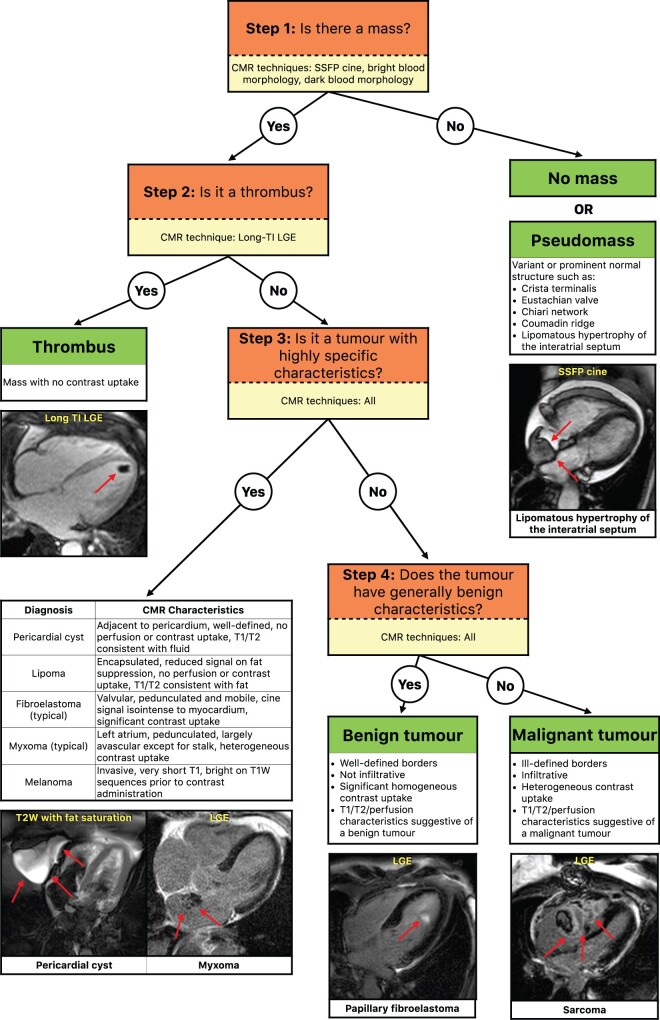
Aims: Cardiovascular magnetic resonance (CMR) imaging is a key diagnostic tool for the evaluation of patients with suspected cardiac tumours. Patient management is guided by the CMR diagnosis, including no further testing if a mass is excluded or if only a pseudomass is found. However, there are no outcomes studies validating this approach.
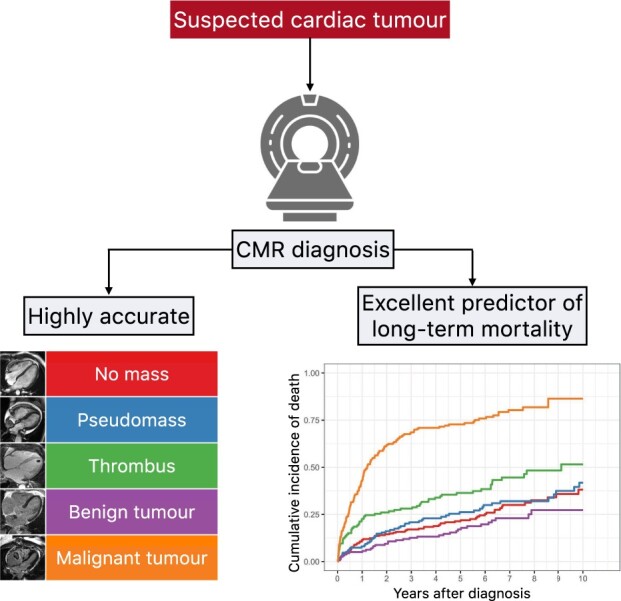
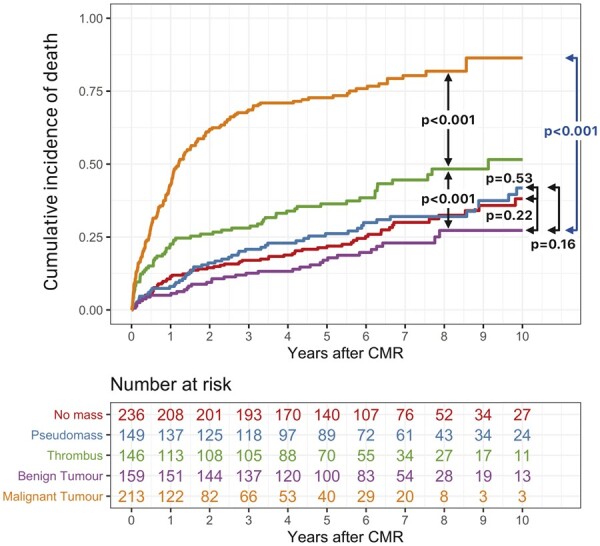
Methods and results: In this multicentre study of patients undergoing clinical CMR for suspected cardiac tumour, CMR diagnoses were assigned as no mass, pseudomass, thrombus, benign tumour, or malignant tumour. A final diagnosis was determined after follow-up using all available data. The primary endpoint was all-cause mortality. Among 903 patients, the CMR diagnosis was no mass in 25%, pseudomass in 16%, thrombus in 16%, benign tumour in 17%, and malignant tumour in 23%. Over a median of 4.9 years, 376 patients died. Compared with the final diagnosis, the CMR diagnosis was accurate in 98.4% of patients. Patients with CMR diagnoses of pseudomass and benign tumour had similar mortality to those with no mass, whereas those with malignant tumour [hazard ratio (HR) 3.31 (2.40-4.57)] and thrombus [HR 1.46 (1.00-2.11)] had greater mortality. The CMR diagnosis provided incremental prognostic value over clinical factors including left ventricular ejection fraction, coronary artery disease, and history of extracardiac malignancy (P < 0.001).
Conclusion: In patients with suspected cardiac tumour, CMR has high diagnostic accuracy. Patients with CMR diagnoses of no mass, pseudomass, and benign tumour have similar long-term mortality. The CMR diagnosis is a powerful independent predictor of mortality incremental to clinical risk factors.
Keywords: Cardiac magnetic resonance; Cardiac masses; Cardiac tumours; Cardio-oncology; Diagnosis; Prognosis.
Published on behalf of the European Society of Cardiology. All rights reserved. © The Author(s) 2021. For permissions, please email: journals.permissions@oup.com.
Figures
Comment in
-
When tissue and outcomes are the issue. Cardiac magnetic resonance for patients with suspected cardiac tumours.Eur Heart J. 2021 Dec 28;43(1):81-83. doi: 10.1093/eurheartj/ehab625. Eur Heart J. 2021. PMID: 34545406 No abstract available.
-
When tissue and outcomes are the issue. Cardiac magnetic resonance for patients with suspected cardiac tumours.Eur Heart J. 2021 Dec 28;43(1):81-83. doi: 10.1093/eurheartj/ehab625. Eur Heart J. 2021. PMID: 36282679 No abstract available.
References
-
- Hendel RC, Patel MR, Kramer CM, Poon M, Hendel RC, Carr JC, Gerstad NA, Gillam LD, Hodgson JM, Kim RJ, Kramer CM, Lesser JR, Martin ET, Messer JV, Redberg RF, Rubin GD, Rumsfeld JS, Taylor AJ, Weigold WG, Woodard PK, Brindis RG, Hendel RC, Douglas PS, Peterson ED, Wolk MJ, Allen JM, Patel MR; American College of Cardiology Foundation Quality Strategic Directions Committee Appropriateness Criteria Working Group; American College of Radiology; Society of Cardiovascular Computed Tomography; Society for Cardiovascular Magnetic Resonance; American Society of Nuclear Cardiology; North American Society for Cardiac Imaging; Society for Cardiovascular Angiography and Interventions; Society of Interventional Radiology. ACCF/ACR/SCCT/SCMR/ASNC/NASCI/SCAI/SIR 2006 appropriateness criteria for cardiac computed tomography and cardiac magnetic resonance imaging: a report of the American College of Cardiology Foundation Quality Strategic Directions Committee Appropriateness Criteria Working Group, American College of Radiology, Society of Cardiovascular Computed Tomography, Society for Cardiovascular Magnetic Resonance, American Society of Nuclear Cardiology, North American Society for Cardiac Imaging, Society for Cardiovascular Angiography and Interventions, and Society of Interventional Radiology. J Am Coll Cardiol 2006;48:1475–1497. - PubMed
-
- Hundley WG, Bluemke DA, Finn JP, Flamm SD, Fogel MA, Friedrich MG, Ho VB, Jerosch-Herold M, Kramer CM, Manning WJ, Patel M, Pohost GM, Stillman AE, White RD, Woodard PK; American College of Cardiology Foundation Task Force on Expert Consensus Documents. ACCF/ACR/AHA/NASCI/SCMR 2010 expert consensus document on cardiovascular magnetic resonance: a report of the American College of Cardiology Foundation Task Force on expert consensus documents. Circulation 2010;121:2462–2508. - PMC - PubMed
-
- Colin GC, Symons R, Dymarkowski S, Gerber B, Bogaert J. Value of CMR to differentiate cardiac angiosarcoma from cardiac lymphoma. JACC Cardiovasc Imaging 2015;8:744–746. - PubMed
-
- Pazos-Lopez P, Pozo E, Siqueira ME, Garcia-Lunar I, Cham M, Jacobi A, Macaluso F, Fuster V, Narula J, Sanz J. Value of CMR for the differential diagnosis of cardiac masses. JACC Cardiovasc Imaging 2014;7:896–905. - PubMed
