. 2021 Oct;27(10):2560-2569.
doi: 10.3201/eid2710.204826.

Population-Based Study of Bloodstream Infection Incidence and Mortality Rates, Finland, 2004-2018

Population-Based Study of Bloodstream Infection Incidence and Mortality Rates, Finland, 2004-2018

Keiju S K Kontula et al. Emerg Infect Dis. 2021 Oct.

Abstract

We evaluated the incidence, outcomes, and causative agents of bloodstream infections (BSI) in Finland during 2004–2018 by using data from the national registries. We identified a total of 173,715 BSIs; annual incidence increased from 150 to 309 cases/100,000 population. BSI incidence rose most sharply among persons >80 years of age. The 1-month case-fatality rate decreased from 13.0% to 12.6%, but the 1-month all-cause mortality rate rose from 20 to 39 deaths/100,000 population. BSIs caused by Escherichia coli increased from 26% to 30% of all BSIs. BSIs caused by multidrug-resistant microbes rose from 0.4% to 2.8%, mostly caused by extended-spectrum β-lactamase-producing E. coli. We observed an increase in community-acquired BSIs, from 67% to 78%. The proportion of patients with severe underlying conditions rose from 14% to 23%. Additional public health and healthcare prevention efforts are needed to curb the increasing trend in community-acquired BSIs and antimicrobial drug–resistant E. coli.

Keywords: Finland; MRSA and other staphylococci; antimicrobial resistance; bacteria; bloodstream infections; case-fatality rates; community-acquired infections; fungi; healthcare-associated infections; incidence; mortality rates; streptococci.


Figures
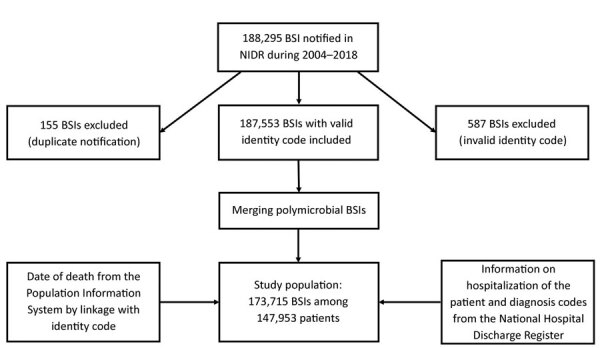
Figure 1
Figure 1
Flowchart of the data reviewed for inclusion in a study of the incidence of BSIs, Finland, 2004–2018. BSI, bloodstream infections; NIDR, National Infectious Disease Register.
Figure 2
Figure 2
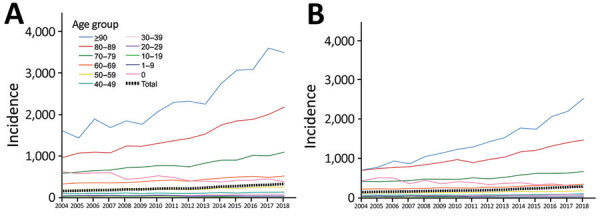
Annual incidence (cases/100,000 population) of bloodstream infections, by sex and age group, Finland, 2004–2018. A) Male patients; B) female patients.
Figure 3
Figure 3
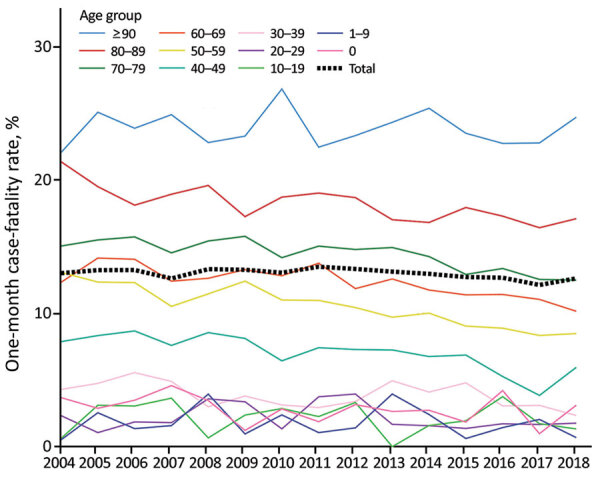
Annual 1-month case-fatality rates for bloodstream infections, by age group, Finland, 2004–2018.
Figure 4
Figure 4
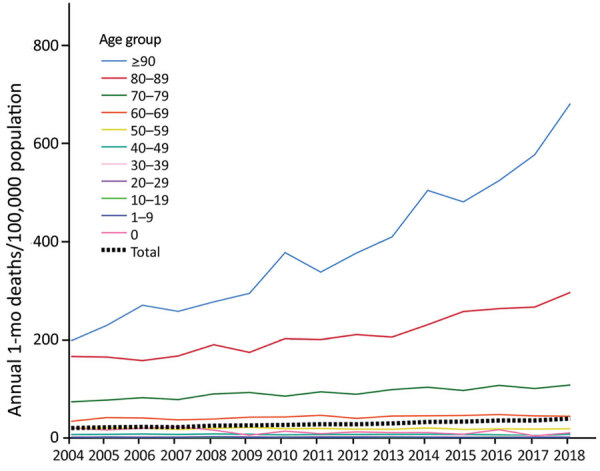
Annual average 1-month bloodstream infection deaths per 100,000 population, by age group, Finland, 2004–2018.
Figure 5
Figure 5
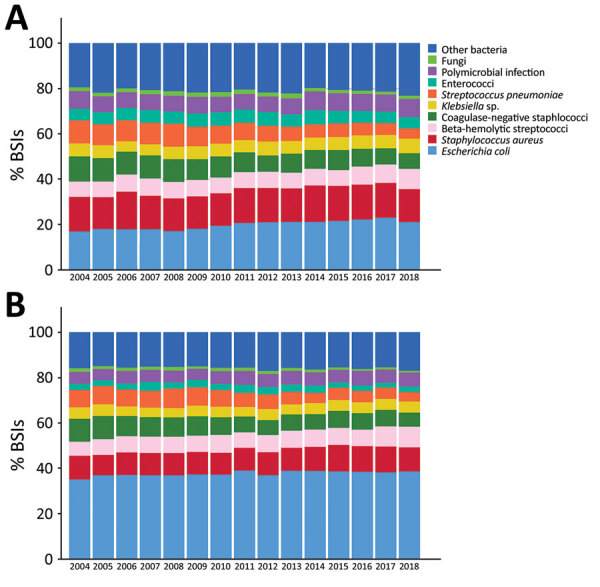
Frequency distribution of the most common causative agents of BSIs, by sex, Finland, 2004–2018. A) Male patients; B) female patients. BSI, bloodstream infections.

References

    1. Uslan DZ, Crane SJ, Steckelberg JM, Cockerill FR III, St Sauver JL, Wilson WR, et al. Age- and sex-associated trends in bloodstream infection: a population-based study in Olmsted County, Minnesota. Arch Intern Med. 2007;167:834–9. 10.1001/archinte.167.8.834 - DOI - PubMed
    1. Wilson J, Elgohari S, Livermore DM, Cookson B, Johnson A, Lamagni T, et al. Trends among pathogens reported as causing bacteraemia in England, 2004-2008. Clin Microbiol Infect. 2011;17:451–8. 10.1111/j.1469-0691.2010.03262.x - DOI - PubMed
    1. Skogberg K, Lyytikäinen O, Ollgren J, Nuorti JP, Ruutu P. Population-based burden of bloodstream infections in Finland. Clin Microbiol Infect. 2012;18:E170–6. 10.1111/j.1469-0691.2012.03845.x - DOI - PubMed
    1. Laupland KB. Defining the epidemiology of bloodstream infections: the ‘gold standard’ of population-based assessment. Epidemiol Infect. 2013;141:2149–57. 10.1017/S0950268812002725 - DOI - PMC - PubMed
    1. Buetti N, Atkinson A, Marschall J, Kronenberg A; Swiss Centre for Antibiotic Resistance (ANRESIS). Incidence of bloodstream infections: a nationwide surveillance of acute care hospitals in Switzerland 2008-2014. BMJ Open. 2017;7:e013665. 10.1136/bmjopen-2016-013665 - DOI - PMC - PubMed

Publication types