. 2021 Oct 7;108(10):1964-1980.
doi: 10.1016/j.ajhg.2021.08.011. Epub 2021 Sep 20.

Rare and de novo variants in 827 congenital diaphragmatic hernia probands implicate LONP1 as candidate risk gene

Affiliations

Rare and de novo variants in 827 congenital diaphragmatic hernia probands implicate LONP1 as candidate risk gene

Lu Qiao et al. Am J Hum Genet. .

Abstract

Congenital diaphragmatic hernia (CDH) is a severe congenital anomaly that is often accompanied by other anomalies. Although the role of genetics in the pathogenesis of CDH has been established, only a small number of disease-associated genes have been identified. To further investigate the genetics of CDH, we analyzed de novo coding variants in 827 proband-parent trios and confirmed an overall significant enrichment of damaging de novo variants, especially in constrained genes. We identified LONP1 (lon peptidase 1, mitochondrial) and ALYREF (Aly/REF export factor) as candidate CDH-associated genes on the basis of de novo variants at a false discovery rate below 0.05. We also performed ultra-rare variant association analyses in 748 affected individuals and 11,220 ancestry-matched population control individuals and identified LONP1 as a risk gene contributing to CDH through both de novo and ultra-rare inherited largely heterozygous variants clustered in the core of the domains and segregating with CDH in affected familial individuals. Approximately 3% of our CDH cohort who are heterozygous with ultra-rare predicted damaging variants in LONP1 have a range of clinical phenotypes, including other anomalies in some individuals and higher mortality and requirement for extracorporeal membrane oxygenation. Mice with lung epithelium-specific deletion of Lonp1 die immediately after birth, most likely because of the observed severe reduction of lung growth, a known contributor to the high mortality in humans. Our findings of both de novo and inherited rare variants in the same gene may have implications in the design and analysis for other genetic studies of congenital anomalies.

Keywords: ALYREF; LONP1; congenital diaphragmatic hernia; de novo variants.


Conflict of interest statement

Declaration of interests The authors declare no competing interests.

Figures
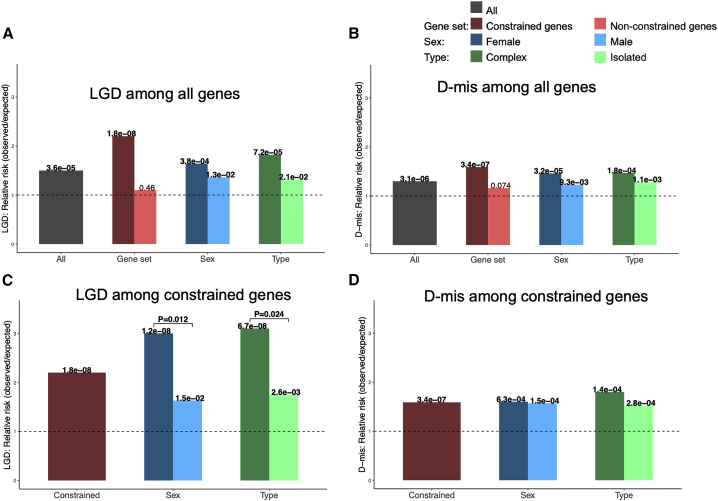
Figure 1
Figure 1
Burden of de novo coding variants in CDH compared to expectation (A–D) LGD among all genes (A); D-mis among all genes (B); LGD among constrained genes (C); D-mis among constrained genes (D). p values between CDH-affected individuals and expectation by Poisson test are labeled for each bar. Significant p values between females and males and complex and isolated individuals by binormal test are labeled.
Figure 2
Figure 2
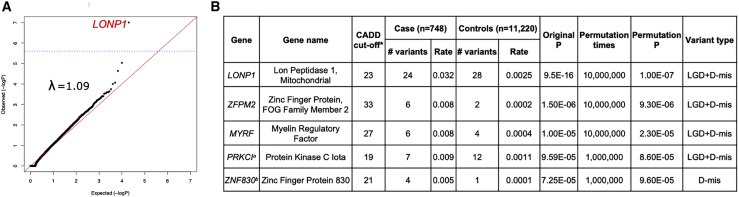
Gene-based association analysis with 748 CDH-affected individuals and 11,220 control individuals across all populations (A) Results of a binomial test confined to ultra-rare LGD and D-mis variants or D-mis only variants in 18,939 protein-coding genes. Horizontal blue line indicates the Bonferroni-corrected threshold for significance. (B) Complete list of top association genes with permutation p values < 1 × 10−4. , a gene-specific CADD score threshold for defining D-mis that maximized the burden of ultra-rare deleterious variants in affected individuals compared to control individuals; #, numbers of deleterious variants; a, MIM: 600539; b, no MIM number.
Figure 3
Figure 3
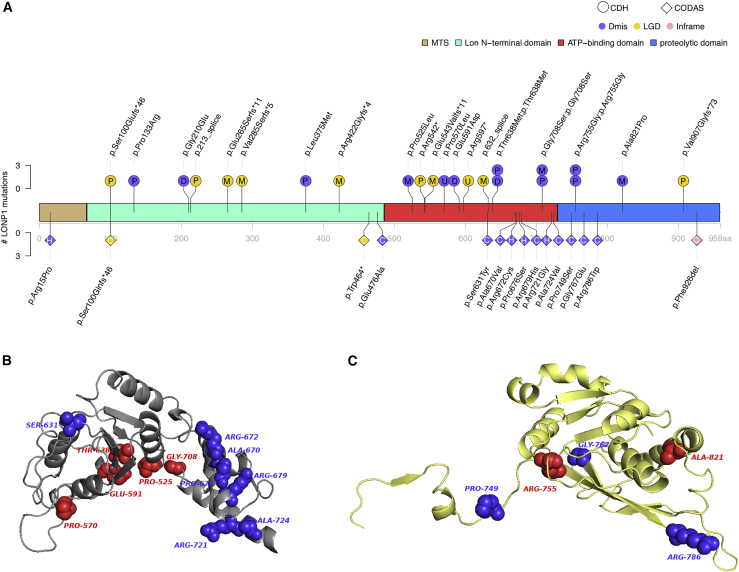
Differential clustering of missense variants within LONP1 in CDH and CODAS syndrome (A) Variant locations in LONP1 (GenBank: NM_004793.3) of CDH and CODAS syndrome. There are three main domains in LONP1: N-terminal Lon domain, ATP-binding domain, and proteolytic domain. Positions indicated at upper structure are variants in CDH. Deleterious heterozygous variants such as LGD and missense with CADD ≥ 25 and allele frequency < 1 × 10−5 across all gnomAD genomes in CDH are presented. Deleterious missense is presented in purple, LGD in yellow, and inframe in pink. Inheritance patterns were labeled in circles of variants (P, paternal; M, maternal; D, de novo; U, singleton unknown). Positions at lower structure are variants in published CODAS syndrome samples. CODAS syndrome is caused by bi-allelic variants in LONP1 (homozygous [H] or compound heterozygous [C] variants) in the diamonds. (B and C) Predicted 3D structure of LONP1 protein with SWISS-Model. (B) CDH (red)- and CODAS (blue)-associated amino acids in ATPase domain (gray). CODAS-associated amino acids (Ala670–Ala724) are clustered at alpha-helix in ATPase domain. (C) CDH (red)- and CODAS (blue)-associated amino acids in protease domain (yellow). CDH-associated amino acid Ala821 is located at alpha-helix.
Figure 4
Figure 4
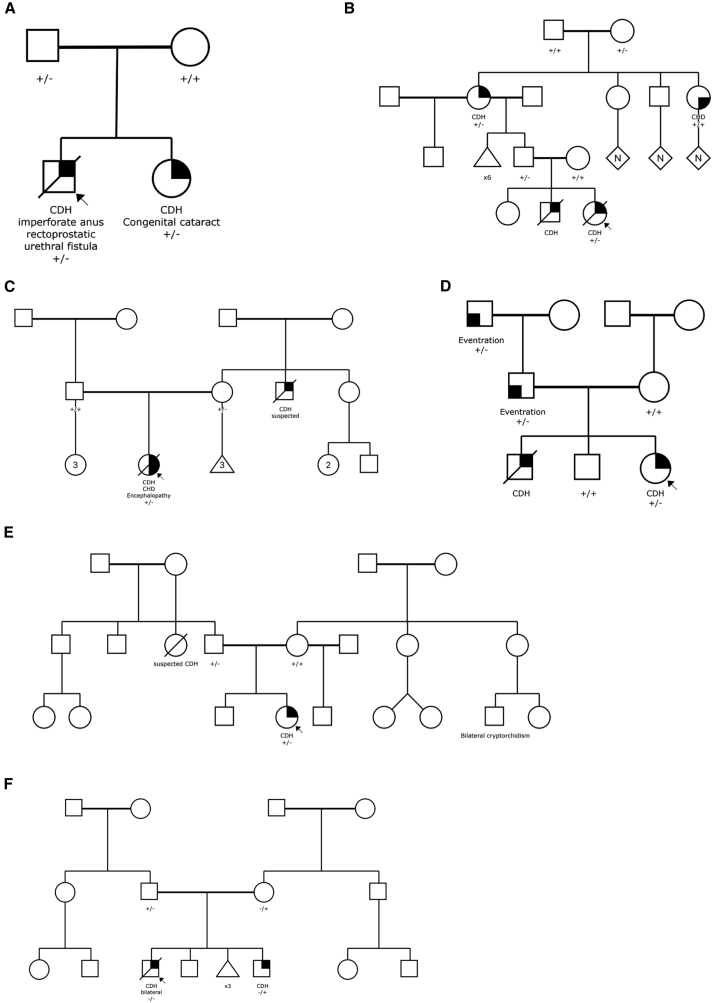
Pedigree of CDH-affected familial individuals and carrying LONP1 deleterious variants (A–F) Family 01-0670, p. Pro133Arg (A); family 04-0022, p.213_splice (B); family 1733, p.Arg422Glyfs4 (C); family 01-0513, p.Thr638Met (D); family 01-0732, p.Val907Glyfs73 (E); family 01-1279 carries bi-allelic heterozygous variants with c.1574C>T (p.Pro525Leu) inherited from the mother and c.2263C>G (p.Arg755Gly) inherited from the father (F).
Figure 5
Figure 5
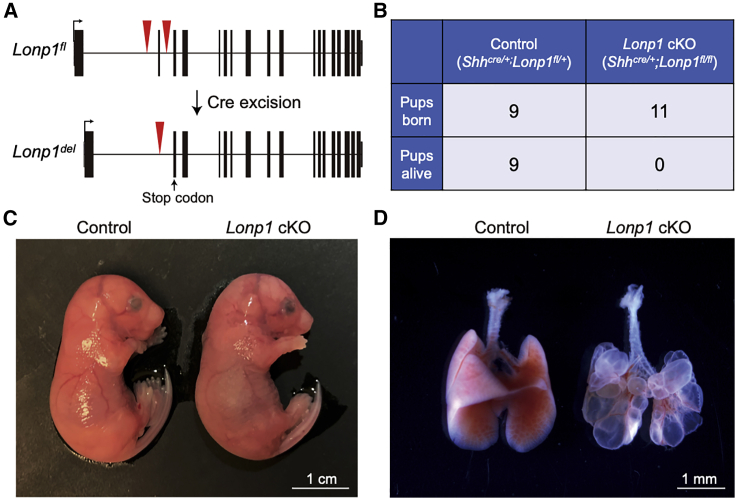
Inactivation of Lonp1 in mice led to disrupted lung development and lethality at birth (A) Gene structure of mouse Lonp1fl conditional allele before and after cre-mediated recombination of the loxP sites (red triangles). Recombination led to a premature stop codon (arrow) in the second exon. (B) Number of embryos genotyped at perinatal stage, showing 100% lethality of the mutant embryos. (C) Representative mutant and control embryos at embryonic day (E) 18.5, the day of birth. (D) Representative mutant and control lungs at E18.5. Scale bars as indicated.

References

    1. Yu L., Hernan R.R., Wynn J., Chung W.K. The influence of genetics in congenital diaphragmatic hernia. Semin. Perinatol. 2020;44:151169. - PMC - PubMed
    1. Kardon G., Ackerman K.G., McCulley D.J., Shen Y., Wynn J., Shang L., Bogenschutz E., Sun X., Chung W.K. Congenital diaphragmatic hernias: from genes to mechanisms to therapies. Dis. Model. Mech. 2017;10:955–970. - PMC - PubMed
    1. Qiao L., Wynn J., Yu L., Hernan R., Zhou X., Duron V., Aspelund G., Farkouh-Karoleski C., Zygumunt A., Krishnan U.S. Likely damaging de novo variants in congenital diaphragmatic hernia patients are associated with worse clinical outcomes. Genet. Med. 2020;22:2020–2028. - PMC - PubMed
    1. Montalva L., Lauriti G., Zani A. Congenital heart disease associated with congenital diaphragmatic hernia: A systematic review on incidence, prenatal diagnosis, management, and outcome. J. Pediatr. Surg. 2019;54:909–919. - PubMed
    1. Lin A.E., Pober B.R., Adatia I. Congenital diaphragmatic hernia and associated cardiovascular malformations: type, frequency, and impact on management. Am. J. Med. Genet. C. Semin. Med. Genet. 2007;145C:201–216. - PMC - PubMed

Publication types

MeSH terms

Supplementary concepts