Review
. 2021 Oct;37(4):749-776.
doi: 10.1016/j.ccc.2021.05.003. Epub 2021 May 28.

Pathophysiology of Acute Respiratory Distress Syndrome and COVID-19 Lung Injury

Affiliations
Review

Pathophysiology of Acute Respiratory Distress Syndrome and COVID-19 Lung Injury

Kai Erik Swenson et al. Crit Care Clin. 2021 Oct.

Abstract

The pathophysiology of acute respiratory distress syndrome (ARDS) is marked by inflammation-mediated disruptions in alveolar-capillary permeability, edema formation, reduced alveolar clearance and collapse/derecruitment, reduced compliance, increased pulmonary vascular resistance, and resulting gas exchange abnormalities due to shunting and ventilation-perfusion mismatch. Mechanical ventilation, especially in the setting of regional disease heterogeneity, can propagate ventilator-associated injury patterns including barotrauma/volutrauma and atelectrauma. Lung injury due to the novel coronavirus SARS-CoV-2 resembles other causes of ARDS, though its initial clinical characteristics may include more profound hypoxemia and loss of dyspnea perception with less radiologically-evident lung injury, a pattern not described previously in ARDS.

Keywords: COVID-19; acute respiratory distress syndrome; pathophysiology.


Figures

Fig. 1
Fig. 1
Spectrum of VA/Q abnormalities in ARDS. The spectrum of VA/Q abnormalities in ARDS (from top to bottom) ranging from shunt (VA/Q = 0), low ventilation-to-perfusion ratio (VA/Q = 0.2–0.01), normal ratio (VA/Q = 0.2–5), high ventilation-to-perfusion ratio (VA/Q = 5–100) to dead space (VA/Q = infinity). Typical mixed venous, alveolar (A), and arterial (A), and mixed venous (mv) Po2 and Pco2 values are shown. Values are those at a fractional inspired O2 concentration of 0.5 at a hemoglobin of 15 g/dL and a respiratory exchange ratio of 0.8.
Fig. 2
Fig. 2
Differences in lung density by CT imaging in prone vs. supine positioning. Differences in lung density by CT scanning in ARDS, taken in the supine position at end exhalation (A), end inspiration (B), and in the prone position at end exhalation (C) and at end inspiration (D). The improvement in aeration in the prone images is consistent with the more uniform VA/Q matching and improved oxygenation with prone positioning.
Fig. 3
Fig. 3
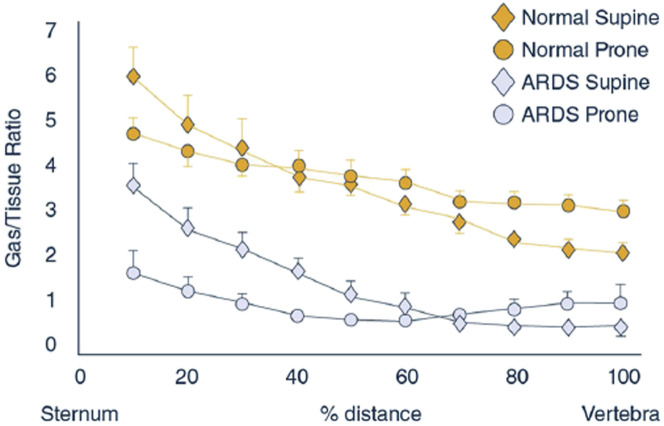
Changes in lung tissue heterogeneity over the anterior-posterior plane. The gas/tissue ratios reflect the degree of uniformity of ventilated lung as a function of the distance between the sternum and the vertebrae. In the supine position, the gas/tissue ratio sharply decreases from the sternum to the vertebrae suggesting that both in normal and in patients with ARDS distending forces are about 3 times higher closer to the sternum than to the vertebrae. In prone position, the gas/tissue ratio is far more homogeneous, indicating a more even distribution of forces and more uniform ventilation throughout the lung.
Fig. 4
Fig. 4
Local ventilatory inhomogeneity as a stress raiser. A stress raiser is a region of early injury that leads to inhomogeneous tissue forces that apply stress and strain to surrounding neighbor regions. An equal volume of gas is introduced into an area of normal lung (A) and into one with a stress raiser (either a collapsed or non-air-filled region-the dark region in (C). In a normal lung, the introduced air with inflation is evenly distributed and leads to uniform inflation at minimal stress (B). In contrast, the lung with a stress raiser, when further inflated (D), subjects the immediate neighboring regions (colored gray) to greater stress (and potential injury) as they are inflated, but the collapsed or fluid-filled region itself is not inflated.
Fig. 5
Fig. 5
Alveolar fluid clearance in uninjured lung vs. ARDS. Alveolar fluid clearance pathways in edematous uninjured lungs (A) and in ARDS (B). Both types I and II alveolar epithelial cells absorb sodium, chloride, and water, respectively, via epithelial sodium channels (ENaCs), cystic fibrosis transmembrane conductance regulator (CFTR), and aquaporin-5 (AQ-5) channels. Energy-dependent Na+/K+ ATPase activity on the basolateral membrane of epithelial cells establishes an osmotic driving gradient for movement of sodium from the alveolar space into the interstitium for removal by capillary blood or lymphatic clearance. Chloride follows passively either by CFTR or paracellularly with water moving transcellularly via AQ-5 or paracellularly. Other cation channels not illustrated are also involved. These pathways along with surfactant maintain a dry and compliant alveolar space for efficient gas exchange. With injury to the lung (B) and loss of the normal tight alveolar–capillary barrier such as in ARDS, fluid moves into the lungs and is less readily reabsorbed. Hypoxia and hypercapnia cause downregulation and loss of the ion and water channels as well as Na+/K+ ATPase activity. This may be compounded by various proinflammatory cytokines and mechanical ventilator-induced lung injury involving high distending volumes and pressures.
Fig. 6
Fig. 6
Events and forms of ventilator-induced lung injury (VILI). The normal alveolus (A) is contrasted with the alveolus (B) injured by mechanical ventilation by volutrauma and atelectrauma causing endothelial and epithelial injury, greater alveolar–capillary permeability, proteinaceous alveolar edema, and recruitment of inflammatory cells. Activation of resident and recruited cells results in biotrauma (C) with the production of proinflammatory mediators that propagate the injury and spillover into the circulation to cause systemic organ damage and dysfunction (D).
Fig. 7
Fig. 7
Respiratory system compliance in COVID-19 and non-COVID-19 ARDS. Distribution of respiratory system compliance (CST) values in various studies of patients with COVID-19 lung injury and compared with patients with ARDS. Most studies find no significant differences between the 2 forms of lung injury.
Fig. 8
Fig. 8
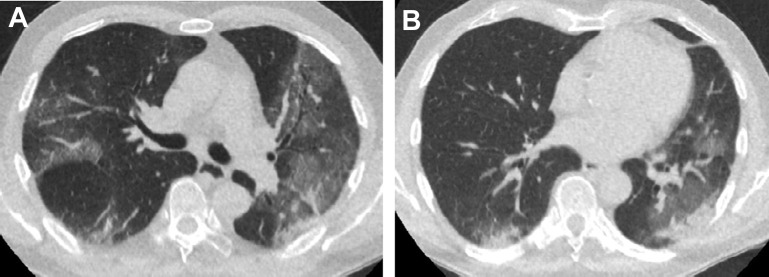
Representative CT imaging of early COVID-19 lung injury. Two axial slices of a patient with COVID-19 lung injury at presentation to the emergency department after several days of fever, mild dyspnea, cough, and malaise. The images show multiple areas of typical ground-glass opacities and some early consolidation (A, B).
Fig. 9
Fig. 9
Changes in pulmonary vascular anatomy in focal COVID-19 lung disease. Conventional (A) and dual-energy CT (B) in a patient with COVID-19 pneumonia without evidence of pulmonary emboli. (A) There is a large area of peripheral ground-glass opacity and consolidation within the right upper lobe and smaller ground-glass opacity in the posterior left upper lobe (green arrowheads), which are accompanied by dilated subsegmental vessels proximal to, and within, the opacities (green arrows). (B) The accompanying image of pulmonary blood volume shows corresponding wedge-shaped areas of decreased perfusion within the upper lobes, with a peripheral halo of higher perfusion (green arrows).
Fig. 10
Fig. 10
Signaling pathways in the control of ventilation. Schematic representation of the multiple afferent signaling pathways to the brainstem respiratory centers that control ventilation from mechano-stretch receptors in muscles and joints, irritant and stretch receptor in the lungs, arterial Po2 and Pco2 (from peripheral chemoreceptors in the carotid body, arterial pH and Pco2 (from central chemoreceptors in the brainstem), fear, and emotional and pain stimuli from the hypothalamus. Signals from the brainstem are also conveyed (corollary projection) to the conscious regions of the brain (amygdala and insular cortex) that perceive dyspnea, work of breathing, and respiratory distress. In COVID-19, it is proposed that some of this signaling and cortical perception may be impaired by direct viral injury to these pathways.

References

    1. Villar J., Blanco J., Kacmarek R.M. Current incidence and outcome of the acute respiratory distress syndrome. Curr Opin Crit Care. 2016;22(1):1–6. - PubMed
    1. Taylor P.R., Martinez-Pomares L., Stacey M., et al. Macrophage receptors and immune recognition. Annu Rev Immunol. 2005;23:901–944. - PubMed
    1. Wiener-Kronish J., Albertine K., Matthay M. Differential responses of the endothelial and epithelial barriers of the lung in sheep to Escherichia coli endotoxin. J Clin Invest. 1991;88(3):864–875. - PMC - PubMed
    1. Matthay M.A., Folkesson H.G., Verkman A. Salt and water transport across alveolar and distal airway epithelia in the adult lung. Am J Physiol. 1996;270(4):L487–L503. - PubMed
    1. Ware L.B., Matthay M.A. Alveolar fluid clearance is impaired in the majority of patients with acute lung injury and the acute respiratory distress syndrome. Am J Respir Crit Care Med. 2001;163(6):1376–1383. - PubMed