


Thermal growth in solar water pump using Prandtl-Eyring hybrid nanofluid: a solar energy application
- PMID: 34548554
- PMCID: PMC8455580
- DOI: 10.1038/s41598-021-98103-8
Thermal growth in solar water pump using Prandtl-Eyring hybrid nanofluid: a solar energy application
Abstract
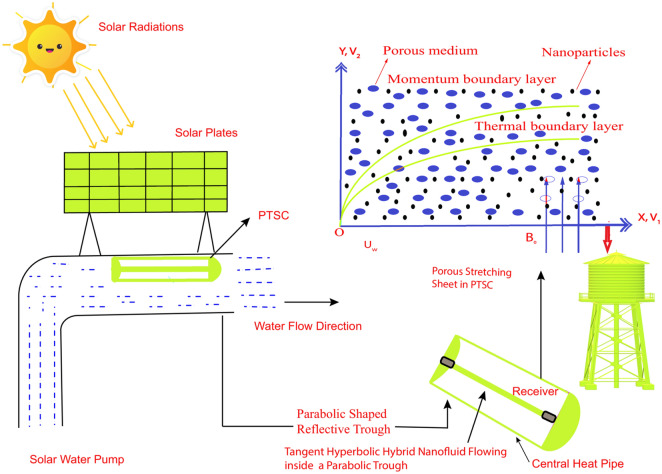
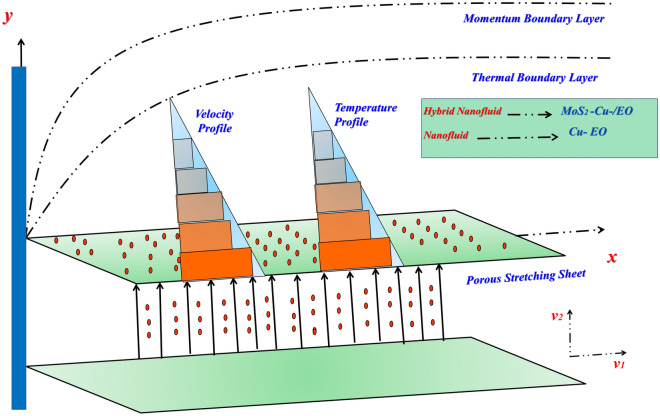
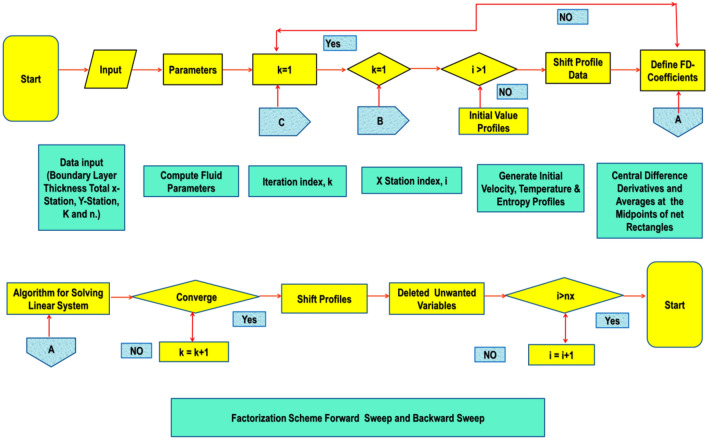
Nowadays, with the advantages of nanotechnology and solar radiation, the research of Solar Water Pump (SWP) production has become a trend. In this article, Prandtl-Eyring hybrid nanofluid (P-EHNF) is chosen as a working fluid in the SWP model for the production of SWP in a parabolic trough surface collector (PTSC) is investigated for the case of numerous viscous dissipation, heat radiations, heat source, and the entropy generation analysis. By using a well-established numerical scheme the group of equations in terms of energy and momentum have been handled that is called the Keller-box method. The velocity, temperature, and shear stress are briefly explained and displayed in tables and figures. Nusselt number and surface drag coefficient are also being taken into reflection for illustrating the numerical results. The first finding is the improvement in SWP production is generated by amplification in thermal radiation and thermal conductivity variables. A single nanofluid and hybrid nanofluid is very crucial to provide us the efficient heat energy sources. Further, the thermal efficiency of MoS2-Cu/EO than Cu-EO is between 3.3 and 4.4% The second finding is the addition of entropy is due to the increasing level of radiative flow, nanoparticles size, and Prandtl-Eyring variable.
© 2021. The Author(s).
Conflict of interest statement
The authors declare no competing interests.
Figures
References
-
- Slimene MB, Arbi Khlifi M. Modelling and study of energy storage devices for photovoltaic lighting. Energy Explor. Exploit. 2020;38:1932–1945. doi: 10.1177/0144598720952894. - DOI
-
- Cano JM, Martin AD, Herrera RS, Vazquez JR, Ruiz-Rodriguez FJ. Grid-connected PV systems controlled by sliding via wireless communication. Energies. 2021;14:1931. doi: 10.3390/en14071931. - DOI
-
- Arifin AM, Redzuan FM, Kadir EA, Ismail N, Zain MM. Design and sizing water pumping system powered by photovoltaic. AIP Conf. Proc. 2020;2306:020022. doi: 10.1063/5.0033116. - DOI
-
- Luu MT, Milani D, Nomvar M, Abbas A. Dynamic modelling and analysis of a novel latent heat battery in tankless domestic solar water heating. Energy Build. 2017;152:227–242. doi: 10.1016/j.enbuild.2017.07.020. - DOI
-
- Koçar G, Eryaşar A, Gödekmerdan E, Özgül S, Düzenli M. A Prospect on Integration of Solar Technology to Modern Greenhouses. Dokuz Eylül Üniversitesi Mühendislik Fakültesi Fen ve Mühendislik Dergisi. 2018;20:245–258.
LinkOut - more resources
Full Text Sources
