


Antecedent infections in Guillain-Barré syndrome in endemic areas of arbovirus transmission: A multinational case-control study
- PMID: 34549484
- PMCID: PMC9291970
- DOI: 10.1111/jns.12469
Antecedent infections in Guillain-Barré syndrome in endemic areas of arbovirus transmission: A multinational case-control study
Abstract
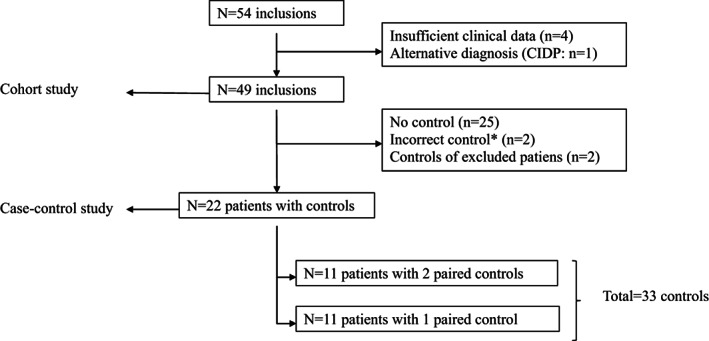
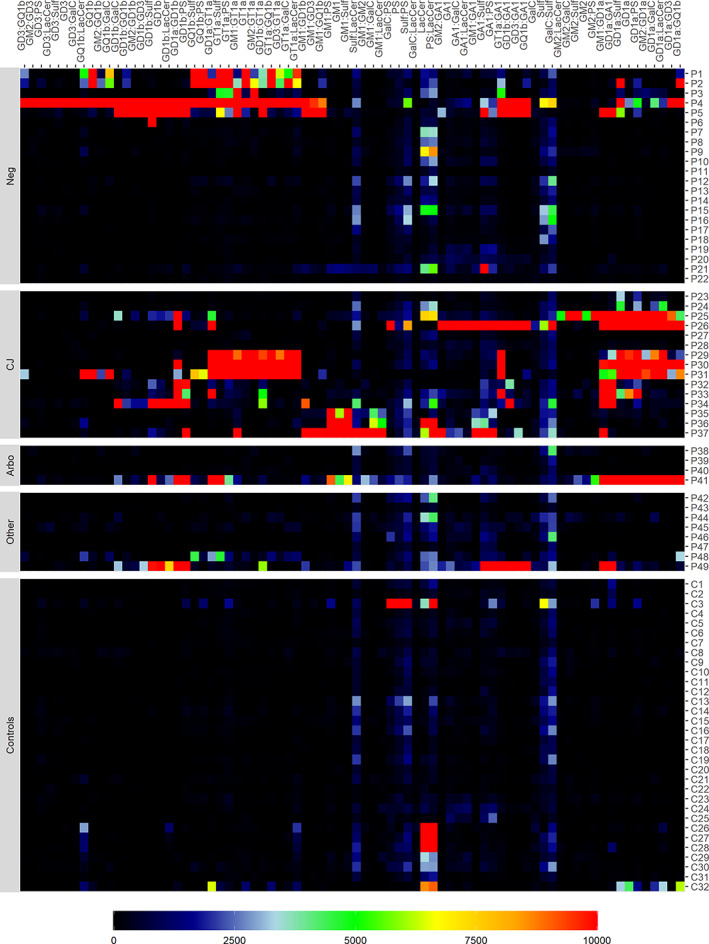
Half of the world's population is at risk of arthropod-borne virus (arbovirus) infections. Several arbovirus infections have been associated with Guillain-Barré syndrome (GBS). We investigated whether arboviruses are driving GBS beyond epidemic phases of transmission and studied the antibody response to glycolipids. The protocol of the International Guillain-Barré syndrome Outcome Study (IGOS), an observational prospective cohort study, was adapted to a case-control design. Serum samples were tested for a recent infection with Zika virus (ZIKV), dengue virus (DENV), chikungunya (CHIKV) virus, hepatitis E virus, Epstein-Barr virus (EBV), cytomegalovirus (CMV), Campylobacter jejuni, and Mycoplasma pneumoniae, and for antibodies to glycolipids. Forty-nine patients were included from Brazil (63%), Argentina (14%), and Malaysia (22%). Evidence of a recent infection was found in 27/49 (55%) patients: C jejuni (n = 15, 31%), M pneumoniae (n = 5, 10%), CHIKV (n = 2, 4%), EBV (n = 1, 2%), C jejuni and M pneumoniae (n = 2, 4%), CMV and DENV (n = 1, 2%), and C jejuni and DENV (n = 1, 2%). In 22 patients, 35 paired controls were collected. Odds ratio for recent infections did not significantly differ between cases and controls. No typical anti-ganglioside antibody binding was associated with recent arbovirus infection. We conclude that arbovirus infections occur in GBS patients outside of epidemic viral transmission, although not significantly more than in controls. Broad infection and anti-ganglioside antibody serology are important to establish the most likely pathogenic trigger in GBS patients. Larger studies are necessary to determine the association between arboviruses and GBS.
Keywords: Guillain-Barré syndrome; Zika virus; anti-ganglioside antibodies; anti-glycolipid antibodies; chikungunya virus; dengue virus.
© 2021 The Authors. Journal of the Peripheral Nervous System published by Wiley Periodicals LLC on behalf of Peripheral Nerve Society.
Conflict of interest statement
SEL, CYT, AAvdE, RR, SCF, SA, MRB, SMBJ, JD, LdK, LLC, CM, WMJr, DFC, AS, BT, and MED report no conflicts of interest. RH reports grants from GBS‐CIDP Foundation International and Health~Holland and is editorial board member of the
Figures
References
-
- Caudie C, Quittard Pinon A, Taravel D, et al. Preceding infections and anti‐ganglioside antibody profiles assessed by a dot immunoassay in 306 French Guillain‐Barre syndrome patients. J Neurol. 2011;258:1958‐1964. - PubMed
-
- Geurtsvankessel CH, Islam Z, Mohammad QD, Jacobs BC, Endtz HP, Osterhaus AD. Hepatitis E and Guillain‐Barré syndrome. Clin Infect Dis. 2013;57:1369‐1370. - PubMed
-
- Rees JH, Soudain SE, Gregson NA, Hughes RA. Campylobacter jejuni infection and Guillain‐Barré syndrome. N Engl J Med. 1995;333:1374‐1379. - PubMed
-
- Jacobs BC, Rothbarth PH, van der Meche FG, et al. The spectrum of antecedent infections in Guillain‐Barré syndrome: a case‐control study. Neurology. 1998;51:1110‐1115. - PubMed
