Methamphetamine Use, Methamphetamine Use Disorder, and Associated Overdose Deaths Among US Adults
- PMID: 34550301
- PMCID: PMC8459304
- DOI: 10.1001/jamapsychiatry.2021.2588
Methamphetamine Use, Methamphetamine Use Disorder, and Associated Overdose Deaths Among US Adults
Abstract
Importance: Mortality associated with methamphetamine use has increased markedly in the US. Understanding patterns of methamphetamine use may help inform related prevention and treatment.
Objective: To assess the national trends in and correlates of past-year methamphetamine use, methamphetamine use disorder (MUD), injection, frequent use, and associated overdose mortality from 2015 to 2019.
Design, setting, and participants: This cross-sectional study analyzed methamphetamine use, MUD, injection, and frequent use data from participants in the 2015 to 2019 National Surveys on Drug Use and Health (NSDUH). Mortality data were obtained from the 2015 to 2019 National Vital Statistics System Multiple Cause of Death files.
Exposures: Methamphetamine use.
Main outcomes and measures: Methamphetamine use, MUD, injection, frequent use, and overdose deaths.
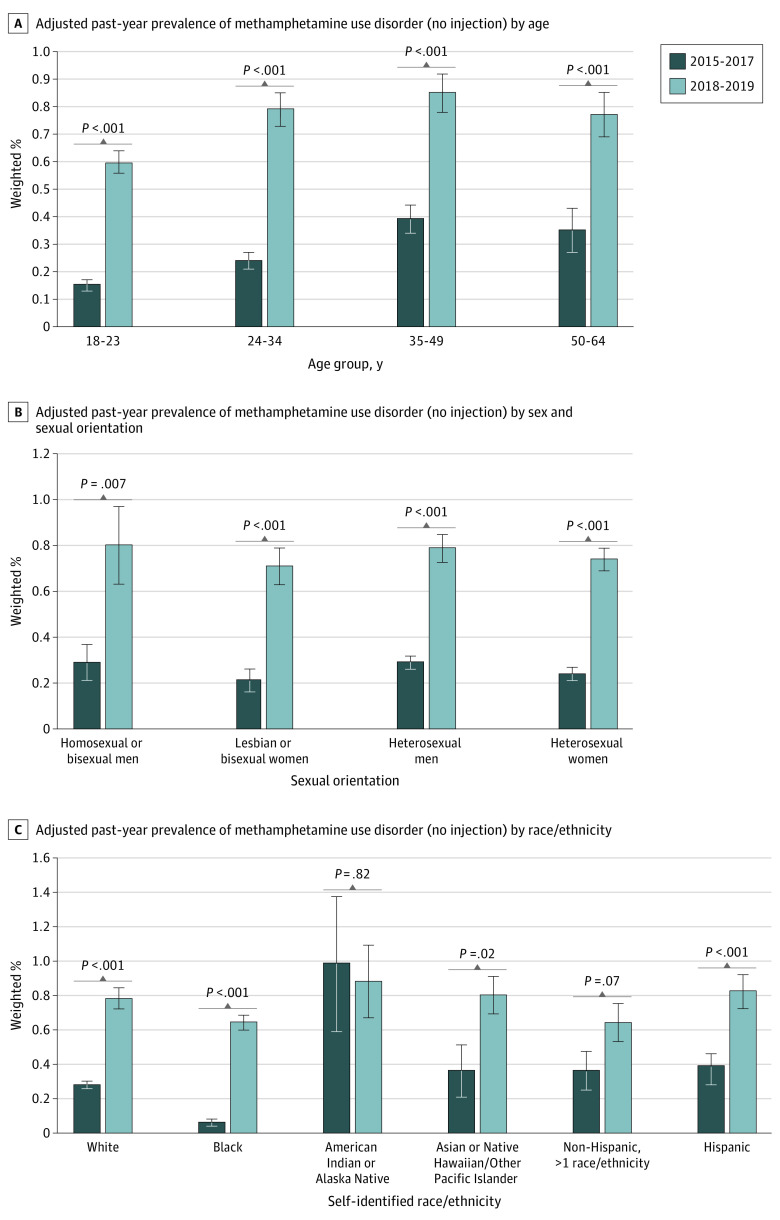
Results: Of 195 711 NSDUH respondents aged 18 to 64 years, 104 408 were women (weighted percentage, 50.9%), 35 686 were Hispanic individuals (weighted percentage, 18.0%), 25 389 were non-Hispanic Black (hereafter, Black) individuals (weighted percentage, 12.6%), and 114 248 were non-Hispanic White (hereafter, White) individuals (weighted percentage, 60.6%). From 2015 to 2019, overdose deaths involving psychostimulants other than cocaine (largely methamphetamine) increased 180% (from 5526 to 15 489; P for trend <.001); methamphetamine use increased 43% (from 1.4 million [95% CI, 1.2-1.6 million] to 2.0 million [95% CI, 1.7-2.3 million]; P for trend = .002); frequent methamphetamine use increased 66% (from 615 000 [95% CI, 512 000-717 000] to 1 021 000 [95% CI, 860 000-1 183 000]; P for trend = .002); methamphetamine and cocaine use increased 60% (from 402 000 [95% CI, 306 000-499 000] to 645 000 [95% CI, 477 000-813 000]; P for trend = .001); and MUD without injection increased 105% (from 397 000 [95% CI, 299 000-496 000] to 815 000 [95% CI, 598 000-1 033 000]; P for trend = .006). The prevalence of MUD or injection surpassed the prevalence of methamphetamine use without MUD or injection in each year from 2017 to 2019 (60% to 67% vs 37% to 40%; P for trend ≤.001). Adults with MUD or using injection were more likely to use methamphetamine frequently (52.68%-53.84% vs 32.59%; adjusted risk ratio, 1.62-1.65; 95% CI, 1.35-1.94). From 2015 to 2019, the adjusted prevalence of MUD without injection more than tripled among heterosexual women (from 0.24% to 0.74%; P < .001) and lesbian or bisexual women (from 0.21% to 0.71%; P < .001) and more than doubled among heterosexual men (from 0.29% to 0.79%; P < .001) and homosexual or bisexual men (from 0.29% to 0.80%; P = .007). It increased over 10-fold among Black individuals (from 0.06% to 0.64%; P < .001), nearly tripled among White individuals (from 0.28% to 0.78%; P < .001), and more than doubled among Hispanic individuals (from 0.39% to 0.82%; P < .001). Risk factors for methamphetamine use, MUD, injection, and frequent use included lower educational attainment, lower annual household income, lack of insurance, housing instability, criminal justice involvement, comorbidities (eg, HIV/AIDS, hepatitis B or C virus, depression), suicidal ideation, and polysubstance use.
Conclusions and relevance: This cross-sectional study found consistent upward trends in overdose mortality, greater risk patterns of methamphetamine use, and populations at higher risk for MUD diversifying rapidly, particularly those with socioeconomic risk factors and comorbidities. Evidence-based prevention and treatment interventions are needed to address surges in methamphetamine use and MUD.
Conflict of interest statement
Figures
References
-
- Hedegaard H, Miniño AM, Warner M. Drug Overdose Deaths in the United States, 1999–2019. National Center for Health Statistics, Centers for Disease Control and Prevention. NCHS Data Brief, no 394. Accessed March 8, 2021. https://www.cdc.gov/nchs/products/databriefs/db394.htm
-
- National Center for Health Statistics, Centers for Disease Control and Prevention . Provisional drug overdose death counts. Accessed on April 15, 2021. https://www.cdc.gov/nchs/nvss/vsrr/drug-overdose-data.htm
-
- Han B. Key Substance Use and Mental Health Indicators in the United States: Results From the 2019 National Survey on Drug Use and Health. Center for Behavioral Health Statistics and Quality, Substance Abuse and Mental Health Services Administration; 2020. HHS Publication No. PEP20-07-01-001, NSDUH Series H-55.
Publication types
MeSH terms
Substances
LinkOut - more resources
Full Text Sources
Medical
Miscellaneous