. 2021 Sep 24;7(39):eabg0505.
doi: 10.1126/sciadv.abg0505. Epub 2021 Sep 22.

High-throughput single-cell quantification of hundreds of proteins using conventional flow cytometry and machine learning

Affiliations

High-throughput single-cell quantification of hundreds of proteins using conventional flow cytometry and machine learning

Etienne Becht et al. Sci Adv. .

Abstract

Modern immunologic research increasingly requires high-dimensional analyses to understand the complex milieu of cell types that comprise the tissue microenvironments of disease. To achieve this, we developed Infinity Flow combining hundreds of overlapping flow cytometry panels using machine learning to enable the simultaneous analysis of the coexpression patterns of hundreds of surface-expressed proteins across millions of individual cells. In this study, we demonstrate that this approach allows the comprehensive analysis of the cellular constituency of the steady-state murine lung and the identification of previously unknown cellular heterogeneity in the lungs of melanoma metastasis–bearing mice. We show that by using supervised machine learning, Infinity Flow enhances the accuracy and depth of clustering or dimensionality reduction algorithms. Infinity Flow is a highly scalable, low-cost, and accessible solution to single-cell proteomics in complex tissues.


Figures
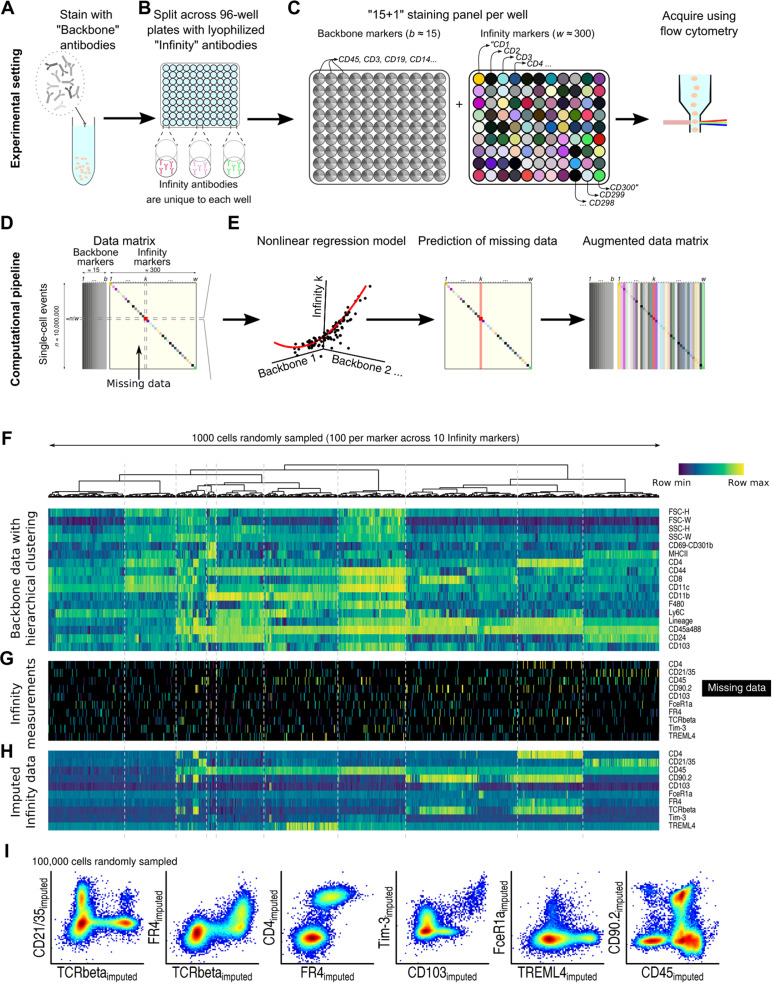
Fig. 1.
Fig. 1.. Summary of the Infinity Flow experimental design and computational pipeline.
Experimental pipeline: (A) Backbone panel staining, (B) Infinity panel staining, and (C) per-well staining panels and data acquisition. Computational pipeline: (D) Data matrix with dense Backbone and sparsely nonmissing Infinity marker measurements and (E) fitting of per-well nonlinear regression models and missing data imputation. Example: (F) On 1000 cells, Backbone matrix with hierarchical clustering of cells, (G) its corresponding sparse Infinity marker measurements, and (H) its corresponding dense Infinity Flow–imputed data. (I) Imputation of coexpression patterns by Infinity Flow.
Fig. 2.
Fig. 2.. Nonlinear regression models accurately impute cytometry data.
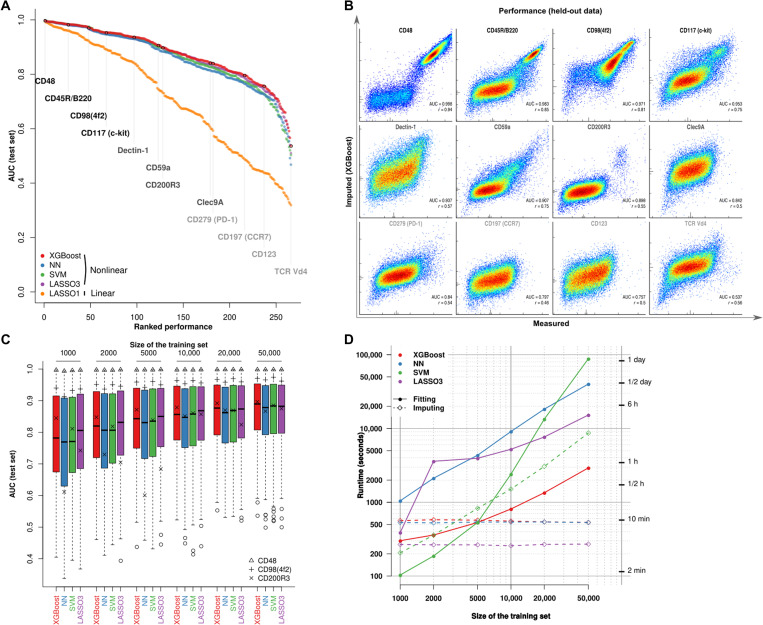
(A) AUC (computed using manual gating as ground truth) across Infinity markers and algorithms. (B) Density heat plots of measured (x axis) versus predicted (y axis) for 12 Infinity markers sampled across the whole range of performances. Vertical lines indicate the thresholds chosen to define positive expression of the markers. (C) For each algorithm, distribution of AUC scores for different sizes of the training set. Three markers are individually highlighted. (D) Runtime for the four algorithms for different sizes of the training set and a fixed size of the imputation set.
Fig. 3.
Fig. 3.. Infinity Flow enables near-exhaustive phenotyping of lung cells.
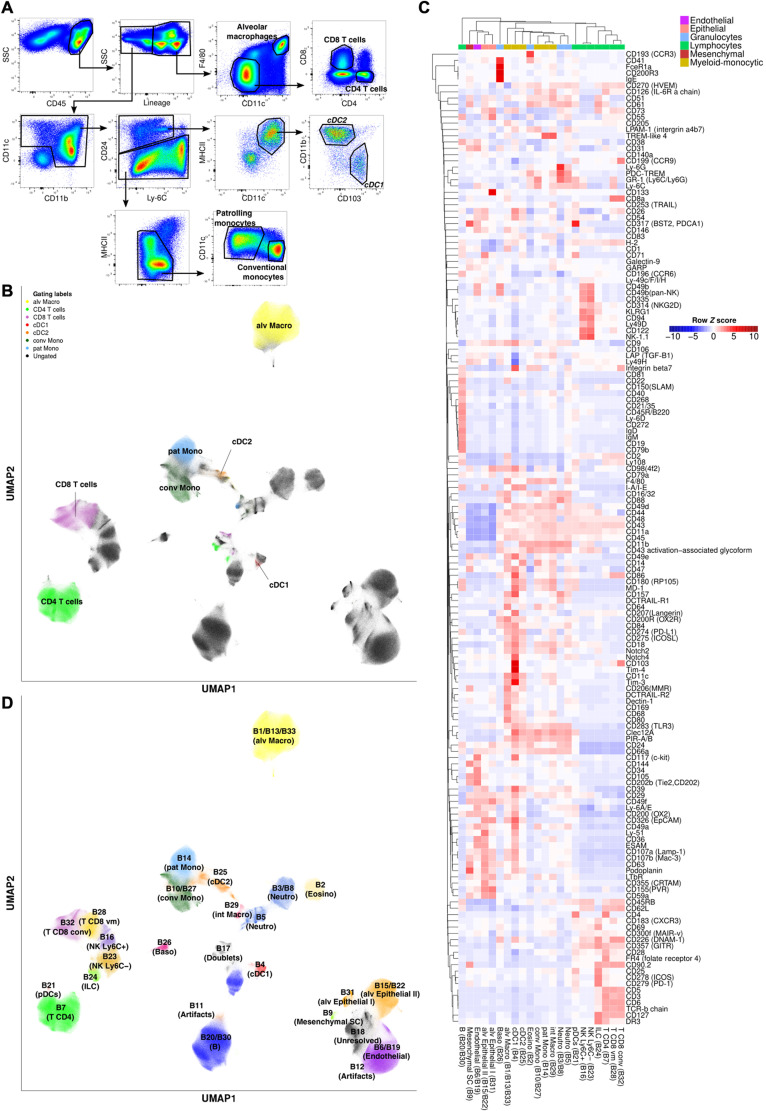
(A) Manual gating of the Backbone data from cells isolated from the lungs of C57BL/6 mice and (B) UMAP dimensionality reduction of the Backbone data, colored by cell phenotypes from manual gating. (C) Median Infinity Flow predictions of 155 Infinity markers showing staining across cell clusters defined by the Phenograph algorithm on the Backbone data. (D) Projection of the cell clusters on the UMAP embedding of the Backbone data.
Fig. 4.
Fig. 4.. Infinity Flow increases the signal-to-noise ratio of MPC datasets.
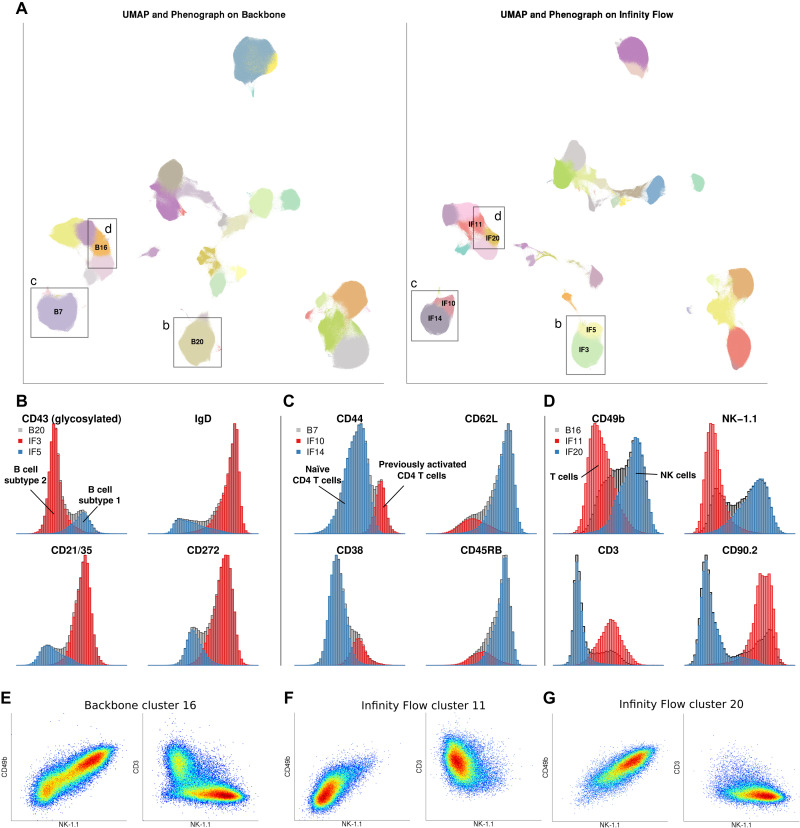
(A) Side-by-side Phenograph clustering and UMAP embedding of the Backbone data (left) and the Infinity Flow–augmented dataset (right). (B) Distribution of markers B cell subtype 1 and B cell subtype 2 in the B cell Backbone cluster B20 (gray) and the two Infinity Flow–augmented B cell clusters IF3 and IF5. (C) Distribution of markers of naïve and previously activated CD4 T cells in the CD4 T cell Backbone cluster B7 (gray) and the two Infinity Flow–augmented CD4 T cell clusters IF10 and IF14. (D) Distribution of markers of NK and T cells in the mixed T CD8 and NK cell Backbone cluster B16 (gray) and the two Infinity Flow–augmented clusters IF11 (T cells) and IF20 (NK cells). Coexpression patterns of CD49b, NK-1.1, and CD3 in the T CD8 and NK Backbone cluster B16 (E), or the Infinity Flow–augmented (F) T cell cluster IF11 or (G) NK cell cluster IF20.
Fig. 5.
Fig. 5.. Infinity Flow identifies heterogeneity within tumor-ingesting macrophages during metastatic seeding of the lung.
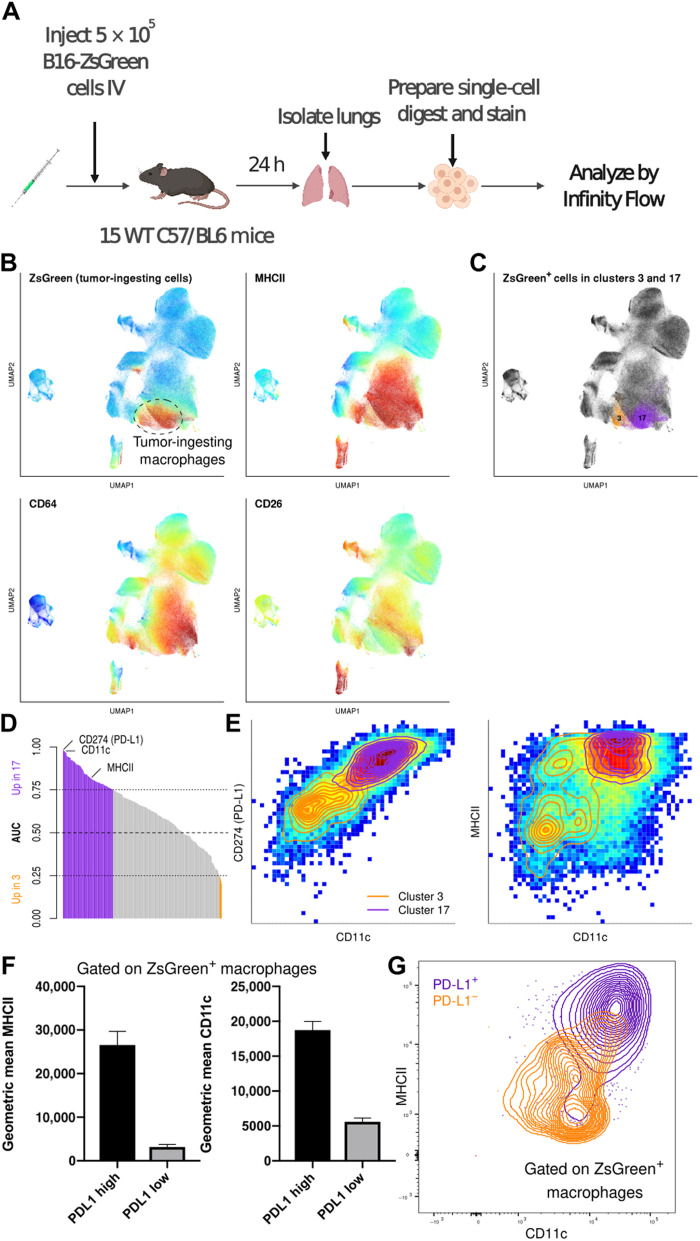
(A) Outline of the experimental setting. (B) Color-coded expression of ZsGreen (Backbone) and MHCII, CD64, and CD26 (imputed) on a UMAP embedding of myeloid cells. (C) ZsGreen+ events from two Phenograph clusters of macrophages. (D) Bar plot representing the AUC of every imputed marker for ZsGreen+ cells from the two macrophages clusters. (E) Color-coded densities of single cells for pairs of markers, overlayed with contours of the two macrophages clusters. (F) Median fluorescence intensities of MHCII and CD11c for PD − L1+ and PD − L1 macrophages in an independent validation cytometry experiment (n = 8). (G) Representative contour plot of PD − L1 and PD − L1+ macrophages on a CD11c versus MHCII plot.

References

    1. Engel P., Boumsell L., Balderas R., Bensussan A., Gattei V., Horejsi V., Jin B. Q., Malavasi F., Mortari F., Schwartz-Albiez R., Stockinger H., van Zelm M. C., Zola H., Clark G., Cd nomenclature 2015: Human leukocyte differentiation antigen workshops as a driving force in immunology. J. Immunol. 195, 4555–4563 (2015). - PubMed
    1. Stoeckius M., Hafemeister C., Stephenson W., Houck-Loomis B., Chattopadhyay P. K., Swerdlow H., Satija R., Smibert P., Simultaneous epitope and transcriptome measurement in single cells. Nat. Methods 14, 865–868 (2017). - PMC - PubMed
    1. Hwang B., Lee D. S., Tamaki W., Sun Y., Ogorodnikov A., Hartoularos G. C., Winters A., Yeung B. Z., Nazor K. L., Song Y. S., Chow E. D., Spitzer M. H., Ye C. J., Scito-seq: Single-cell combinatorial indexed cytometry sequencing. Nat. Methods 18, 903–911 (2021). - PMC - PubMed
    1. Abdelaal T., Höllt T., van Unen V., Lelieveldt B. P. F., Koning F., Reinders M. J. T., Mahfouz A., CyTOFmerge: Integrating mass cytometry data across multiple panels. Bioinformatics 35, 4063–4071 (2019). - PMC - PubMed
    1. Pedreira C. E., Costa E. S., Barrena S., Lecrevisse Q., Almeida J., van Dongen J. J. M., Orfao A.; on behalf of EuroFlow Consortium , Generation of flow cytometry data files with a potentially infinite number of dimensions. Cytometry A 73A, 834–846 (2008). - PubMed