Whole-Genome Sequencing of SARS-CoV-2: Assessment of the Ion Torrent AmpliSeq Panel and Comparison with the Illumina MiSeq ARTIC Protocol
- PMID: 34550806
- PMCID: PMC8601232
- DOI: 10.1128/JCM.00649-21
Whole-Genome Sequencing of SARS-CoV-2: Assessment of the Ion Torrent AmpliSeq Panel and Comparison with the Illumina MiSeq ARTIC Protocol
Abstract
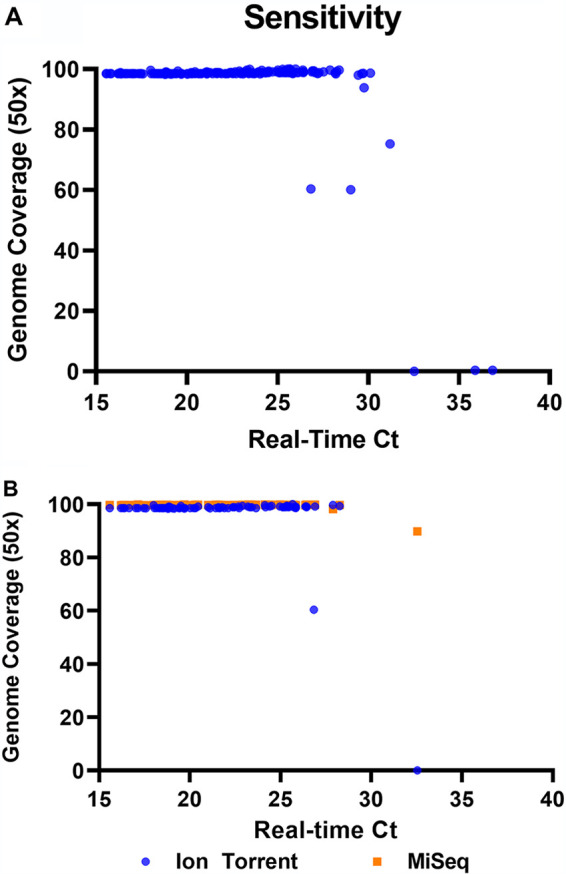
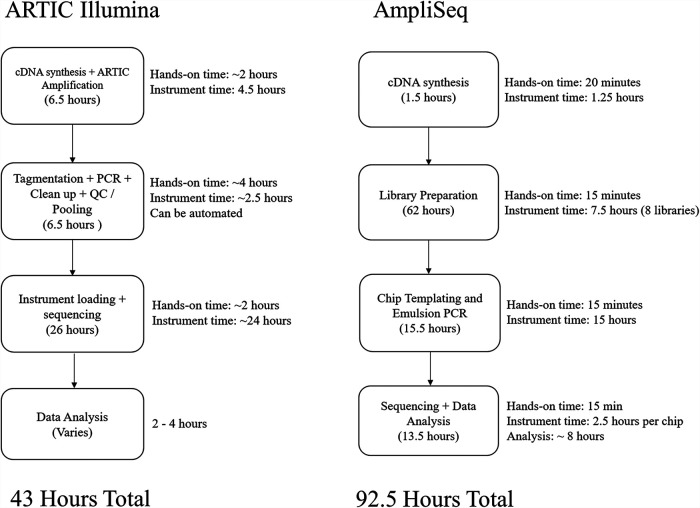
Fast and effective methods are needed for sequencing of the severe acute respiratory syndrome coronavirus 2 (SARS-CoV-2) genome to track genetic mutations and to identify new and emerging variants during the ongoing pandemic. The objectives were to assess the performance of the SARS-CoV-2 AmpliSeq research panel and S5 plug-in analysis tools for whole-genome sequencing analysis of SARS-CoV-2 and to compare the results with those obtained with the MiSeq-based ARTIC analysis pipeline, using metrics such as depth, coverage, and concordance of single-nucleotide variant (SNV) calls. A total of 191 clinical specimens and a single cultured isolate were extracted and sequenced with AmpliSeq technology and analysis tools. Of the 191 clinical specimens, 83 (with threshold cycle [CT] values of 15.58 to 32.54) were also sequenced using an Illumina MiSeq-based method with the ARTIC analysis pipeline, for direct comparison. A total of 176 of the 191 clinical specimens sequenced on the S5XL system and prepared using the SARS-CoV-2 research panel had nearly complete coverage (>98%) of the viral genome, with an average depth of 5,031×. Similar coverage levels (>98%) were observed for 81/83 primary specimens that were sequenced with both methods tested. The sample with the lowest viral load (CT value of 32.54) achieved 89% coverage using the MiSeq method and failed to sequence with the AmpliSeq method. Consensus sequences produced by each method were identical for 81/82 samples in areas of equal coverage, with a single difference present in one sample. The AmpliSeq approach is as effective as the Illumina-based method using ARTIC v3 amplification for sequencing SARS-CoV-2 directly from patient specimens across a range of viral loads (CT values of 15.56 to 32.54 [median, 22.18]). The AmpliSeq workflow is very easily automated with the Ion Chef and S5 instruments and requires less training and experience with next-generation sequencing sample preparation than the Illumina workflow.
Keywords: ARTIC; AmpliSeq; Ion Torrent; MiSeq; SARS-CoV-2; whole-genome sequencing.
Figures
References
-
- Wu F, Zhao S, Yu B, Chen Y-M, Wang W, Song Z-G, Hu Y, Tao Z-W, Tian J-H, Pei Y-Y, Yuan M-L, Zhang Y-L, Dai F-H, Liu Y, Wang Q-M, Zheng J-J, Xu L, Holmes EC, Zhang Y-Z. 2020. A new coronavirus associated with human respiratory disease in China. Nature 579:265–269. 10.1038/s41586-020-2008-3. - DOI - PMC - PubMed
-
- Li Q, Wu J, Nie J, Zhang L, Hao H, Liu S, Zhao C, Zhang Q, Liu H, Nie L, Qin H, Wang M, Lu Q, Li X, Sun Q, Liu J, Zhang L, Li X, Huang W, Wang Y. 2020. The impact of mutations in SARS-CoV-2 spike on viral infectivity and antigenicity. Cell 182:1284–1294.e9. 10.1016/j.cell.2020.07.012. - DOI - PMC - PubMed
-
- Lucey M, Macori G, Mullane N, Sutton-Fitzpatrick U, Gonzalez G, Coughlan S, Purcell A, Fenelon L, Fanning S, Schaffer K. 2021. Whole-genome sequencing to track severe acute respiratory syndrome coronavirus 2 (SARS-CoV-2) transmission in nosocomial outbreaks. Clin Infect Dis 72:e727–e735. 10.1093/cid/ciaa1433. - DOI - PMC - PubMed
-
- Speake H, Phillips A, Chong T, Sikazwe C, Levy A, Lang J, Scalley B, Speers DJ, Smith DW, Effler P, McEvoy SP. 2020. Flight-associated transmission of severe acute respiratory syndrome coronavirus 2 corroborated by whole-genome sequencing. Emerg Infect Dis 26:2872–2880. 10.3201/eid2612.203910. - DOI - PMC - PubMed
Publication types
MeSH terms
Grants and funding
LinkOut - more resources
Full Text Sources
Medical
Miscellaneous