. 2021 Dec;31(12):2249-2258.
doi: 10.1111/sms.14061. Epub 2021 Oct 4.

Angiotensin-Converting Enzyme 2 (SARS-CoV-2 receptor) expression in human skeletal muscle

Affiliations

Angiotensin-Converting Enzyme 2 (SARS-CoV-2 receptor) expression in human skeletal muscle

Mario Perez-Valera et al. Scand J Med Sci Sports. 2021 Dec.

Abstract

The study aimed to determine the levels of skeletal muscle angiotensin-converting enzyme 2 (ACE2, the SARS-CoV-2 receptor) protein expression in men and women and assess whether ACE2 expression in skeletal muscle is associated with cardiorespiratory fitness and adiposity. The level of ACE2 in vastus lateralis muscle biopsies collected in previous studies from 170 men (age: 19-65 years, weight: 56-137 kg, BMI: 23-44) and 69 women (age: 18-55 years, weight: 41-126 kg, BMI: 22-39) was analyzed in duplicate by western blot. VO2 max was determined by ergospirometry and body composition by DXA. ACE2 protein expression was 1.8-fold higher in women than men (p = 0.001, n = 239). This sex difference disappeared after accounting for the percentage of body fat (fat %), VO2 max per kg of legs lean mass (VO2 max-LLM) and age (p = 0.47). Multiple regression analysis showed that the fat % (β = 0.47) is the main predictor of the variability in ACE2 protein expression in skeletal muscle, explaining 5.2% of the variance. VO2 max-LLM had also predictive value (β = 0.09). There was a significant fat % by VO2 max-LLM interaction, such that for subjects with low fat %, VO2 max-LLM was positively associated with ACE2 expression while as fat % increased the slope of the positive association between VO2 max-LLM and ACE2 was reduced. In conclusion, women express higher amounts of ACE2 in their skeletal muscles than men. This sexual dimorphism is mainly explained by sex differences in fat % and cardiorespiratory fitness. The percentage of body fat is the main predictor of the variability in ACE2 protein expression in human skeletal muscle.

Keywords: ACE2; COVID-19; VO2max; biopsies; cardiorespiratory fitness; exercise; obesity; sex differences.


Conflict of interest statement

The authors declare that they have no conflict of interest.

Figures
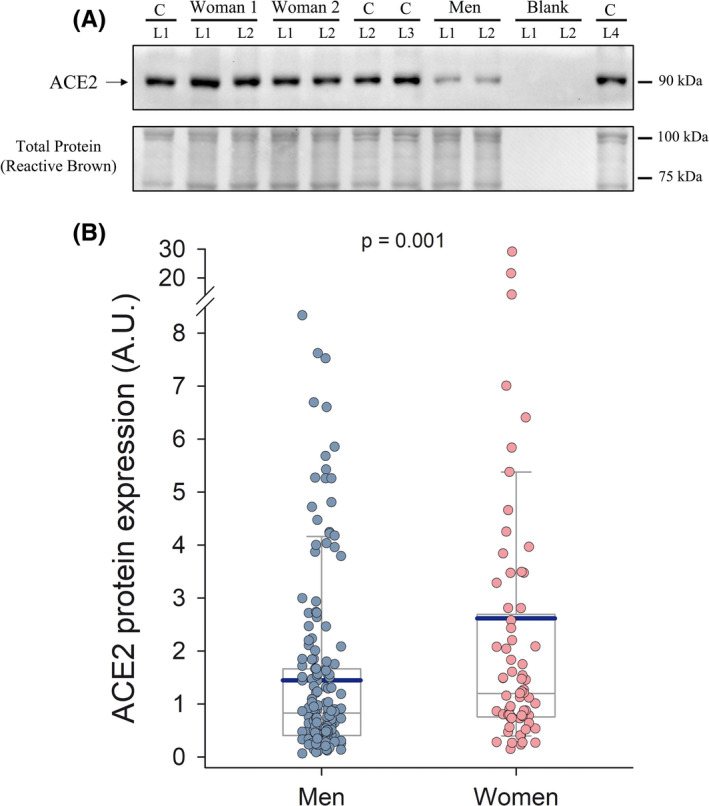
FIGURE 1
FIGURE 1
Skeletal muscle ACE2 protein expression levels in men and women covering a wide range of age, fitness, and body composition: (A) Representative immunoblot images and total amount of protein loaded (Reactive Brown Staining) from two women and one man participating in the study. All experimental samples were run in duplicate, while a control human sample (non‐experimental) was included onto each gel to allow normalization and loading control. C, control non‐experimental sample; L, gel lane for a particular sample or blank. Estimated molecular weights are indicated by arrows on the side of the blot. (B) Box and whisker plots of ACE2 skeletal muscle protein expression in all men (n = 170) and women (n = 69) included in the study (arbitrary units, A.U.). The extremes of the whiskers represent the limits of the 5th and 95th percentiles, respectively; the thin and thick horizontal lines inside the boxes correspond to the mean and median values, respectively; and the lower and upper limits of the box delimit the 1st and 3rd quartiles, respectively. The statistical analysis was performed with logarithmically transformed data. p‐value = 0.001 for the difference between men and women (unpaired two‐tailed t‐test) with all data included in the analysis and p = 0.007 after removing the two women with higher ACE2 values
FIGURE 2
FIGURE 2
Skeletal muscle ACE2 protein expression and cardiorespiratory fitness. Each straight line represents the linear relationship between the logarithm of the level of ACE2 expression in the human vastus lateralis skeletal muscle and maximal oxygen uptake (VO2max, expressed as mL of O2 per kg of lean mass of the lower extremities (LLM)), for the percentages of body fat indicated. N = 215 (146 men and 69 women). This graph was created using the regression model reported in Table 2
FIGURE 3
FIGURE 3
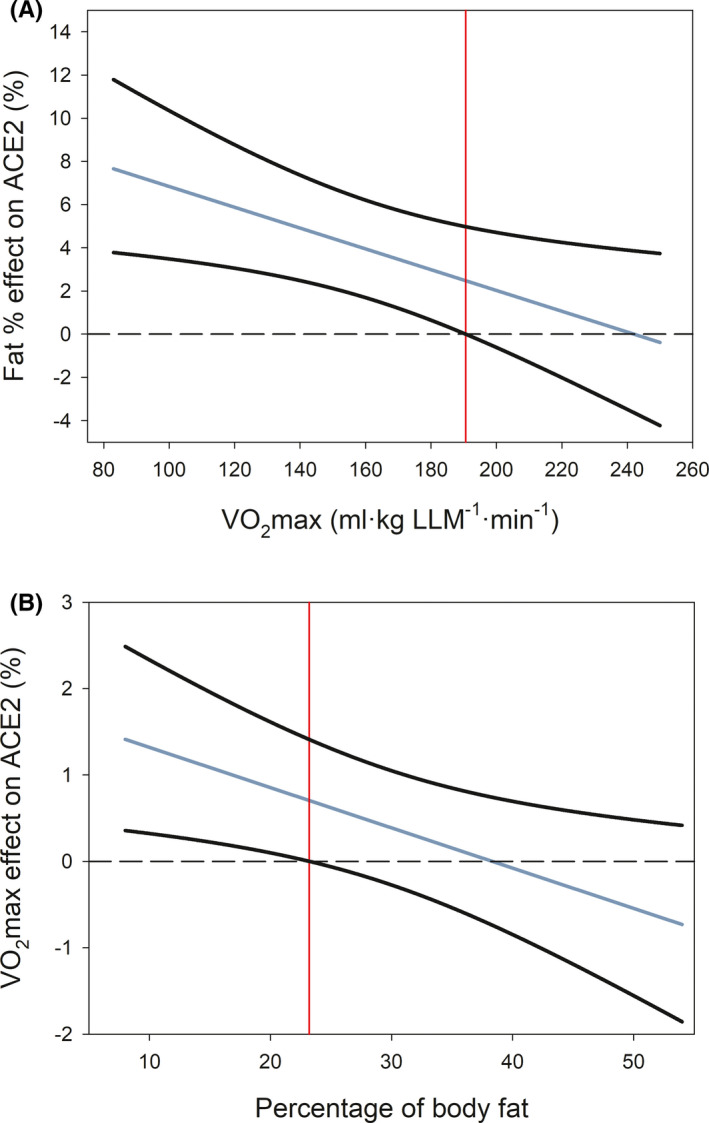
Johnson‐Neyman analysis depicting the moderator effects of the percentage of body fat and cardiorespiratory fitness on ACE2 protein expression in human skeletal muscle. (A) Moderator effect of VO2max on the linear relationship between the percentage of body fat (fat %) and ACE2 protein expression. The black lines depict the 95% confidence interval, and the red line indicates the value of VO2max (190.6 ml·kg LLM−1·min−1) above which the moderator effect is not statistically significant. Below this value, for a given level of VO2max, ACE2 expression increases in the percentage indicated in the “Y” axis per each unit of increase of fat %. (B) Moderator effect of fat % on the linear relationship between VO2max and ACE2 protein expression. The black lines depict 95% confidence interval, and the red line indicates the value of fat % (23.2%), above which the moderator effect is not statistically significant. Below this value, for a given level of fat %, ACE2 expression increases in the percentage indicated in the “Y” axis per each unit of increase in VO2max

References

    1. Li W, Moore MJ, Vasilieva N, et al. Angiotensin‐converting enzyme 2 is a functional receptor for the SARS coronavirus. Nature. 2003;426(6965):450‐454. - PMC - PubMed
    1. Hoffmann M, Kleine‐Weber H, Schroeder S, et al. SARS‐CoV‐2 cell entry depends on ACE2 and TMPRSS2 and Is blocked by a clinically proven protease inhibitor. Cell. 2020;181(2):271‐280. - PMC - PubMed
    1. Parit R, Jayavel S. Association of ACE inhibitors and angiotensin type II blockers with ACE2 overexpression in COVID‐19 comorbidities: A pathway‐based analytical study. Eur J Pharmacol. 2021;896:173899. - PMC - PubMed
    1. Zheng YY, Ma YT, Zhang JY, Xie X. COVID‐19 and the cardiovascular system. Nat Rev Cardiol. 2020;17(5):259‐260. - PMC - PubMed
    1. Sharma RK, Li J, Krishnan S, Richards EM, Raizada MK, Mohandas R. Angiotensin‐converting enzyme 2 and COVID‐19 in cardiorenal diseases. Clin Sci (Lond). 2021;135(1):1‐17. - PMC - PubMed

Substances