. 2021 Oct 11;49(18):10275-10288.
doi: 10.1093/nar/gkab796.

Dual targeting of higher-order DNA structures by azacryptands induces DNA junction-mediated DNA damage in cancer cells

Affiliations

Dual targeting of higher-order DNA structures by azacryptands induces DNA junction-mediated DNA damage in cancer cells

Joanna Zell et al. Nucleic Acids Res. .

Abstract

DNA is intrinsically dynamic and folds transiently into alternative higher-order structures such as G-quadruplexes (G4s) and three-way DNA junctions (TWJs). G4s and TWJs can be stabilised by small molecules (ligands) that have high chemotherapeutic potential, either as standalone DNA damaging agents or combined in synthetic lethality strategies. While previous approaches have claimed to use ligands that specifically target either G4s or TWJs, we report here on a new approach in which ligands targeting both TWJs and G4s in vitro demonstrate cellular effects distinct from that of G4 ligands, and attributable to TWJ targeting. The DNA binding modes of these new, dual TWJ-/G4-ligands were studied by a panel of in vitro methods and theoretical simulations, and their cellular properties by extensive cell-based assays. We show here that cytotoxic activity of TWJ-/G4-ligands is mitigated by the DNA damage response (DDR) and DNA topoisomerase 2 (TOP2), making them different from typical G4-ligands, and implying a pivotal role of TWJs in cells. We designed and used a clickable ligand, TrisNP-α, to provide unique insights into the TWJ landscape in cells and its modulation upon co-treatments. This wealth of data was exploited to design an efficient synthetic lethality strategy combining dual ligands with clinically relevant DDR inhibitors.


Figures

Graphical Abstract
Graphical Abstract
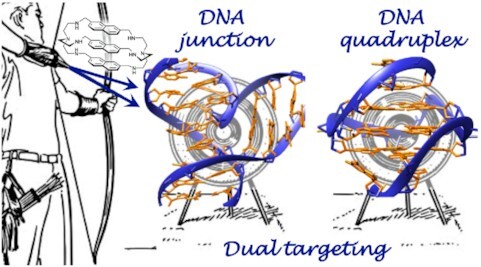
Small molecules that concomitantly target three-way DNA junctions (TWJs) and G-quadruplexes (G4s) are used here to study the landscape of alternative DNA folds and their potential as therapeutic targets to trigger DNA structure-dependent DNA damage in human cells.
Figure 1.
Figure 1.
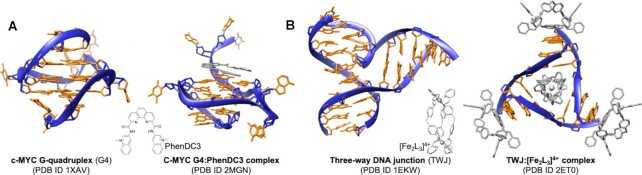
Crystal or NMR structures of G4-/TWJ-forming oligonucleotides without or with ligand: (A) G4 (62) with PhenDC3; (63) (B) TWJ (64) with the iron supramolecular helicate [Fe2L3]4+(54).
Figure 2.
Figure 2.
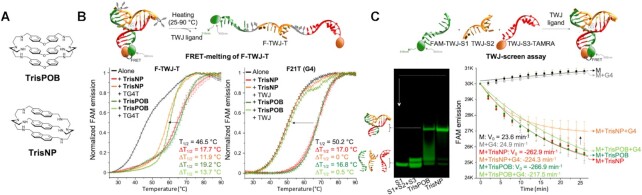
(A) Chemical structures of TrisPOB and TrisNP. (B) Competitive FRET-melting assays using labelled intramolecular TWJ- and G4-forming oligonucleotides: experiments performed from 25 to 90°C with F-TWJ-T (0.2 μM) in the presence of TrisNP or TrisPOB (1.0 μM, 5 mol. eq.) and competitive non-fluorescent G4 TG4T (50 mol. eq.) (left panel) and labelled G4 F21T (0.2 μM) in the presence of TrisNP or TrisPOB (1.0 μM, 5 mol. eq.) and competitive non-fluorescent TWJ (15 mol. eq.) (right panel). (C) TWJ-folding monitored by either PAGE (TWJ-S1 (5.0 μM), TWJ-S1 + TWJ-S2 + TWJ-S3 (M, 5.0 μM), M + TrisPOB and M + TrisNP, (5 mol. eq., 1 h; gels post-stained with SybrGold)) (left) or TWJ-Screen assays performed with a mixture of FAM-TWJ-S1, TWJ-S2 and TWJ-S3-TAMRA (M, 0.2 μM) alone or in presence of ligand (5 mol. eq.), with or without competitive TG4T (5 mol. eq.). Control experiments are provided in Supplementary Figure S1.
Figure 3.
Figure 3.
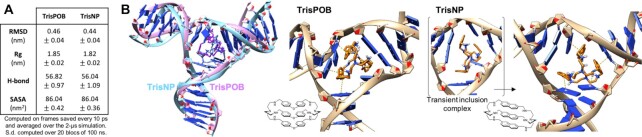
(A) Metrics quantifying the interaction between TrisPOB and TrisNP with TWJs. (B) Representative conformations of TrisNP and TrisPOB bound in a TWJ, obtained via MD simulations; π-stacking and polar–π interactions are shown as dotted lines; the transient inclusion complex in which a nucleobase (dT) is sandwiched inside TrisNP is shown in brackets.
Figure 4.
Figure 4.
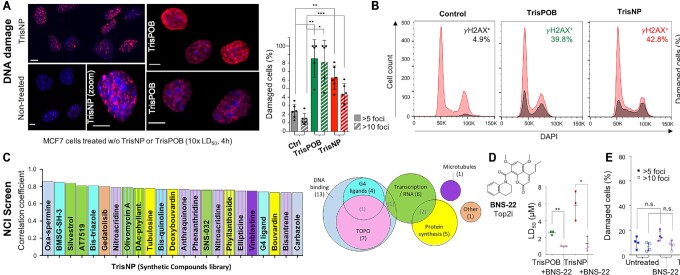
(A,B) Immunodetection of DNA damage in MCF7 cells non-treated or treated with 10 × LD50 of TrisPOB and TrisNP (9 and 22 μM) for 4 h at 37°C prior to immunolabeling with antibodies raised against γH2AX (secondary antibody labelled with Alexa Fluor 647, λem = 670 nm) and DAPI nuclear staining (λem = 450 nm); scale bars = 5 μm. γH2AX foci are quantified by fluorescence imaging (% of cells with > 5 and > 10 γH2AX foci) with ImageJ plugin 3D Object Counter (80 to 200 cells from >8 different images per condition (A), or quantified by flow cytometry and data treatment using FlowJo software (B), repeated in at least three separate experiments. (C) NCI databases of Synthetic Compounds (left panel and Venn diagram) tested in the NCI-60 cytotoxicity assay show the compounds with the highest correlations of cytotoxicity fingerprint with TrisNP and TrisPOB. Colour-coding shows the mechanism of action described for the compounds. (D) Antiproliferative activity of TrisPOB and TrisNP is markedly increased in the presence of a subtoxic concentration of BNS-22 (12.5 μM) in MCF7 cells over 72 h. (E) Immunodetection of DNA damage in MCF7 cells treated with or without BNS-22 (50 μM, 5 h) and/or 10 × LD50 of TrisNP (4 h) prior to immunolabeling with γH2AX-specific antibody. Quantified as previously. P values were calculated using a paired, two-tailed t test. ns: P> 0.05; *P< 0.05; **P< 0.005; **P < 0.0005 (A, BDE).
Figure 5.
Figure 5.
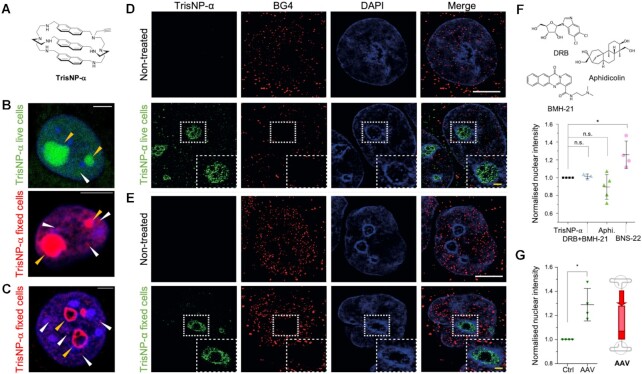
(A) Structure of TrisNP-α. (B,C) In situ click imaging obtained with TrisNP-α (3 μM, 4 h) incubated in live or fixed cells, then illuminated with Alexa Fluor 488-azide (green, live cell incubation) or Alexa Fluor 594-azide (red, post-fixation incubation). Ligand is present in the nucleoli (yellow arrows) and the nucleoplasm (white arrows). Cells pre-extracted (C) with CSK + RNAse show perinucleolar staining (yellow arrows). Nuclei are counterstained with DAPI (blue). Scale bars = 5 μm. (DE) Super-resolution images of MCF7 cells are treated with TrisNP-α (3 h, 3 μM), pre-extracted with CSK + RNase A, fixed, clicked, and co-stained with BG4 antibody (D) or pre-extracted with CSK + RNase A, fixed, incubated with TrisNP-α (3 h, 10 μM), clicked and co-stained with BG4 antibody (E). Nuclei are counterstained with DAPI. White scale bar = 5 μm, yellow scale bar = 1 μm. (F) Change in nuclear intensity of live TrisNP-α click staining after pre-treatment with inhibitors DRB + BMH-21 (100/1 μM), aphidicolin (10 μM) and BNS-22 (50 μM). (G) TrisNP-α nuclear intensity increases with AAV1-mCherry treatment, stained as previously described and labelled after fixation via click reactions with AF488-azide. Nuclear intensity after inhibitor or AAV treatment was quantified in FIJI ImageJ and normalised to TrisNP-α staining. P values were calculated using a paired, two-tailed t test. ns: P> 0.05; *P< 0.05 (FG).
Figure 6.
Figure 6.
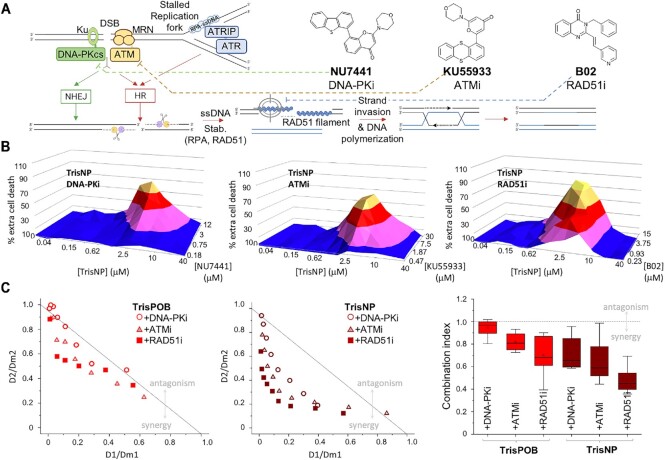
(A) Double-strand breaks (DSB) and stalled replication forks are repaired by HR and NHEJ, mediated by DNA-PK and ATM kinases and RAD51. Created with BioRender. Chemical structure of DDR inhibitors NU7441 (DNA-PKi), KU55933 (ATMi) and B02 (RAD51i). (B) 3D pyramid plots showing the percentage of extra cell death for the combination of TrisNP (lethal concentration range: 0–40 μM), with DNA-PKi, ATMi, or RAD51i (non-lethal concentration range, see Supplementary Data). Results are the average of three separate experiments each containing technical duplicates. (C) Normalised isobolograms for combination of TrisPOB or TrisNP with DNA-PKi (circles), ATMi (triangles), and RAD51i (squares). Points above the grey horizontal line show antagonism between agents, below the line show synergism. Combination index graph (right) of the same co-treatments. Derived from the same raw data as the pyramid plots in Figure 5B.

References

    1. Jackson S.P., Bartek J.. The DNA-damage response in human biology and disease. Nature. 2009; 461:1071–1078. - PMC - PubMed
    1. Ciccia A., Elledge S.J.. The DNA damage response: making it safe to play with knives. Mol. Cell. 2010; 40:179–204. - PMC - PubMed
    1. Zell J., Rota Sperti F., Britton S., Monchaud D.. DNA folds threaten genetic stability and can be leveraged for chemotherapy. RSC Chem. Biol. 2021; 2:47–76. - PMC - PubMed
    1. Hustedt N., Durocher D.. The control of DNA repair by the cell cycle. Nat. Cell Biol. 2017; 19:1–9. - PubMed
    1. Scully R., Panday A., Elango R., Willis N.A.. DNA double-strand break repair-pathway choice in somatic mammalian cells. Nat. Rev. Mol. Cell Biol. 2019; 20:698–714. - PMC - PubMed

Publication types

Substances