. 2021 Jul 9:15:100868.
doi: 10.1016/j.ssmph.2021.100868. eCollection 2021 Sep.

Intersectional trends in employment quality in older adults in the United States

Affiliations

Intersectional trends in employment quality in older adults in the United States

Sarah B Andrea et al. SSM Popul Health. .

Abstract

Americans' working lives have become more precarious over the past several decades. Worsening employment quality has been linked to poorer physical and mental health and may disproportionately impact marginalized working populations. We examined differences in the quality and character of worker-employer relationships among older workers in the United States (US) across intersecting gender-racial/ethnic-educational subgroups. Using longitudinal data on employment stability, material rewards, workers' rights, working-time arrangements, unionization, and interpersonal power relations from the Health and Retirement Study (1992-2016), we used principal components analysis to construct an employment quality (EQ) score. We estimated intersectional differences in EQ, overall and over time, using generalized estimating equations. Overall, EQ was greatest for white men with college degrees and poorest for Latinx women with < high school degrees. Over time, EQ tended to remain unchanged or slightly worsen across intersectional strata; the greatest EQ reduction was for Latinx women with college degrees, while the greatest improvement was for white women with high school degrees. There are enduring and growing inequities in EQ for older marginalized adults in the US, which may contribute to growing health inequities.

Keywords: Employment quality; Health and retirement study; Inequities; Intersectionality; Precarious employment.


Conflict of interest statement

None.

Figures
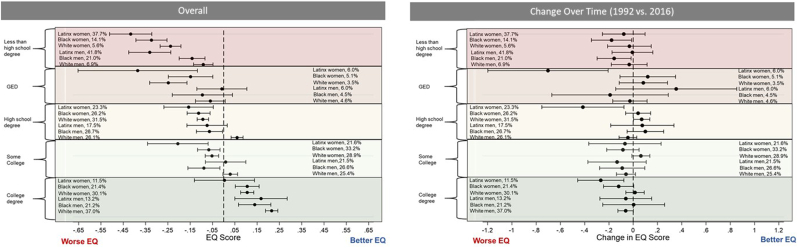
Fig. 1
Fig. 1
Employment quality by educational attainment, race/ethnicity, and gender in adults aged 50 and older participating in the labor force, Health and Retirement Study 19922016. Displayed are subgroup-specific estimates and 95% confidence intervals derived using linear generalized estimating equations. All models included an exchangeable correlation structure, categorical indicators of survey year, robust standard errors clustered at the respondent-level, and respondent-level sampling weights. Reported percentages are within strata of race and gender (e.g., 37.7% of Latinx women had < high school degree). Abbreviations: EQ, Employment Quality; GED, General Equivalency Diploma.

References

    1. Ahonen E.Q., Fujishiro K., Cunningham T., Flynn M. Work as an inclusive part of population health inequities research and prevention. American Journal of Public Health. 2018;108:306–311. doi: 10.2105/AJPH.2017.304214. - DOI - PMC - PubMed
    1. Andrea S.B., Eisenberg-Guyot J., Oddo V.M., Peckham T., Jacoby D., Hajat A. 2021. Beyond hours worked and dollars earned: Multidimensional employment quality, retirement trajectories and health in later life. Work, aging and retirement in press. - PMC - PubMed
    1. Bailey Z.D., Krieger N., Agénor M., Graves J., Linos N., Bassett M.T. Structural racism and health inequities in the USA: Evidence and interventions. The Lancet. 2017;389:1453–1463. doi: 10.1016/S0140-6736(17)30569-X. - DOI - PubMed
    1. Benach J., Muntaner C. Precarious employment and health: Developing a research agenda. Journal of Epidemiology & Community Health. 2007;61:276–277. doi: 10.1136/jech.2005.045237. - DOI - PMC - PubMed
    1. Benach J., Vives A., Amable M., Vanroelen C., Tarafa G., Muntaner C. Precarious employment: Understanding an emerging social determinant of health. Annual Review of Public Health. 2014;35:229–253. doi: 10.1146/annurev-publhealth-032013-182500. - DOI - PubMed

LinkOut - more resources
