Clinical Trial
. 2021 Nov 1;7(11):1669-1677.
doi: 10.1001/jamaoncol.2021.3836.

Final Overall Survival Efficacy Results of Ivosidenib for Patients With Advanced Cholangiocarcinoma With IDH1 Mutation: The Phase 3 Randomized Clinical ClarIDHy Trial

Affiliations
Clinical Trial

Final Overall Survival Efficacy Results of Ivosidenib for Patients With Advanced Cholangiocarcinoma With IDH1 Mutation: The Phase 3 Randomized Clinical ClarIDHy Trial

Andrew X Zhu et al. JAMA Oncol. .

Abstract

Importance: Isocitrate dehydrogenase 1 (IDH1) variations occur in up to approximately 20% of patients with intrahepatic cholangiocarcinoma. In the ClarIDHy trial, progression-free survival as determined by central review was significantly improved with ivosidenib vs placebo.

Objective: To report the final overall survival (OS) results from the ClarIDHy trial, which aimed to demonstrate the efficacy of ivosidenib (AG-120)-a first-in-class, oral, small-molecule inhibitor of mutant IDH1-vs placebo for patients with unresectable or metastatic cholangiocarcinoma with IDH1 mutation.

Design, setting, and participants: This multicenter, randomized, double-blind, placebo-controlled, clinical phase 3 trial was conducted from February 20, 2017, to May 31, 2020, at 49 hospitals across 6 countries among patients aged 18 years or older with cholangiocarcinoma with IDH1 mutation whose disease progressed with prior therapy.

Interventions: Patients were randomized 2:1 to receive ivosidenib, 500 mg, once daily or matched placebo. Crossover from placebo to ivosidenib was permitted if patients had disease progression as determined by radiographic findings.

Main outcomes and measures: The primary end point was progression-free survival as determined by blinded independent radiology center (reported previously). Overall survival was a key secondary end point. The primary analysis of OS followed the intent-to-treat principle. Other secondary end points included objective response rate, safety and tolerability, and quality of life.

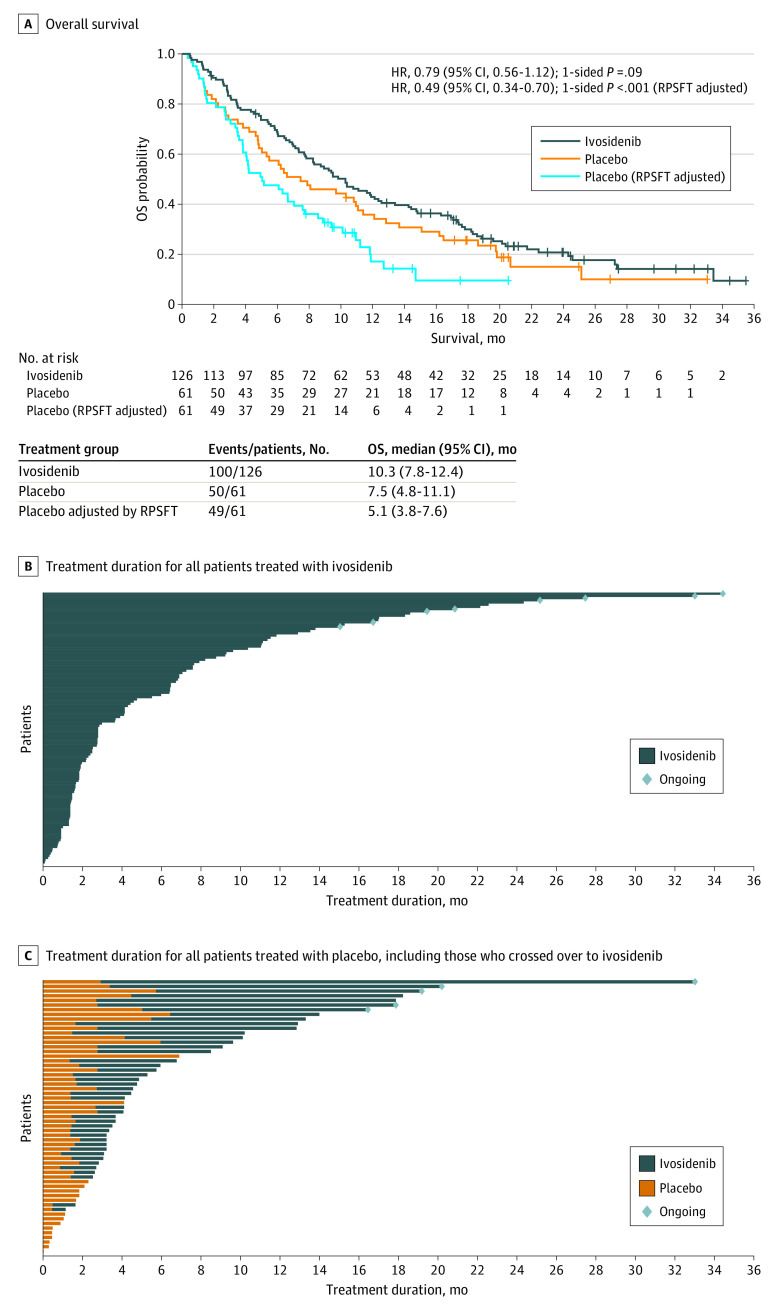
Results: Overall, 187 patients (median age, 62 years [range, 33-83 years]) were randomly assigned to receive ivosidenib (n = 126; 82 women [65%]; median age, 61 years [range, 33-80 years]) or placebo (n = 61; 37 women [61%]; median age, 63 years [range, 40-83 years]); 43 patients crossed over from placebo to ivosidenib. The primary end point of progression-free survival was reported elsewhere. Median OS was 10.3 months (95% CI, 7.8-12.4 months) with ivosidenib vs 7.5 months (95% CI, 4.8-11.1 months) with placebo (hazard ratio, 0.79 [95% CI, 0.56-1.12]; 1-sided P = .09). When adjusted for crossover, median OS with placebo was 5.1 months (95% CI, 3.8-7.6 months; hazard ratio, 0.49 [95% CI, 0.34-0.70]; 1-sided P < .001). The most common grade 3 or higher treatment-emergent adverse event (≥5%) reported in both groups was ascites (11 patients [9%] receiving ivosidenib and 4 patients [7%] receiving placebo). Serious treatment-emergent adverse events considered ivosidenib related were reported in 3 patients (2%). There were no treatment-related deaths. Patients receiving ivosidenib reported no apparent decline in quality of life compared with placebo.

Conclusions and relevance: This randomized clinical trial found that ivosidenib was well tolerated and resulted in a favorable OS benefit vs placebo, despite a high rate of crossover. These data, coupled with supportive quality of life data and a tolerable safety profile, demonstrate the clinical benefit of ivosidenib for patients with advanced cholangiocarcinoma with IDH1 mutation.

Trial registration: ClinicalTrials.gov Identifier: NCT02989857.


Conflict of interest statement

Conflict of Interest Disclosures: Dr Zhu reported serving as a consultant for or is on scientific advisory boards for AstraZeneca, Bayer, Eisai, Exelixis, Gilead, Lilly, Merck, Roche/Genentech, and Sanofi-Aventis; and receiving research funding from Bayer, Bristol Myers Squibb, Lilly, Merck, and Novartis outside the submitted work. Dr Macarulla reported being on advisory boards for AstraZeneca, Baxalta, Celgene, Eisai, Genzyme, Incyte, Ipsen, Lab, Lilly, Menarini, Merck Sharp & Dohme, Polaris, Prime Oncology, QED, Roche, Sanofi-Aventis, Servier, Shire, and Surface Oncology Inc; receiving travel/accommodation funding from Celgene, H3 Biomedicine, Merck, Sanofi, and Servier; and receiving research grant/funding (to institution) from Agios, ASLAN, AstraZeneca, Baxalta, Bayer, Celgene, Genentech, Halozyme, Immunomedics, Lilly, Merrimack, Millennium, Novartis, Novocure, Pfizer, Pharmacyclics, and Roche outside the submitted work. Dr Javle reported being on advisory boards for AstraZeneca, EMD Serono, Incyte, Merck, Mundipharma, OncoSil, and QED; and receiving honoraria or research support from Bayer, Beigene, Incyte, Merck, Merck Serono, Novartis, Pieris, QED, Rafael, and Seattle Genetics outside the submitted work. Dr Kelley reported being on advisory boards for Agios (funding to institution), AstraZeneca (funding to institution), Bristol Myers Squibb (funding to institution), Exact Sciences (funding to individual), Genentech/Roche (funding to individual), Gilead (funding to individual), and Merck (funding to institution); receiving travel/accommodation funding from Ipsen; and receiving research grant/funding (to institution) from Adaptimmune, Agios, AstraZeneca, Bayer, Bristol Myers Squibb, EMD Serono, Exelixis, Genentech/Roche, Lilly, MedImmune, Merck Sharp & Dohme, Novartis, Partner, QED, and Taiho outside the submitted work. Dr Cleary reported being on advisory boards for Bristol Myers Squibb; receiving travel/accommodation funding from Agios, Bristol Myers Squibb, and Roche; and receiving research grant/funding from AbbVie (funding to individual), AstraZeneca (funding to individual), Bristol Myers Squibb (funding to institution), Esperas (funding to individual), Genentech/Roche (funding to institution), Merck (funding to individual), Merus (funding to institution), and Tesaro (funding to individual) outside the submitted work. Dr Catenacci reported being on advisory boards for Amgen, Astellas, Bristol Myers Squibb, Daiichi Sankyo/UCB Japan, Genentech/Roche, Guardant Health, Lilly, Merck, Seattle Genetics, Taiho, and Zymeworks; participating in speakers’ bureaus for Foundation Medicine, Genentech, Guardant Health, Lilly, Merck, and Tempus; and receiving honoraria from Amgen, Archer, Astellas, Bristol Myers Squibb, Daiichi Sankyo/UCB Japan, Five Prime, Foundation Medicine, Genentech/Roche, Gristone Oncology, Guardant Health, Lilly, Merck, Natera, Pieris, QED, Seattle Genetics, Taiho, Tempus, and Zymeworks outside the submitted work. Dr Borad reported being on advisory boards for Agios (funding to institution), ArQule (funding to institution), Celgene (funding to institution), De Novo (funding to individual), Exelixis (funding to individual), G1 (funding to individual), Genentech (funding to individual), Halozyme (funding to institution), Immunovative Therapies (funding to individual), Imvax (funding to individual), Inspyr (funding to individual), Insys (funding to institution), KLUS (funding to individual), Lynx Group (funding to individual), Merck (funding to individual), Novartis (funding to institution), Pieris (funding to institution), Taiho (funding to institution), and Western Oncolytics (funding to individual); holding stock in AVEO, Gilead, Intercept, and Spectrum; receiving travel/accommodation funding from ArQule, AstraZeneca, and Celgene; and receiving research grant/funding (to institution) from Adaptimmune, Agios, ARIAD, Basilea, BioLineRx, Boston Biomedical, Celgene, Dicerna, Eisai, EMD Serono, Halozyme, ImClone Systems, Incyte, Ionis Pharmaceuticals, MedImmune, Merck Serono, miRNA, Novartis, Pieris, Puma Biotechnology, QED, Redhill Biopharma, Senhwa Biosciences, SillaJen, Sun Biopharma, Taiho, Threshold, and Toray Industries outside the submitted work. Dr Bridgewater reported being on advisory boards for AstraZeneca, Basilea, Bayer, Incyte, Merck Serono, Roche, and Servier; receiving honoraria from Merck Serono and Servier; receiving travel/accommodation funding from Bristol Myers Squibb, Bristol Myers Squibb/Medarex, Merck Serono, Merck Sharp & Dohme, and Servier; participating in speakers’ bureaus for Amgen, Bristol Myers Squibb, and Celgene; and receiving research grant/funding from Amgen outside the submitted work. Dr Harris reported being on advisory boards for Bristol Myers Squibb, Eisai, Exelixis, NeoTherma, QED, and Zymeworks; receiving travel/accommodation funding from Eisai; and receiving research grant/funding (to institution) from Agios, ArQule, Bayer, Bristol Myers Squibb, BTG, Exelixis, Halozyme, MedImmune, and Merck outside the submitted work. Dr Murphy reported being on advisory boards for AbbVie; and receiving research grant/funding from Bristol Myers Squibb outside the submitted work. Dr Oh reported being on advisory boards for ASLAN, AstraZeneca, Basilea, Bayer, Beigene, Celgene, Genentech/Roche, Halozyme, Merck Serono, Novartis, Taiho, and Zymeworks; and receiving research grant/funding from Array BioPharma, AstraZeneca, Beigene, Lilly, Merck Sharp & Dohme, Novartis, and Servier outside the submitted work. Dr Lowery reported being on advisory boards for Agios, Celgene, Pfizer, and Roche outside the submitted work. Dr Goyal reported being on advisory boards for Agios, Alentis, AstraZeneca, H3 Biomedicine, Incyte, QED, Sirtex Medical, and Taiho Oncology; being a consultant for Agios, Alentis, Exelixis, Genentech, Incyte, QED, Sirtex Medical, and Taiho Oncology; and receiving research grant/funding (to institution) from Adaptimmune, Bayer, Bristol Myers Squibb, Eisai, Genentech, Leap, Loxo Oncology, MacroGenics, Merck, Novartis, NuCana, and Relay outside the submitted work. Dr Shroff reported being on advisory boards for Agios, Clovis, Debiopharm, Exelixis, Merck, QED, and Seattle Genetics; and receiving research grant/funding from Agios, Halozyme, Lilly, Merck, and Pieris outside the submitted work. Dr El-Khoueiry reported being on advisory boards for ABL Bio, Agenus, Agios, Bayer, Bristol Myers Squibb, CytomX, Eisai, Exelixis, Gilead, Merck, Merck Serono, Pieris, QED, Roche/Genentech, and Target PharmaSolutions (consultant and advisory board); and receiving research grant/funding from Astex (to institution), AstraZeneca (to institution), and Merck (to institution) outside the submitted work. Drs Chamberlain, Choe, Liu, and Pandya and Ms Gliser were employees of and held stock in Agios at the time of this study; they are now employees of Servier. Dr Aguado-Fraile was an employee of and held stock in Agios, at the time of this study. Dr Wu was an employee of, held stock in, and held patents, royalties, and other intellectual property with Agios at the time of this study. Dr Valle reported being on advisory boards for Agios, AstraZeneca, Debiopharm, Genoscience, Hutchison MediPharma, Imaging Equipment Ltd, Incyte, Ipsen, Keocyt, Merck, Mundipharma, Novartis, NuCana, PCI Biotech, Pfizer, Pieris, Servier, QED, and Wren Laboratories; receiving travel/accommodation funding from Lilly, NuCana, and Pfizer; participating in speakers’ bureaus for Imaging Equipment Ltd, Ipsen, Novartis, and NuCana; and receiving honoraria from Ipsen outside the submitted work. Dr Abou-Alfa reported serving as a consultant for or being on scientific advisory boards for Agios, AstraZeneca, Autem Medical, Bayer, Beigene, Berry Genomics, Celgene, Eisai, Flatiron Health, Genoscience, Gilead, Incyte, Ipsen, LAM, Lilly, Merck Serono, Minapharm, QED, RedHill Biopharma, Roche/Genentech, SillaJen, TheraBionic, twoXAR, and Vector Health; receiving travel/accommodation funding from Polaris; and receiving research funding (to institution) from Agios, AstraZeneca, Bayer, Bristol Myers Squibb, CASI, Exelixis, Incyte, Polaris, Puma Biotechnology, and QED outside the submitted work. Drs Zhu, Chamberlain, Aguado-Fraile, Choe, Wu, Liu, and Pandya and Ms Gliser were employees at Agios Pharmaceuticals Inc, when the study was conducted and completed. No other disclosures were reported.

Figures

Figure 1.
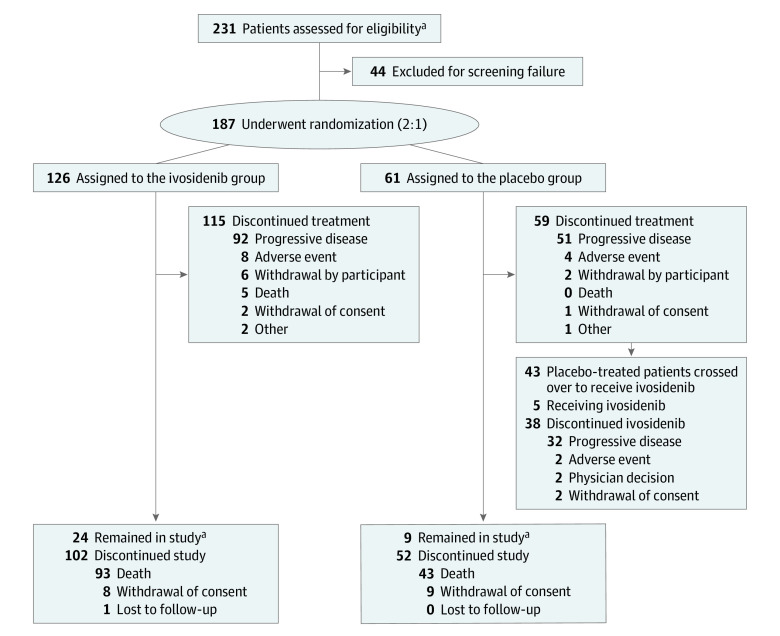
Figure 1.. CONSORT Diagram
aAs of the data cutoff date (May 31, 2020).
Figure 2.
Figure 2.. Overall Survival and Treatment Duration in the Intent-to-Treat Population
A, Overall survival in the intent-to-treat population. Reproduced from Zhu. B, Median treatment duration with ivosidenib (n = 123), 2.8 months (range, 0.1-34.4 months). C, All patients treated with placebo are shown in orange (n = 59); those who crossed over to ivosidenib are shown in dark blue (n = 43). Median treatment duration with placebo, 1.6 months (range, 0-6.9 months); median treatment duration with ivosidenib after crossover, 2.7 months (range, 0.3-29.8 months). HR indicates hazard ratio; OS, overall survival; and RPSFT, rank-preserving structural failure time. Crosses indicate censoring. aPatients without documentation of death at the data cutoff date were censored at the date the patient was last known to be alive or the data cutoff date, whichever was earlier.

References

    1. Saha SK, Zhu AX, Fuchs CS, Brooks GA. Forty-year trends in cholangiocarcinoma incidence in the U.S.: intrahepatic disease on the rise. Oncologist. 2016;21(5):594-599. doi:10.1634/theoncologist.2015-0446 - DOI - PMC - PubMed
    1. Banales JM, Marin JJG, Lamarca A, et al. . Cholangiocarcinoma 2020: the next horizon in mechanisms and management. Nat Rev Gastroenterol Hepatol. 2020;17(9):557-588. doi:10.1038/s41575-020-0310-z - DOI - PMC - PubMed
    1. Valle J, Wasan H, Palmer DH, et al. ; ABC-02 Trial Investigators . Cisplatin plus gemcitabine versus gemcitabine for biliary tract cancer. N Engl J Med. 2010;362(14):1273-1281. doi:10.1056/NEJMoa0908721 - DOI - PubMed
    1. Ramírez-Merino N, Aix SP, Cortés-Funes H. Chemotherapy for cholangiocarcinoma: an update. World J Gastrointest Oncol. 2013;5(7):171-176. doi:10.4251/wjgo.v5.i7.171 - DOI - PMC - PubMed
    1. Lamarca A, Palmer DH, Wasan HS, et al. . ABC-06: a randomised phase III, multi-centre, open-label study of active symptom control (ASC) alone or ASC with oxaliplatin/5-FU chemotherapy (ASC+mFOLFOX) for patients (pts) with locally advanced/metastatic biliary tract cancers (ABC) previously-treated with cisplatin/gemcitabine (CisGem) chemotherapy. J Clin Oncol. 2019;37(15)(suppl):abstract 4003. doi:10.1200/JCO.2019.37.15_suppl.4003 - DOI

Publication types

Associated data