Review
. 2021 Dec;69(6):471-486.
doi: 10.1007/s12026-021-09236-x. Epub 2021 Sep 23.

Chimeric antigen receptor (CAR) immunotherapy: basic principles, current advances, and future prospects in neuro-oncology

Affiliations
Review

Chimeric antigen receptor (CAR) immunotherapy: basic principles, current advances, and future prospects in neuro-oncology

Hyeon Joo Yoo et al. Immunol Res. 2021 Dec.

Abstract

With recent advances, chimeric antigen receptor (CAR) immunotherapy has become a promising modality for patients with refractory cancer diseases. The successful results of CAR T cell therapy in relapsed and refractory B-cell malignancies shifted the paradigm of cancer immunotherapy by awakening the scientific, clinical, and commercial interest in translating this technology for the treatment of solid cancers. This review elaborates on fundamental principles of CAR T cell therapy (development of CAR construct, challenges of CAR T cell therapy) and its application on solid tumors as well as CAR T cell therapy potential in the field of neuro-oncology. Glioblastoma (GBM) is identified as one of the most challenging solid tumors with a permissive immunological milieu and dismal prognosis. Standard multimodal treatment using maximal safe resection, radiochemotherapy, and maintenance chemotherapy extends the overall survival beyond a year. Recurrence is, however, inevitable. GBM holds several unique features including its vast intratumoral heterogeneity, immunosuppressive environment, and a partially permissive anatomic blood-brain barrier, which offers a unique opportunity to investigate new treatment approaches. Tremendous efforts have been made in recent years to investigate novel CAR targets and target combinations with standard modalities for solid tumors and GBM to improve treatment efficacy. In this review, we outline the history of CAR immunotherapy development, relevant CAR target antigens validated with CAR T cells as well as preclinical approaches in combination with adjunct approaches via checkpoint inhibition, bispecific antibodies, and second-line systemic therapies that enhance anticancer efficacy of the CAR-based cancer immunotherapy.

Keywords: Adoptive cell therapy; CAR; Chimeric antigen receptor; Immunotherapy; Neuro-oncology; T cells.


Conflict of interest statement

The authors declare that they have no conflict of interest.

Figures
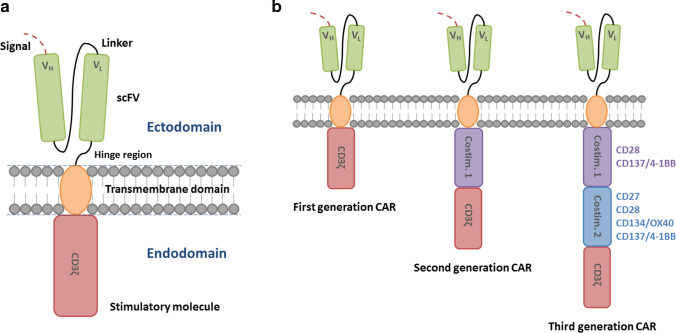
Fig. 1
Fig. 1
A Chimeric antigen receptor (CAR). CARs consist of four main components: the single-chain fragment variant (scFv), an extracellular spacer domain (hinge region), a transmembrane domain, and an intracellular signaling domain (stimulatory molecule: CD3ζ). VH, heavy chain variable region. VL, light chain variable region. B Evolution of chimeric antigen receptor (CAR). According to the evolution of CARs, the sophistication of the receptor has grown over time. They are referred to as the first, second, and third CARs, depending on the structure of their intracellular T cell region. Costim., costimulatory domain/element
Fig. 2
Fig. 2
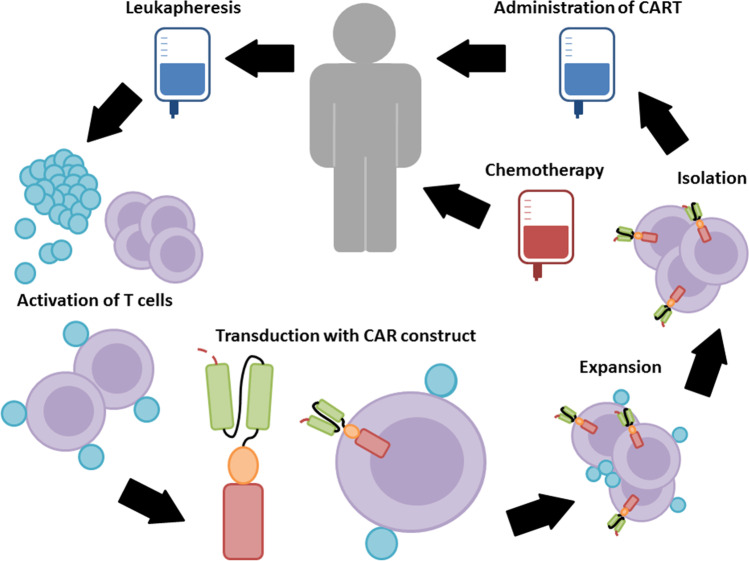
Manufacture of chimeric antigen receptor (CAR) T cells. Primarily, autologous T cells are isolated through leukapheresis and genetically modified ex vivo to express CARs, followed by the expansion in culture. After gene transfer of a CAR vector, the CAR T cells are expanded. Magnetic bead-based artificial antigen-presenting cells, which were used to activate T cells, are subsequently removed from the culture to isolate CAR T cells. The final CAR T cell culture is washed, concentrated, and subjected to end-of-process formulation with quality control testing and cryopreservation. Patients usually receive a lymphodepletion prior to the ultimate CAR T cell administration

References

    1. Rosenberg SA, Packard BS, Aebersold PM, et al. Use of tumor-infiltrating lymphocytes and interleukin-2 in the immunotherapy of patients with metastatic melanoma. A preliminary report. N Engl J Med. 1988;319:1676–1680. doi: 10.1056/NEJM198812223192527. - DOI - PubMed
    1. Billingham RE, Brent L, Medawar PB. Quantitative studies on tissue transplantation immunity. II. The origin, strength and duration of actively and adoptively acquired immunity. Proc R Soc Lond B Biol Sci. 1954;143:58–80. doi: 10.1098/rspb.1954.0054. - DOI - PubMed
    1. Mitchison NA. Studies on the immunological response to foreign tumor transplants in the mouse. I. The role of lymph node cells in conferring immunity by adoptive transfer. J Exp Med. 1955;102:157–177. doi: 10.1084/jem.102.2.157. - DOI - PMC - PubMed
    1. Kolb HJ, Mittermuller J, Clemm C, et al. Donor leukocyte transfusions for treatment of recurrent chronic myelogenous leukemia in marrow transplant patients. Blood. 1990;76:2462–2465. doi: 10.1182/blood.V76.12.2462.2462. - DOI - PubMed
    1. Sadelain M, Rivière I, Riddell S. Therapeutic T cell engineering. Nature. 2017;545:423–431. doi: 10.1038/nature22395. - DOI - PMC - PubMed

MeSH terms

Substances