


Academic service-learning nursing partnerships in the Americas: a scoping review
- PMID: 34556090
- PMCID: PMC8459147
- DOI: 10.1186/s12912-021-00698-w
Academic service-learning nursing partnerships in the Americas: a scoping review
Abstract
Background: Academic service-learning nursing partnerships (ASLNPs) integrate instruction, reflection, and scholarship with tailored service through enriched learning experiences that teach civic responsibility and strengthen communities, while meeting academic nursing outcomes.
Objective: This scoping review aimed to identify, appraise, and synthesize evidence of community focused ASLNPs that promote primary health care throughout the Americas region.
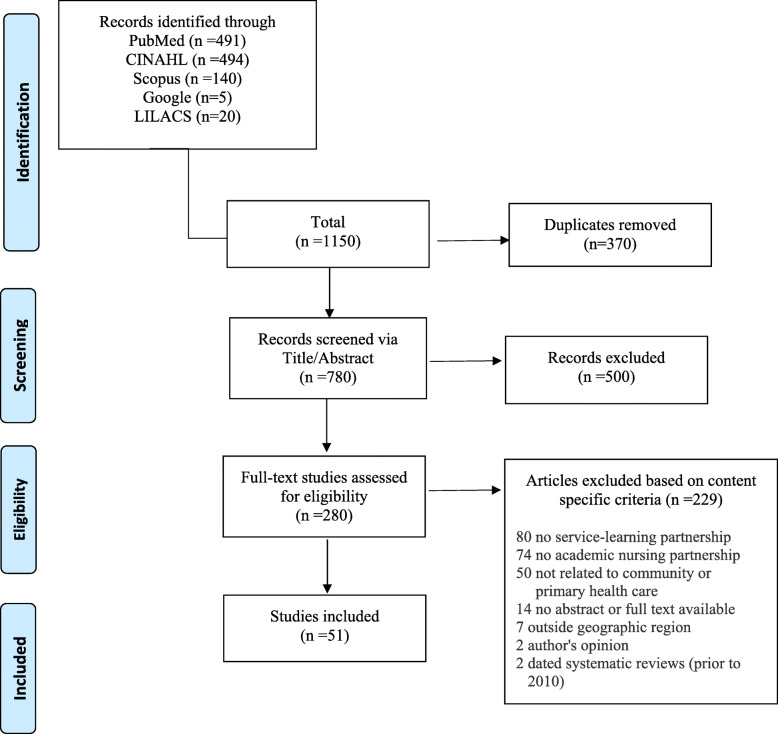
Methods: A systematic search of PubMed, CINAHL, Scopus, Google Scholar, and LILACS English-language databases was performed in accordance with PRISMA guidelines. Full-text articles published since 2010 were reviewed using an inductive thematic approach stemming from the "Advancing Healthcare Transformation: a New Era for Academic Nursing Report" and the Pan American Health Organization "Strategic Directions for Nursing."
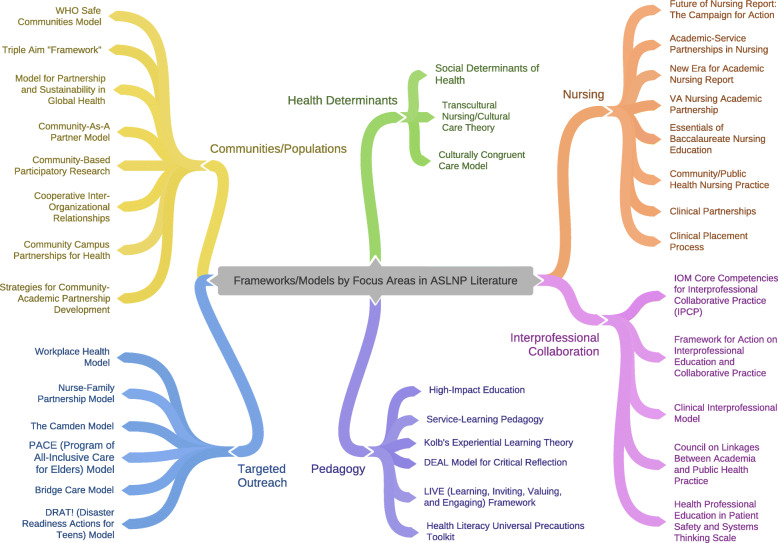
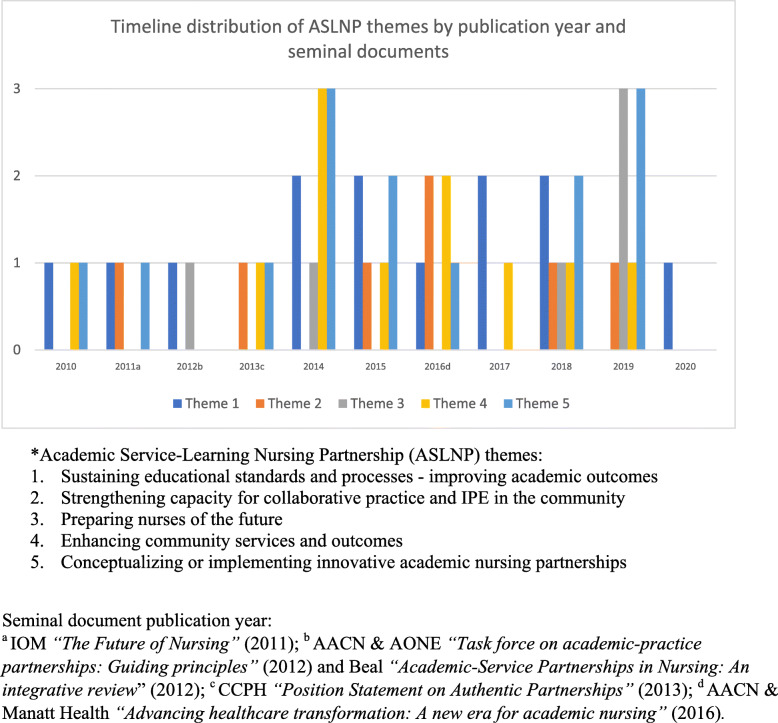
Results: A total of 51 articles were included with the vast majority 47 (92.1 %) representing North America. Structured, established relationships between an academic nursing institution or program and one or more community serving entities resulted in high levels of effectiveness and innovation across settings. Five themes emerged: (a) sustaining educational standards and processes - improving academic outcomes (25.5 %), (b) strengthening capacity for collaborative practice and interprofessional education (13.7 %), (c) preparing nurses of the future (11.8 %), (d) enhancing community services and outcomes (21.6 %), and (e) conceptualizing or implementing innovative academic nursing partnerships (27.4 %). A synthesis of conceptual frameworks and models revealed six focus areas: communities/populations (26.2 %), nursing (26.2 %), pedagogy (19 %), targeted outreach (14.3 %), interprofessional collaboration (11.9 %), and health determinants (9.5 %). A proliferation in US articles, triggered by nursing policy publications, was confirmed.
Conclusions: ASLNPs serve as mechanisms for nurses and faculty to develop and lead change across a wide variety of community settings and healthcare systems, develop scholarship, as well as for students to apply the knowledge and skills learned. Given the lack of geographically broad evidence, successes and challenges across U.S. partnerships should be viewed cautiously. Nevertheless, ASLNPs can play a critical role towards meeting the goal of universal health access and coverage through partnering with the education sector. Further investigation of grey literature as well as Spanish and Portuguese language literature from Latin American and Caribbean countries is highly recommended.
Keywords: Academic nursing; Americas; Community-based; Partnerships; Primary health care; Service-learning; Universal health.
© 2021. The Author(s).
Conflict of interest statement
AM is a Senior Editorial Board Member for BMC Nursing. Other co-authors declare no competing interests.
Figures

References
-
- Van de Ven AH. Engaged scholarship: a guide for organizational and social research. Oxford, U.K.: Oxford University Press; 2007.
-
- American Association of Colleges of Nursing-American Organization of Nurse Executives. Task force on academic-practice partnerships: Guiding principles: In; 2012. Available from: https://www.aacnnursing.org/Academic-Practice-Partnerships/The-Guiding-P.... Accessed: 10 Jan 2020.
-
- Institute of Medicine (US) Committee on the Robert Wood Johnson Foundation Initiative on the Future of Nursing, at the Institute of Medicine. The Future of Nursing: Leading Change, Advancing Health. Washington (DC): National Academies Press (US); 2011. Available from: https://www.ncbi.nlm.nih.gov/books/NBK209880/. 10.17226/12956. - PubMed
Publication types
LinkOut - more resources
Full Text Sources
