


Reasons for and Scenarios Associated with Failure to Cease Smoking: Results from a Qualitative Study Among Polish Smokers Who Had Unsuccessfully Attempted to Quit
- PMID: 34556977
- PMCID: PMC8453429
- DOI: 10.2147/PPA.S320798
Reasons for and Scenarios Associated with Failure to Cease Smoking: Results from a Qualitative Study Among Polish Smokers Who Had Unsuccessfully Attempted to Quit
Abstract
Purpose: Most smokers attempt to quit smoking, but few are successful. Data regarding the reasons for this relapse and the course of the relapse process may be helpful for determining efficient methods of smoking cessation. This study aimed to identify the causes of and scenarios associated with smoking relapse after effective smoking cessation.
Patients and methods: We conducted 20 semi-structured interviews with smokers who had previously unsuccessfully attempted to quit. The data underwent qualitative content analysis.
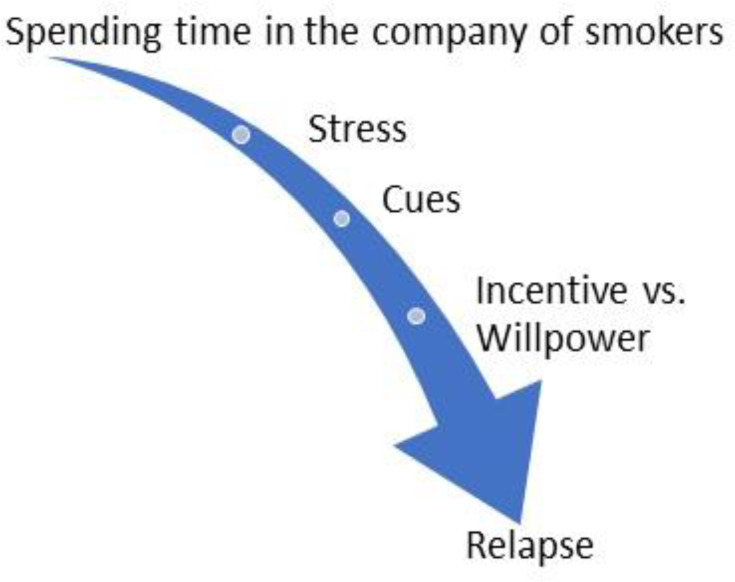
Results: Three major themes were identified: reasons for smoking relapse; smoking relapse scenarios; and perception of the influence of personal environments, including family and physicians, on refraining from smoking after cessation. The first theme comprised the following subthemes: insufficient willpower and self-discipline, contact with smokers, exposure to stressful situations, lack of family support, weight gain, and insufficient improvement in one's mental and physical well-being. The second theme contained enjoyable social events, professional life, critical events, and encouragement to smoke from family members. The respondents frequently emphasized the large role of interaction with other smokers.
Conclusion: The predominant factors underlying smoking relapse include insufficient willpower and self-discipline and exposure to stress. The most frequent relapse scenario concerned experiencing negative or positive emotions when interacting with other smokers.
Keywords: primary care; qualitative research; relapse; smoking cessation.
© 2021 Buczkowski et al.
Conflict of interest statement
The authors declare no conflicts of interest for this work.
Figures
References
-
- World Health Organization. Tobacco free initiative; 2019. Available from: https://www.who.int/news-room/fact-sheets/detail/tobacco. Accessed September11, 2021.
-
- World Health Organization. Global report. Mortality attributable to tobacco; 2012. Available from: https://apps.who.int/iris/bitstream/handle/10665/44815/9789241564434_eng.... Accessed September11, 2021.
LinkOut - more resources
Full Text Sources
