Review
. 2021 Sep 7:12:724033.
doi: 10.3389/fphar.2021.724033. eCollection 2021.

Gut Microbiota Modulation as a Potential Target for the Treatment of Lung Infections

Affiliations
Review

Gut Microbiota Modulation as a Potential Target for the Treatment of Lung Infections

Clênio Silva Cruz et al. Front Pharmacol. .

Abstract

The gastrointestinal and respiratory systems are colonized by a complex ecosystem of microorganisms called the microbiota. These microorganisms co-evolved over millions of years with the host, creating a symbiotic relationship that is fundamental for promoting host homeostasis by producing bioactive metabolites and antimicrobial molecules, and regulating the immune and inflammatory responses. Imbalance in the abundance, diversity, and function of the gut microbiota (known as dysbiosis) have been shown to increase host susceptibility to infections in the lungs, suggesting crosstalk between these organs. This crosstalk is now referred to as the gut-lung axis. Hence, the use of probiotics, prebiotics, and synbiotics for modulation of gut microbiota has been studied based on their effectiveness in reducing the duration and severity of respiratory tract infections, mainly owing to their effects on preventing pathogen colonization and modulating the immune system. This review discusses the role and responses of probiotics, prebiotics, and synbiotics in the gut-lung axis in the face of lung infections.

Keywords: gut-lung axis; immunobiotics; inflammation; microbiota; mucosal immmunity; prebiotcs; probiotics; symbiotics.


Conflict of interest statement

The authors declare that the research was conducted in the absence of any commercial or financial relationships that could be construed as a potential conflict of interest.

Figures
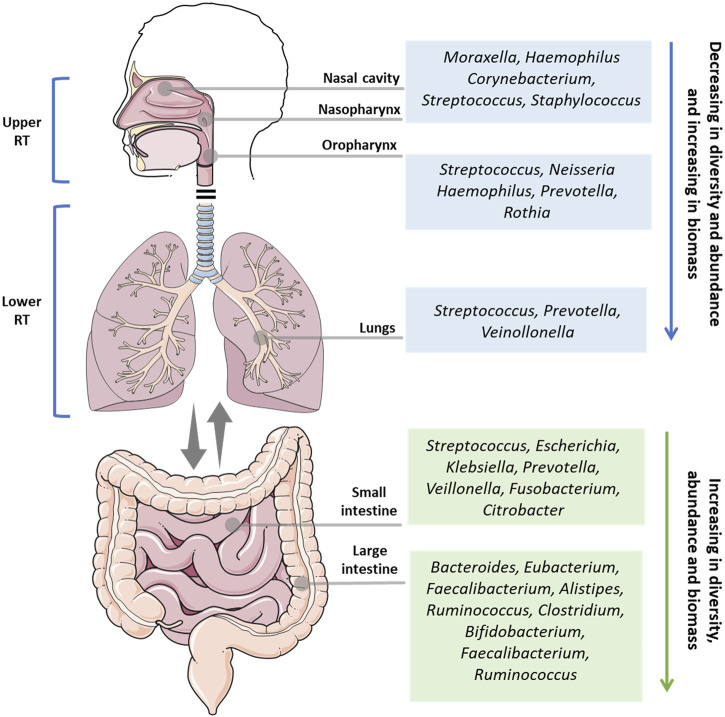
FIGURE 1
FIGURE 1
Overview of the main microbial genus in the health upper respiratory tract (nasal cavity, nasopharynx, oropharynx), lower respiratory tract (lungs), small intestine, and large intestine. RT: respiratory tract.
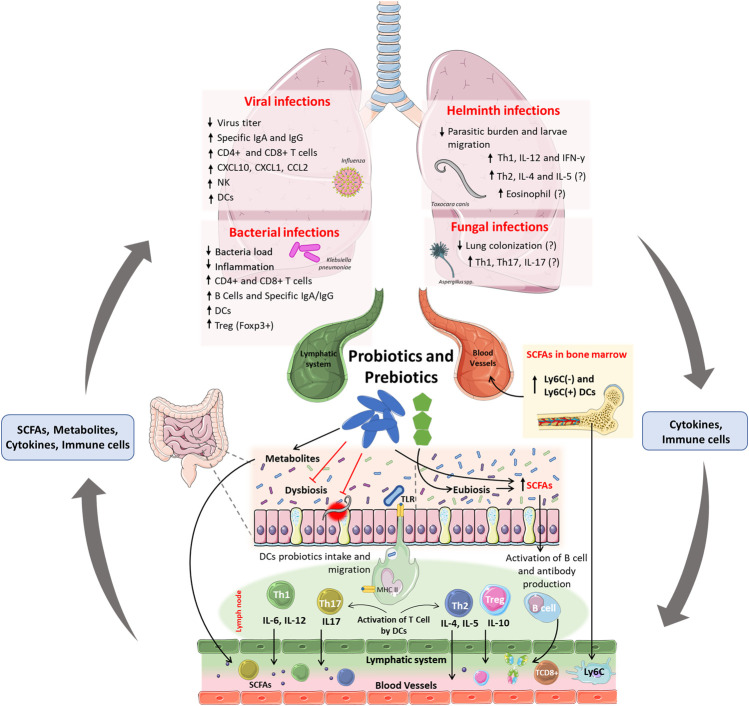
FIGURE 2
FIGURE 2
Effects and mainly mechanisms of probiotics and prebiotics in the gut-lung axis and context of respiratory infections. Probiotics and prebiotics administered orally can improve dysbiosis and induce eubiosis in the host, leading to an increase in SCFAs directly (produced by probiotics) or indirectly (produced by commensal microbiota). Furthermore, probiotics can also reduce the burden and epithelial damage induced by intestinal parasites. The uptake of probiotics by DCs in the intestinal submucosa, and their migration to lymph nodes, induces the activation and proliferation of Th1, Th2, Th17, Treg, and B cells. Activated T cells and B cells produce cytokines and antibodies, enter the circulatory and lymphatic systems, and reach the lungs, where they will increase resistance to infections caused by viruses, bacteria, and fungi. The fermentation of prebiotics and production of SCFAs increases the number of DCs precursors in the bone marrow and increases CD8+ T cells activity, that confer protection against infections in the lung. The immunomodulation demonstrated after the administration of probiotics and prebiotics may be linked to the reduced viral titer, bacterial colonization, parasite load, and migration in the lungs. Probiotic-induced immunomodulation can increase the frequency of dendritic cells and CD4+ and CD8+ T cells in the lungs against infections by viruses and bacteria and can increase specific IgG and IgM antibodies to these pathogens. Also, the increase in Treg cells may be related to the reduction of inflammation-induced lung damage. In parasitic infections, probiotics have been linked with increased frequency of Th1 and concentration of IL-12 and IFN-γ, which may justify the reduction in the parasite load and larvae migration in the lung. Because there are no scientific studies that demonstrate the reduction of lung colonization by fungi after oral administration of probiotics, is still unknow if the antimycotic potential from probiotics metabolites, as shown in vitro, could be applied in an in vivo system.

References

    1. Akuthota P., Weller P. F. (2012). Eosinophilic Pneumonias. Clin. Microbiol. Rev. 25, 649–660. 10.1128/CMR.00025-12 - DOI - PMC - PubMed
    1. Alvarez S., Herrero C., Bru E., Perdigon G. (2001). Effect of Lactobacillus Casei and Yogurt Administration on Prevention of Pseudomonas aeruginosa Infection in Young Mice. J. Food Prot. 64, 1768–1774. 10.4315/0362-028X-64.11.1768 - DOI - PubMed
    1. Antunes K. H., Fachi J. L., de Paula R., da Silva E. F., Pral L. P., dos Santos A. Á., et al. (2019). Microbiota-Derived Acetate Protects Against Respiratory Syncytial Virus Infection Through a GPR43-Type 1 Interferon Response. Nat. Commun. 10, 3273–3317. 10.1038/s41467-019-11152-6 - DOI - PMC - PubMed
    1. Avilada L. F. d. C. d. C. de., Conceição F. R., Telmo P. d. L., Dutra G. F., Santos D. G. d. l., Martins L. H. R., et al. (2012). Saccharomyces Boulardii Reduces Infection Intensity of Mice With Toxocariasis. Vet. Parasitol. 187, 337–340. 10.1016/j.vetpar.2012.01.002 - DOI - PubMed
    1. Bae J. Y., Kim J. I., Park S., Yoo K., Kim I. H., Joo W., et al. (2018). Effects of Lactobacillus Plantarum and Leuconostoc Mesenteroides Probiotics on Human Seasonal and Avian Influenza Viruses. J. Microbiol. Biotechnol. 28, 893–901. 10.4014/jmb.1804.04001 - DOI - PubMed

LinkOut - more resources