. 2021 Sep 21;7(1):dvab009.
doi: 10.1093/eep/dvab009. eCollection 2021.

Refraining from use diminishes cannabis-associated epigenetic changes in human sperm

Affiliations

Refraining from use diminishes cannabis-associated epigenetic changes in human sperm

Rose Schrott et al. Environ Epigenet. .

Abstract

Cannabis use alters sperm DNA methylation, but the potential reversibility of these changes is unknown. Semen samples from cannabis users and non-user controls were collected at baseline and again following a 77-day period of cannabis abstinence (one spermatogenic cycle). Users and controls did not significantly differ by demographics or semen analyses. Whole-genome bisulfite sequencing identified 163 CpG sites with significantly different DNA methylation in sperm between groups (P < 2.94 × 10⁻⁹). Genes associated with altered CpG sites were enriched with those involved in development, including cardiogenesis and neurodevelopment. Many of the differences in sperm DNA methylation between groups were diminished after cannabis abstinence. These results indicate that sustained cannabis abstinence significantly reduces the number of sperm showing cannabis-associated alterations at genes important for early development.

Keywords: DNA methylation; cannabis; development; epigenetics; sperm.


Figures

Figure 1:
Figure 1:
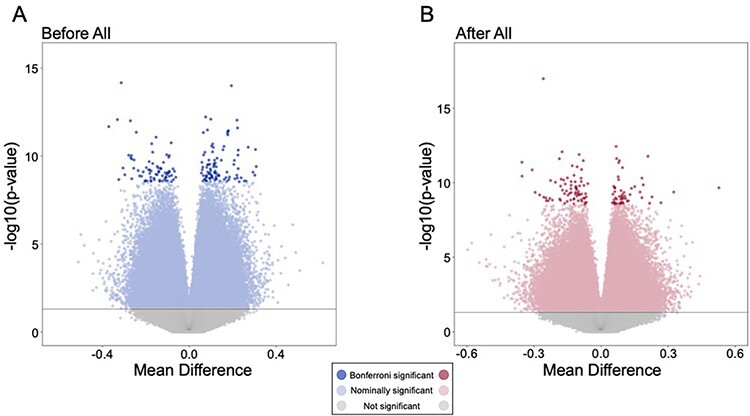
genes associated with differentially methylated CpG sites. (A) Differentially methylated CpG sites between users and controls before abstinence. Gray circles are non-significant, light blue circles are nominally significant, and dark blue circles are Bonferroni significant (n = 163, P < 2.94 × 10−9). (B) Differentially methylated CpG sites between users and controls after abstinence. Gray circles are non-significant, pink circles are nominally significant, and red circles are Bonferroni significant (n = 127, P < 2.94 × 10−9)
Figure 2:
Figure 2:
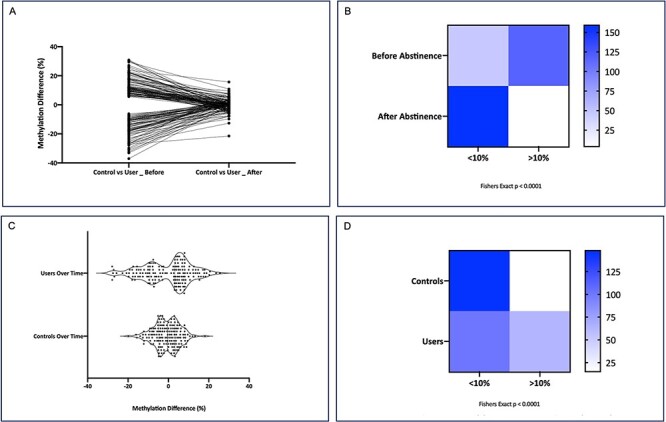
effect of abstinence on DNA methylation. (A) Methylation change over time between cannabis users (n = 18) and controls (n = 24). The methylation difference is plotted on the y-axis and the x-axis is the methylation difference at the 163 Bonferroni significant CpG sites between users and controls before and after abstinence. (B) Methylation changes were binned into <10% or >10% between users and controls both before and after abstinence. The distribution of the 163 CpG sites with a > 10% methylation difference between users and controls was significantly different before and after cannabis abstinence (Fisher’s exact P < 0.0001). (C) Violin plots show the distribution of methylation changes within groups over time. The width of the plot shows the density of the distribution of the datapoints. The median, 25th, and 75th quartiles are represented. (D) Methylation changes were binned into <10% or >10% methylation difference for users over time as well as controls over time. A Fisher’s exact test indicates that this distribution of the number of CpG sites with a > 10% methylation difference over time is significantly different between the users and controls (P < 0.0001)
Figure 3:
Figure 3:
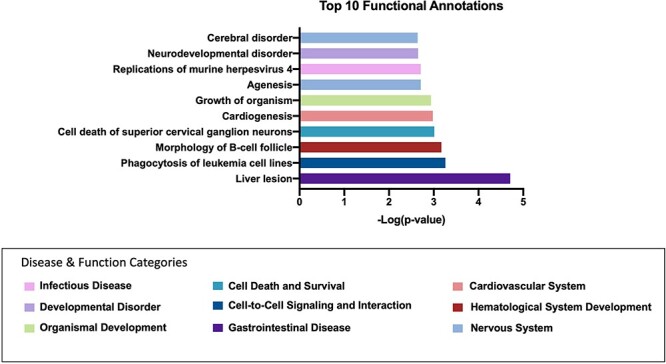
top IPA disease and function annotations for cannabis users compared to controls before abstinence. Graph of the top 10 most significant disease or function annotations associated with genes differentially methylated between cannabis users and controls before abstinence. y-Axis represents the annotation, x-axis is the−log of the P-value. The colors correspond to the category to which this disease or function was annotated (represented by the color legend at the bottom of the figure)
Figure 4:
Figure 4:
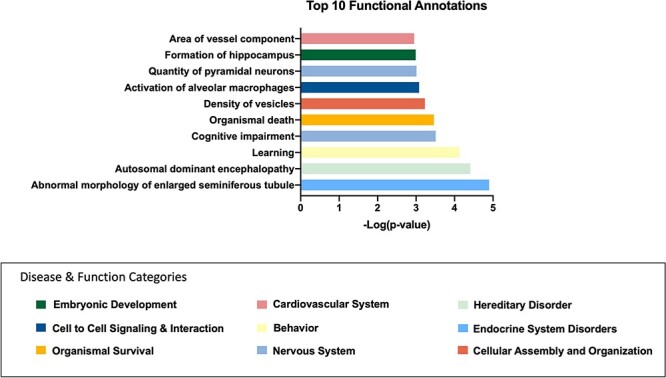
top IPA disease and function annotations for cannabis users compared to controls after abstinence. Graph of the top 10 most significant disease or function annotations associated with genes differentially methylated between cannabis users and controls after abstinence. y-Axis represents the annotation, x-axis is the−log of the P-value. The colors correspond to the category for which this disease or function was annotated to (represented by the color legend at the bottom of the figure)
Figure 5:
Figure 5:
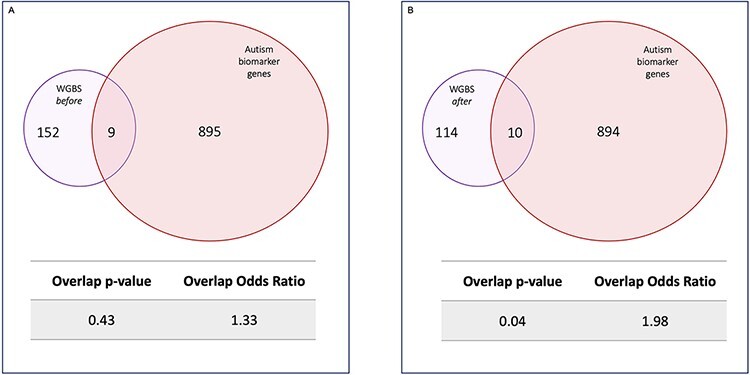
WGBS and autism epimutation biomarker gene overlap. Venn diagrams showing the number of differentially methylated genes in common between WGBS and a list of genes with methylation epimutations used as a biomarker panel for paternal risk of autism susceptibility. A nonsignificant overlap between (A) genes differentially methylated before abstinence and genes identified on the biomarker panel (P = 0.43, odds ratio = 1.33) and a significant overlap between (B) genes differentially methylated after abstinence and genes identified on the biomarker panel (P = 0.04, odds ratio = 1.98)

References

    1. Murphy SK, Itchon-Ramos N, Visco Z. et al.Cannabinoid exposure and altered DNA methylation in rat and human sperm. Epigenetics 2018;13:1208–21. - PMC - PubMed
    1. Schrott R, Acharya K, Itchon-Ramos N. et al.Cannabis use is associated with potentially heritable widespread changes in autism candidate gene DLGAP2 DNA methylation in sperm. Epigenetics 2020;15:161–73. - PMC - PubMed
    1. Holloway ZR, Hawkey AB, Pippin E. et al.Paternal factors in neurodevelopmental toxicology: THC exposure of male rats causes long-lasting neurobehavioral effects in their offspring. Neurotoxicology 2020;78:57–63. - PubMed
    1. Levin ED, Hawkey AB, Hall BJ. et al.Paternal THC exposure in rats causes long-lasting neurobehavioral effects in the offspring. Neurotoxicol Teratol 2019;74:106806. - PubMed
    1. Slotkin TA, Skavicus S, Levin ED. et al.Paternal Δ9-tetrahydrocannabinol exposure prior to mating elicits deficits in cholinergic synaptic function in the offspring. Toxicol Sci 2020;174:210–7. - PubMed