Review
. 2021 Mar 22;2(2):100098.
doi: 10.1016/j.xinn.2021.100098. eCollection 2021 May 28.

Intrinsic magnetic topological insulators

Affiliations
Review

Intrinsic magnetic topological insulators

Pinyuan Wang et al. Innovation (Camb). .

Abstract

Introducing magnetism into topological insulators breaks time-reversal symmetry, and the magnetic exchange interaction can open a gap in the otherwise gapless topological surface states. This allows various novel topological quantum states to be generated, including the quantum anomalous Hall effect (QAHE) and axion insulator states. Magnetic doping and magnetic proximity are viewed as being useful means of exploring the interaction between topology and magnetism. However, the inhomogeneity of magnetic doping leads to complicated magnetic ordering and small exchange gaps, and consequently the observed QAHE appears only at ultralow temperatures. Therefore, intrinsic magnetic topological insulators are highly desired for increasing the QAHE working temperature and for investigating topological quantum phenomena further. The realization and characterization of such systems are essential for both fundamental physics and potential technical revolutions. This review summarizes recent research progress in intrinsic magnetic topological insulators, focusing mainly on the antiferromagnetic topological insulator MnBi2Te4 and its family of materials.


Conflict of interest statement

The authors declare no competing interests.

Figures
None
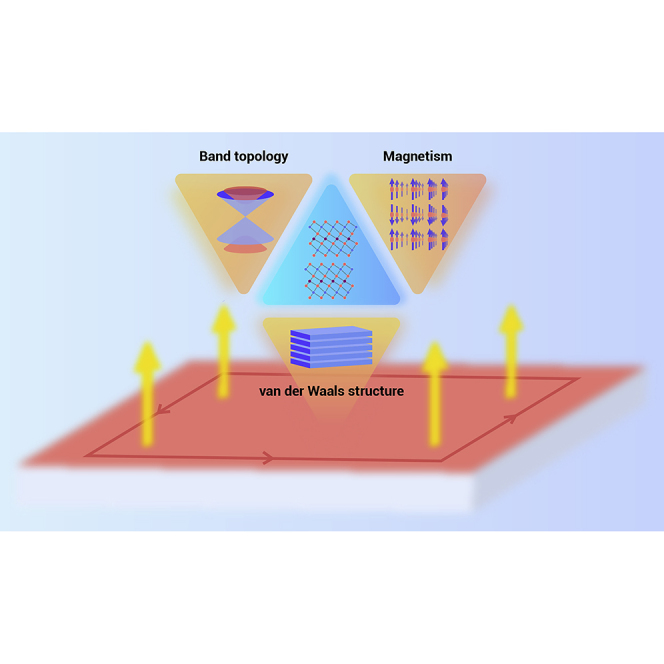
Graphical abstract
Figure 1
Figure 1
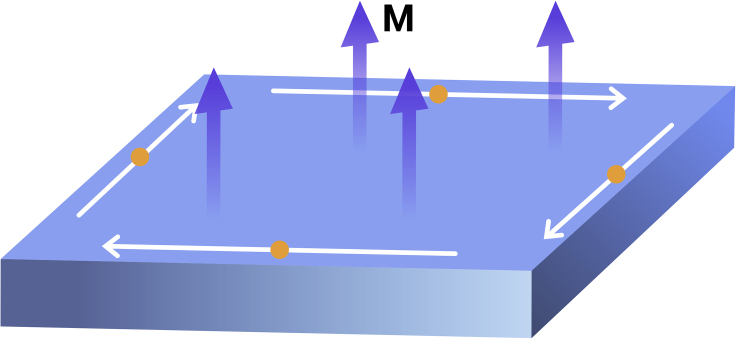
Schematic of quantum anomalous Hall effect Illustrated are the chiral edge states (denoted by the white arrows) of the quantum anomalous Hall insulator (QAHI) induced by magnetism (denoted by the blue arrows). When the Fermi level is tuned to the exchange gap, electronic transport is dominated by the edge state, which results in the quantum anomalous Hall effect (QAHE).
Figure 2
Figure 2
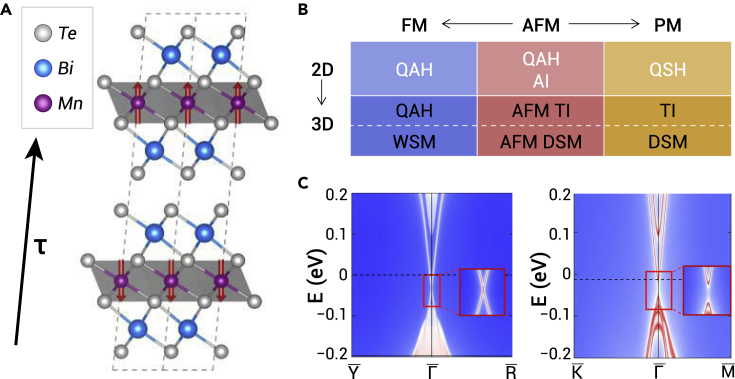
Crystal structures and calculated topological properties of MnBi2Te4 (A) The directions of the magnetic moments in each layer are represented by arrows; τ denotes the half-lattice translation operation; (B) various magnetic configurations (FM, ferromagnetism; AFM, antiferromagnetism; PM, paramagnetism) and corresponding topological states of thin-film and bulk MnBi2Te4 (MBT) (WSM, Weyl semimetal; DSM, Dirac semimetal; AI, axion insulator); (C) the top surface states open an exchange energy gap induced by magnetic moments under the AFM-z configuration, while all side surface states remain gapless due to equivalent time-reversal symmetry. Adapted from Li et al.
Figure 3
Figure 3
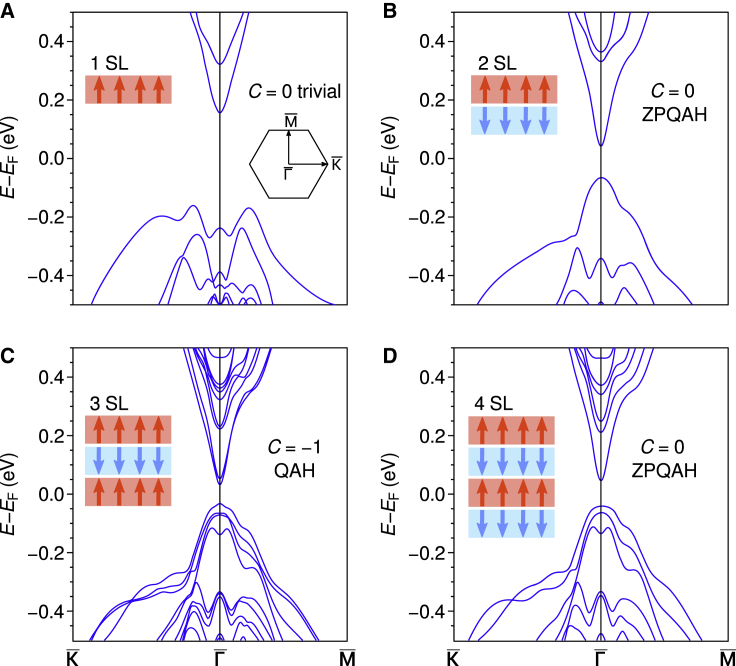
Calculated band structures of few-SL AFM MBT (A) Single-layer MBT is topologically trivial, whereas (B) two or (D) more even layers of MBT open a topologically nontrivial gap of around 100 meV that exhibits ZPQAH, and (C) three or more odd layers of MBT show QAHE. Adapted from Otrokov et al.
Figure 4
Figure 4
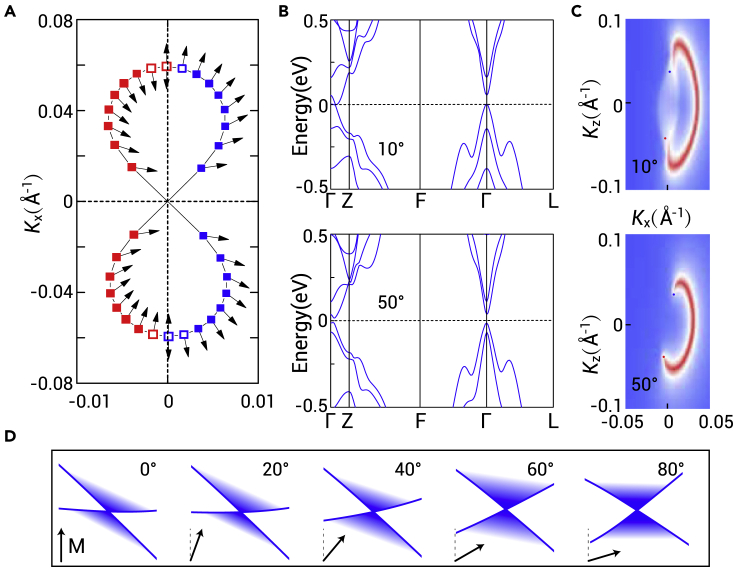
Topological phase transition of bulk FM MBT under external magnetic field (A) phase transition between type I WSMs (solid squares) and type II WSMs (open squares); Weyl points evolve in the kx–kz plane as the direction of the magnetic field (black arrows) rotates from the z axis to the x axis; calculated band structures of (B) bulk and (C) surface states of FM MBT with magnetic orientation angles of 10° (upper) and 50° (lower); (D) band dispersion around Weyl points in out-of-plane direction under distinct magnetic configurations with polar angle θ = 0°, 20°, 40°, 60°, and 80°; the Fermi level is denoted by the dashed line, and the tilted Weyl cone becomes upright gradually with increasing θ. Adapted from Li et al.
Figure 5
Figure 5
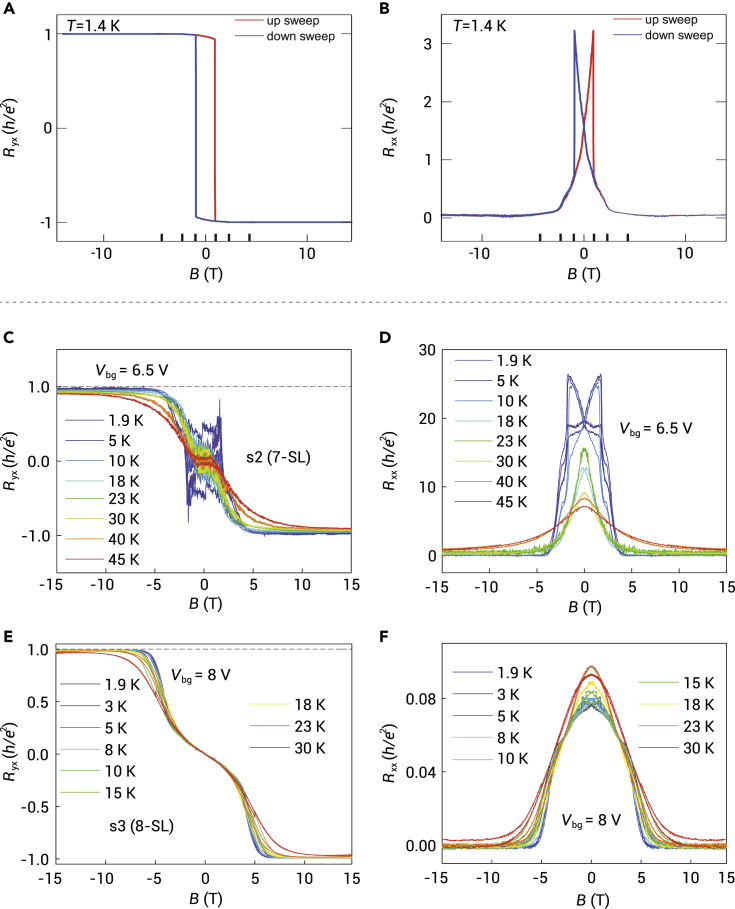
QAHE in MBT devices (A and B) QAHE at zero magnetic field in a five-SL MBT flake. Ryx and Rxx versus magnetic field as measured at 1.4 K. A nearly quantized Hall resistance of Ryx=0.97he2 is observed, and Rxx reaches 0.061he2. An even better Hall plateau of 0.998he2 is obtained as the magnetic field is increased up to 2.5 T. Adapted from Deng et al. (C and D) Temperature dependence of C = 1 Chern insulator states in a seven-SL MBT device; the nearly quantized Hall resistance plateau remains at temperatures as high as 45 K. (E and F) Temperature dependence of Ryx and Rxx versus magnetic field in an eight-SL MBT device; a well-defined quantized Hall resistance plateau survives up to 30 K. Adapted from Ge et al.
Figure 6
Figure 6
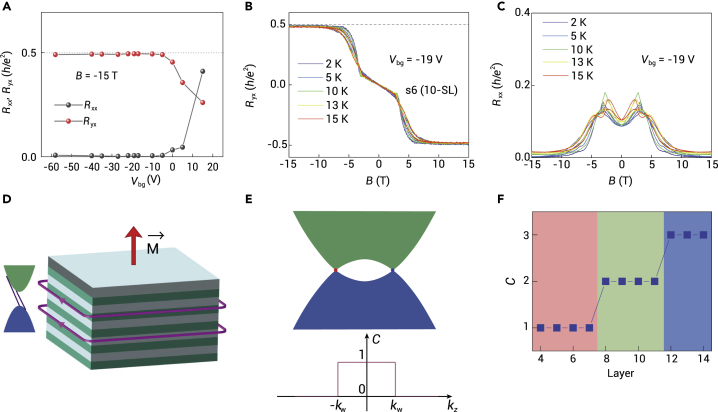
High-Chern-number Chern insulator states with C = 2 in a 10-SL MBT device (A) Rxx and Ryx as functions of back gate voltage at 2 K and −15 T, featured by a Hall resistance plateau of h/2e2 and vanishing Rxx at a back gate voltage of −58 V ≤ Vbg ≤ −10 V, indicating a Chern insulator with Chern number C = 2. (B and C) Temperature dependence of high-Chern-number Chern insulator states in ten-SL MBT device; Ryx and Rxx at different temperatures from 2 K to 15 K are shown as functions of the magnetic field strength; a Hall resistance plateau of 0.97h/2e2 survives to 13 K. (D) Schematic of high-Chern-number Chern insulator states with two chiral edge states across the band gap; gray and green indicate adjacent MBT SLs. (E) Illustration of band structure of bulk FM MBT, which is a magnetic WSM; the distance between the Weyl points at the Brillouin zone is 2kw, and the Chern number jumps at the positions of the Weyl points. (F) Calculated Chern number as a function of film thickness. Adapted from Ge et al.
Figure 7
Figure 7
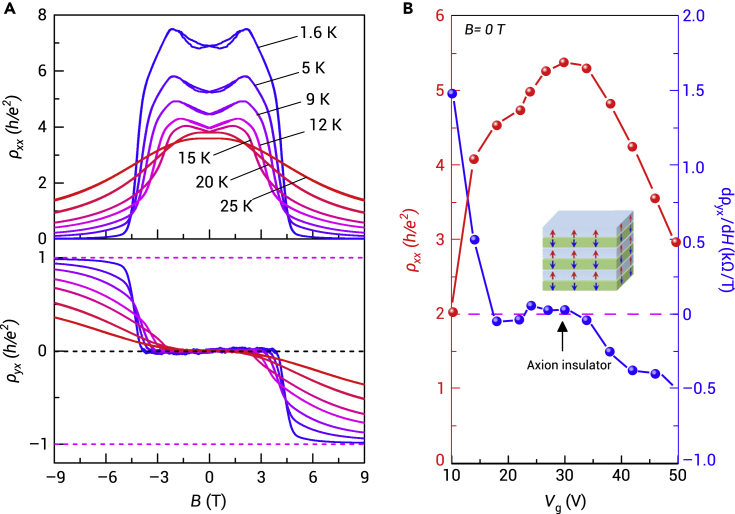
Magnetic-field-driven axion-insulator–Chern insulator transition in a six-SL MBT device (A) Longitudinal and Hall resistivities versus magnetic field strength at various temperatures with gate voltage Vg = 25 V. (B) Gate dependence of axion insulator state. Adapted from Liu et al.
Figure 8
Figure 8
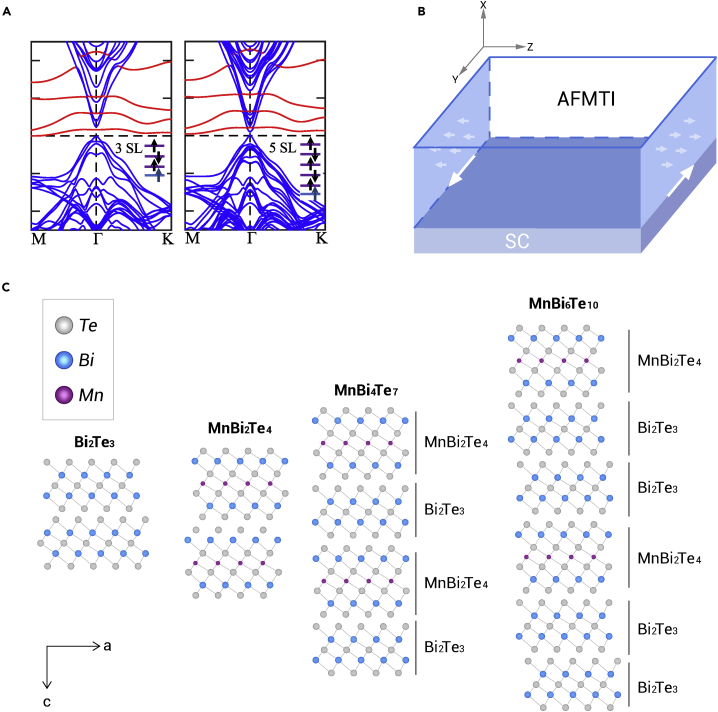
MBT heterojunctions and MBT family (A) Calculated band structures of one-SL to six-SL MBT thin films in proximity to a CrI3 layer; the blue lines represent MBT bands and the red lines represent Cr-eg bands; in the insets, the MBT layers and CrI3 monolayer are denoted by purple and blue layers, respectively; the results show that the CrI3 monolayer induces an exchange bias of around 40 meV, and the band topology of MBT is little affected; adapted from Fu et al. (B) Majorana hinge modes at the edge of the interface between an AFM TI (e.g., MBT) and an s-wave superconductor; the Majorana modes are indicated by blue and red arrows, and the easy axis of AFM is in the z direction; adapted fromPeng and Xu. (C) crystal structures of MBT family; the common structural characteristic is that one MBT SL is sandwiched by n Bi2Te3 quintuple layers; shown are the cases of n = 0 for MBT, n = 1 for MnBi4Te7, and n = 2 for MnBi6Te10.
Figure 9
Figure 9
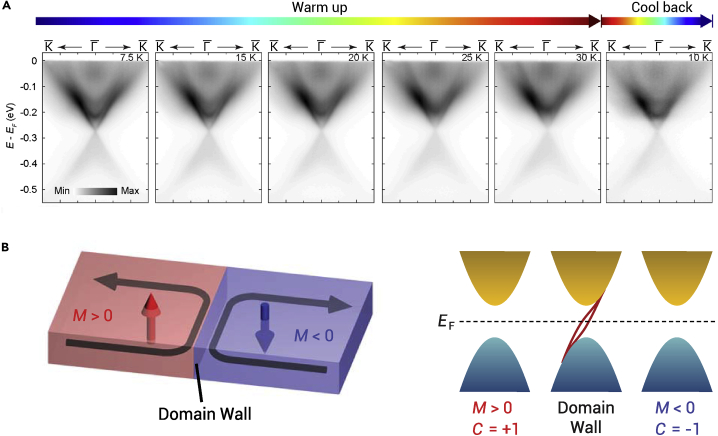
Observed gapless surface states in MBT and schematic of the domain wall scenario (A) Gapless surface states observed by ARPES at various temperatures. Adapted from Chen et al. (B) Magnetic moment fluctuation model, which considers that the magnetic moment fluctuation forms a series of disordered domains: boundary states can be formed between disordered domains with different moments, and these edge states provide the density of electronic states at the Dirac point. Adapted from Yasuda et al.

References

    1. Hasan M.Z., Kane C.L. Colloquium: topological insulators. Rev. Mod. Phys. 2010;82:3045.
    1. Klitzing K.V., Dorda G., Pepper M. New method for high-accuracy determination of the fine-structure constant based on quantized Hall resistance. Phys. Rev. Lett. 1980;45:494.
    1. Thouless D.J., Kohmoto M., Nightingale M.P., den Nijs M. Quantized Hall conductance in a two-dimensional periodic potential. Phys. Rev. Lett. 1982;49:405.
    1. Wang J. Quantum phenomena in topological materials. Sci. China Phys. Mech. Astron. 2020;63:127031.
    1. He K. MnBi2Te4-family intrinsic magnetic topological materials. NPJ Quantum Mater. 2020;5:1–4.

LinkOut - more resources