


mHealth Interventions for Lifestyle and Risk Factor Modification in Coronary Heart Disease: Randomized Controlled Trial
- PMID: 34559058
- PMCID: PMC8501404
- DOI: 10.2196/29928
mHealth Interventions for Lifestyle and Risk Factor Modification in Coronary Heart Disease: Randomized Controlled Trial
Abstract
Background: Self-management of lifestyle and cardiovascular disease risk factors is challenging in older patients with coronary heart disease (CHD). SMS text messaging could be a potential support tool for self-management and the most affordable and accessible method through a mobile phone. High-quality evidence had been lacking, and previous studies evaluated the effects of SMS text messaging on the subjective measures of short-term outcomes. Recently, a large-sized randomized controlled trial in Australia reported promising findings on the objective measures upon 6-month follow-up. However, an examination of the effectiveness of such interventions in an Asian population with unique demographic characteristics would be worthwhile.
Objective: This study examined the effectiveness of a 1-way SMS text messaging program to modify the lifestyle and cardiovascular disease risk factors of patients who underwent the first percutaneous coronary intervention (PCI).
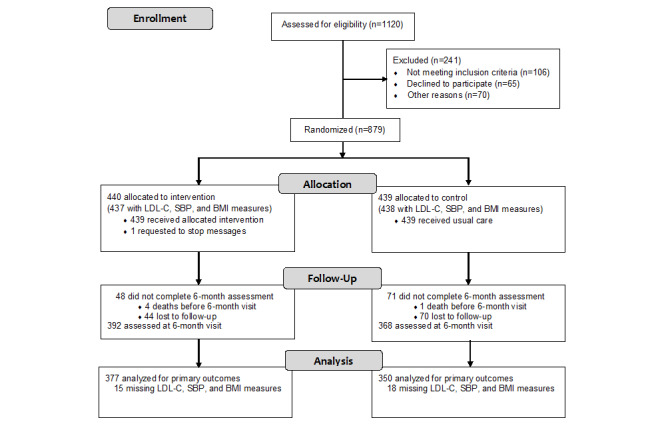
Methods: A parallel, single-blinded, 1:1 random allocation clinical trial was conducted with 879 patients treated through PCI. They were recruited during hospital admission from April 2017 to May 2020 at 2 university hospitals in the Republic of Korea. In addition to standard care, the intervention group received access to a supporting website and 4 SMS text messages per week for 6 months regarding a healthy diet, physical activity, smoking cessation, and cardiovascular health. Random allocation upon study enrollment and SMS text messaging after hospital discharge were performed automatically using a computer program. The coprimary outcomes were low-density-lipoprotein cholesterol (LDL-C), systolic blood pressure (SBP), and BMI. The secondary outcomes were change in lifestyle and adherence to the recommended health behaviors.
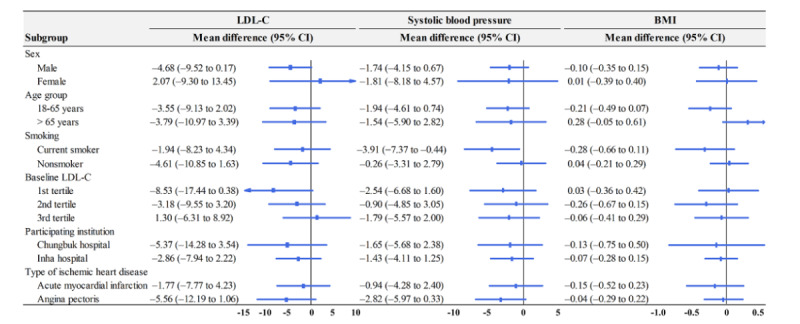
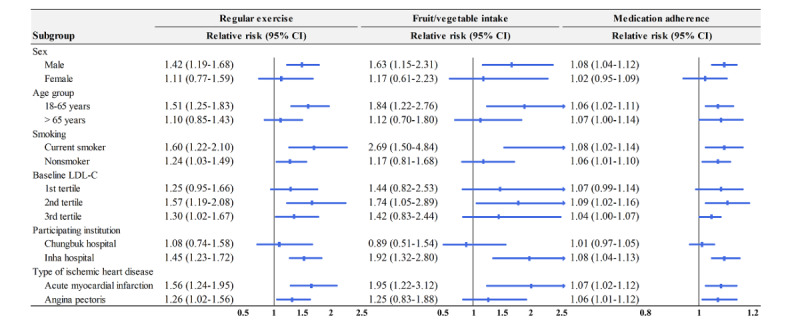
Results: Of the eligible population, 440 and 439 patients who underwent PCI were assigned to the intervention and control groups, respectively. The 1-way SMS text messaging program significantly enhanced physical activity (P=.02), healthy diet (P<.01), and medication adherence (P<.04) among patients with CHD. Hence, more people were likely to control their cardiovascular disease risk factors per the recommendations. The intervention group was more likely to control all 5 risk factors by 62% (relative risk 1.62, 95% CI 1.05-2.50) per the recommendations. On the other hand, physiological measures of the primary outcomes, including LDL-C levels, SBP, and BMI, were not significant. Most participants found the SMS text messaging program useful and helpful in motivating lifestyle changes.
Conclusions: Lifestyle-focused SMS text messages were effective in the self-management of a healthy diet, exercise, and medication adherence, but their influence on the physiological measures was not significant. One-way SMS text messages can be used as an affordable adjuvant method for lifestyle modification to help prevent the recurrence of cardiovascular disease.
Trial registration: Clinical Research Information Service (CRiS) KCT0005087; https://cris.nih.go.kr/cris/search/detailSearch.do/19282.
Keywords: coronary heart disease; lifestyle modification; mHealth; mobile health; prevention; text message.
©Jang-Whan Bae, Seoung-Il Woo, Joongyub Lee, Sang-Don Park, Sung Woo Kwon, Seong Huan Choi, Gwang-Seok Yoon, Mi-Sook Kim, Seung-Sik Hwang, Won Kyung Lee. Originally published in JMIR mHealth and uHealth (https://mhealth.jmir.org), 24.09.2021.
Conflict of interest statement
Conflicts of Interest: None declared.
Figures
References
-
- Heran BS, Chen JM, Ebrahim S, Moxham T, Oldridge N, Rees K, Thompson DR, Taylor RS. Exercise-based cardiac rehabilitation for coronary heart disease. Cochrane Database Syst Rev. 2011 Jul 06;(7):CD001800. doi: 10.1002/14651858.CD001800.pub2. http://europepmc.org/abstract/MED/21735386 - DOI - PMC - PubMed
-
- Cardiovascular diseases (CVDs) World Health Organization. 2021. [2021-09-07]. https://www.who.int/news-room/fact-sheets/detail/cardiovascular-diseases...
-
- Chow CK, Jolly S, Rao-Melacini P, Fox KA, Anand SS, Yusuf S. Association of diet, exercise, and smoking modification with risk of early cardiovascular events after acute coronary syndromes. Circulation. 2010 Feb 16;121(6):750–758. doi: 10.1161/CIRCULATIONAHA.109.891523.CIRCULATIONAHA.109.891523 - DOI - PubMed
-
- Beratarrechea A, Lee AG, Willner JM, Jahangir E, Ciapponi A, Rubinstein A. The impact of mobile health interventions on chronic disease outcomes in developing countries: a systematic review. Telemed J E Health. 2014 Jan;20(1):75–82. doi: 10.1089/tmj.2012.0328. http://europepmc.org/abstract/MED/24205809 - DOI - PMC - PubMed
Publication types
MeSH terms
LinkOut - more resources
Full Text Sources
Medical
Miscellaneous
