


Reverse shoulder arthroplasty in complex fractures of the proximal humerus: results after 7 years of follow-up
- PMID: 34559320
- PMCID: PMC8463641
- DOI: 10.1186/s10195-021-00597-5
Reverse shoulder arthroplasty in complex fractures of the proximal humerus: results after 7 years of follow-up
Abstract
Background: There is still little information about the long-term results of clinical and radiological evolution in patients older than 65 years with complex proximal humerus fractures (CPHF) treated acutely with reverse shoulder arthroplasty (RSA). The aim of this paper was to evaluate function and results 7 years after surgery.
Material and methods: A prospective cross-sectional cohort study was designed for this purpose. Patients who underwent RSA surgery during 2012 because of a CPHF were included. The surgical approach was randomized (deltopectoral vs anterosuperior). Functional activity, evolution of tuberosities and evidence of scapular notching 7 years after surgery were analyzed.
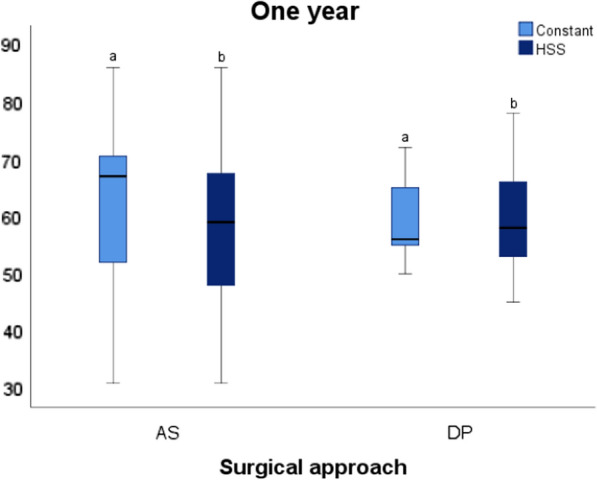
Results: After evaluating 32 patients, the Constant score improved from 64.83 in the first year to 69.54 at 7 years postoperative. Results were independent of the approach used. Functional outcomes were poorer in patients with scapular notching and when tuberosities were resorbed or displaced.
Conclusions: At 7 years, function in patients undergoing RSA after CPHF demonstrated improvement in all patients except those who developed scapular notching or when tuberosities did not consolidate in an anatomical position. These results are completely independent of the approach used.
Level of evidence: III Controlled cohort study.
Keywords: Elderly patient; Outcomes; Proximal humerus fracture; Reverse shoulder arthroplasty; Scapular notching.
© 2021. The Author(s).
Conflict of interest statement
The authors declare that they have no competing interests.
Figures


References
-
- Kaisidis A, Pantos PG, Heger H, et al. Reverse shoulder arthroplasty for the treatment of three and four part fractures of the proximal humerus in patients older than 75 years old. Acta Orthop Belg. 2014;80:99–105. - PubMed
MeSH terms
LinkOut - more resources
Full Text Sources
Medical
Research Materials
