


Offer Acceptance Patterns for Liver Donors Aged 70 and Older
- PMID: 34559954
- PMCID: PMC9627749
- DOI: 10.1002/lt.26309
Offer Acceptance Patterns for Liver Donors Aged 70 and Older
Abstract
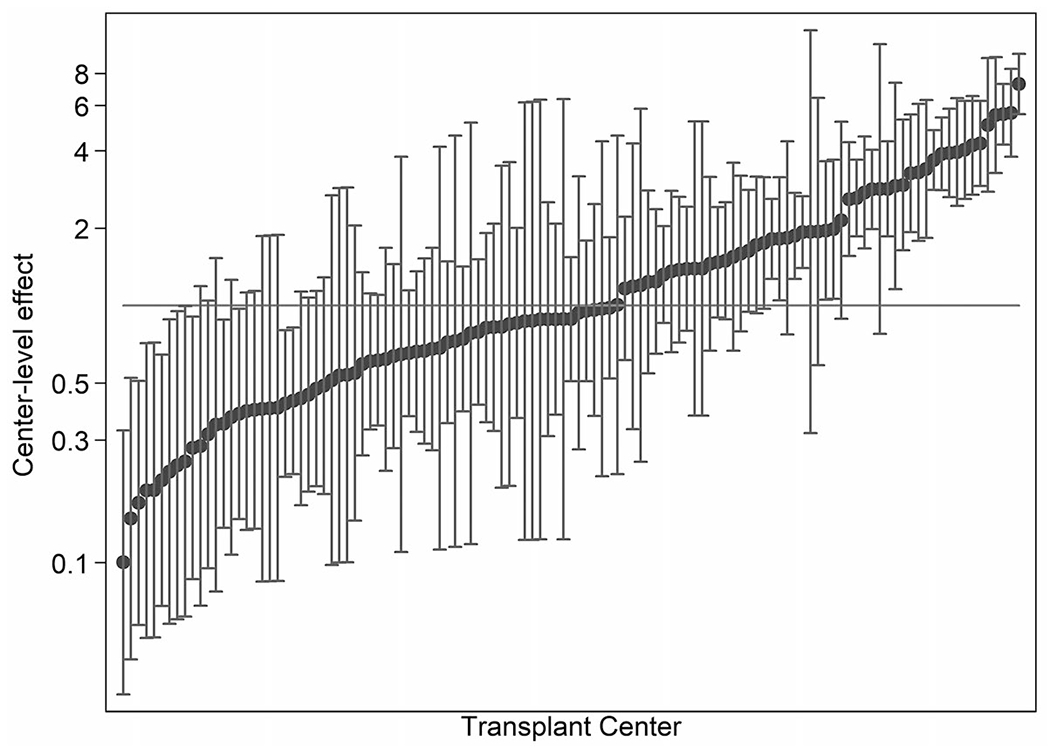
Despite a documented survival benefit, older liver donor (OLD, age ≥70) graft offers are frequently declined, with utilization worsening over the last decade. To understand how offer acceptance varies by center, we studied 1113 eventually transplanted OLD grafts from 2009 to 2017 using Scientific Registry of Transplant Recipients (SRTR) data and random-intercept multilevel logistic regression. To understand how center-level acceptance of OLD graft offers might be associated with waitlist and posttransplant outcomes, we studied all adult, actively listed, liver-only candidates and recipients during the study period using Poisson regression (transplant rate), competing risks regression (waitlist mortality), and Cox regression (posttransplant mortality). Among 117 centers, OLD offer acceptance ranged from 0 (23 centers) to 95 acceptances, with a median odds ratio of 2.88. Thus, a candidate may be three times as likely to receive an OLD graft simply by listing at a different center. Centers in the highest quartile (Q4) of OLD acceptance (accepted 39% of OLD offers) accepted more nationally shared organs (Q4 versus Q1: 14.1% versus 0.0%, P < 0.001) and had higher annual liver transplant volume (Q4 versus Q1: 80 versus 21, P < 0.001). After adjustment, nationally shared OLD offers (adjusted odds ratio [aOR]: 0.16, 95% confidence interval [CI]: 0.13-0.20) and offers to centers with higher median Model for End-Stage Liver Disease (MELD) at transplant (aOR: 0.74, 95% CI: 0.62-0.87) were less likely to be accepted. OLD offers to centers with higher annual transplant volume were more likely to be accepted (aOR: 1.21, 95% CI: 1.14-1.30). Additionally, candidates listed at centers within the highest quartile of OLD graft offer acceptance had higher deceased donor liver transplantation (DDLT) rates (adjusted incidence rate ratio: 1.45, 95% CI: 1.41-1.50), lower waitlist mortality (adjusted subhazard ratio: 0.76, 95% CI: 0.72-0.76), and similar posttransplant survival (adjusted hazard ratio: 0.93, 95% CI: 0.86-1.01) when compared with those listed at centers in the lowest quartile of OLD graft offer acceptance. The wide variation in OLD offer acceptance supports the need for optimizing the organ offer process and efficiently directing OLD offers to centers more likely to use them.
Copyright © 2021 American Association for the Study of Liver Diseases.
Conflict of interest statement
Potential conflict of interest: Nothing to report.
Figures


References
-
- Halazun KJ, Rana AA, Fortune B, Quillin RC, Verna EC, Samstein B, et al. No country for old livers? Examining and optimizing the utilization of elderly liver grafts. Am J Transplant 2018;18:669–678. - PubMed
-
- Croome KP, Lee DD, Keaveny AP, Taner CB. Noneligible donors as a strategy to decrease the organ shortage. Am J Transplant 2017;17:1649–1655. - PubMed
Publication types
MeSH terms
Grants and funding
LinkOut - more resources
Full Text Sources
Medical
