. 2021 Nov:157:308-347.
doi: 10.1016/j.ejca.2021.07.039. Epub 2021 Sep 21.

The European cancer burden in 2020: Incidence and mortality estimates for 40 countries and 25 major cancers

Affiliations

The European cancer burden in 2020: Incidence and mortality estimates for 40 countries and 25 major cancers

Tadeusz Dyba et al. Eur J Cancer. 2021 Nov.

Abstract

Introduction: Europe is an important focus for compiling accurate and up-to-date world cancer statistics owing to its large share of the world's total cancer burden. This article presents incidence and mortality estimates for 25 major cancers across 40 individual countries within European areas and the European Union (EU-27) for the year 2020.

Methods: The estimated national incidence and mortality rates are based on statistical methodology previously applied and verified using the most recently collected incidence data from 151 population-based cancer registries, mortality data and 2020 population estimates.

Results: Estimates reveal 4 million new cases of cancer (excluding non-melanoma skin cancer) and 1.9 million cancer-related deaths. The most common cancers are: breast in women (530,000 cases), colorectum (520,000), lung (480,000) and prostate (470,000). These four cancers account for half the overall cancer burden in Europe. The most common causes of cancer deaths are: lung (380,000), colorectal (250,000), breast (140,000) and pancreatic (130,000) cancers. In EU-27, the estimated new cancer cases are approximately 1.4 million in males and 1.2 million in females, with over 710,000 estimated cancer deaths in males and 560,000 in females.

Conclusion: The 2020 estimates provide a basis for establishing priorities in cancer-control measures across Europe. The long-established role of cancer registries in cancer surveillance and the evaluation of cancer control measures remain fundamental in formulating and adapting national cancer plans and pan-European health policies. Given the estimates are built on recorded data prior to the onset of coronavirus disease 2019 (COVID-19), they do not take into account the impact of the pandemic.

Keywords: Cancer; Cancer registries; Estimation; Europe; Incidence; Mortality.


Conflict of interest statement

Conflict of interest statement None declared.

Figures
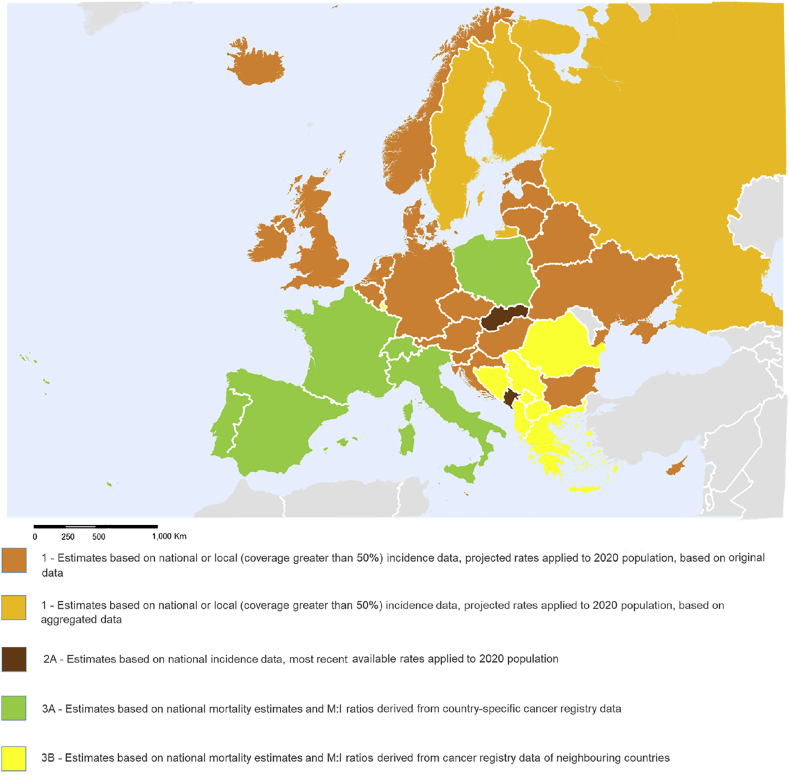
Fig. 1
Fig. 1
Methods of estimation for 2020 incidence in Europe. © European Union, 2016. Map produced by EC-JRC. The boundaries and the names shown on this map do not imply official endorsement or acceptance by the European Union.
Fig. 2
Fig. 2
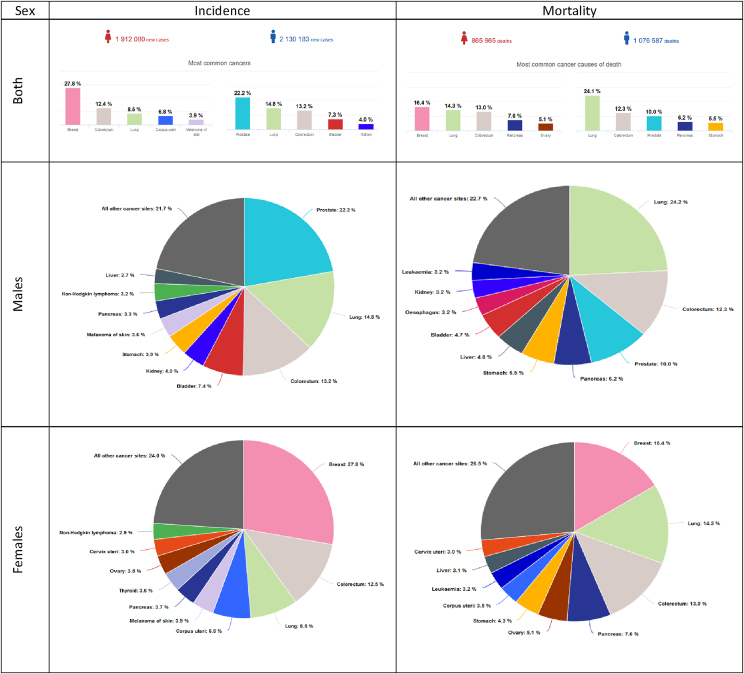
Total number and distribution of the estimated cases and deaths for the 5 (in the bar charts) or 10 (in the pie charts) most common cancers in Europe for 2020 by sex. For each sex, the area of the bars and pie charts reflects the proportion of the total number of cases or deaths.
Fig. 3
Fig. 3
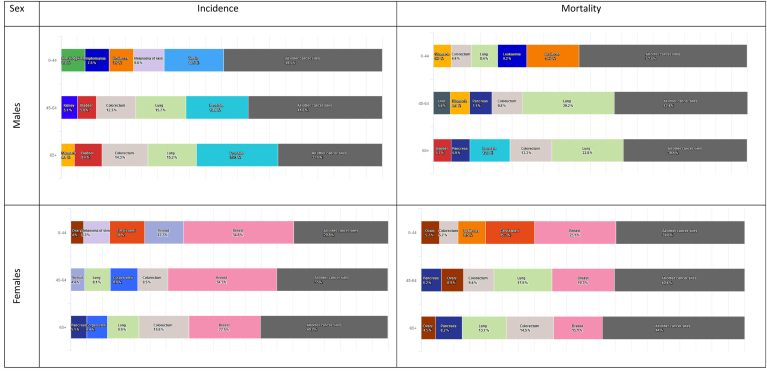
Cancer incidence and mortality percentage distribution by age group and sex in Europe for 2020.
Fig. 4
Fig. 4
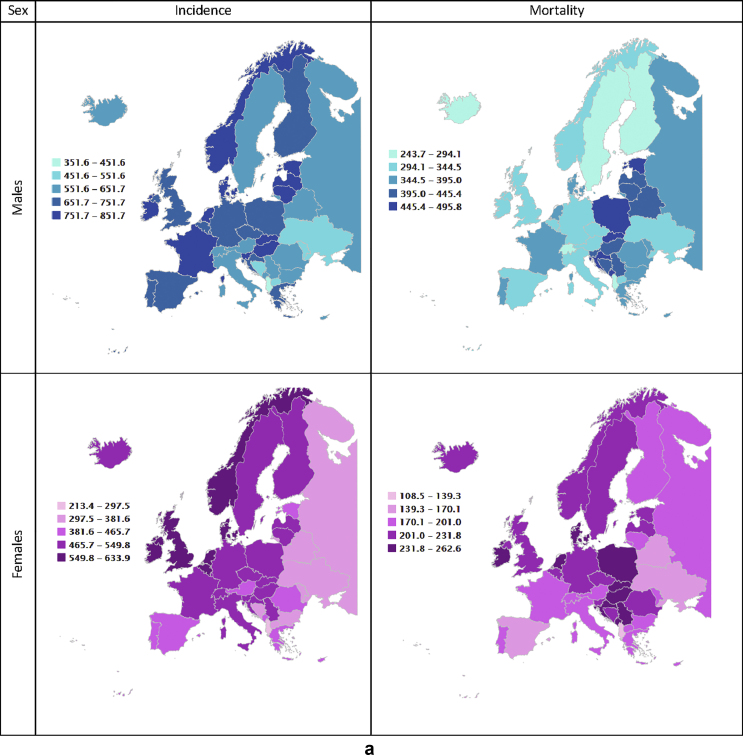
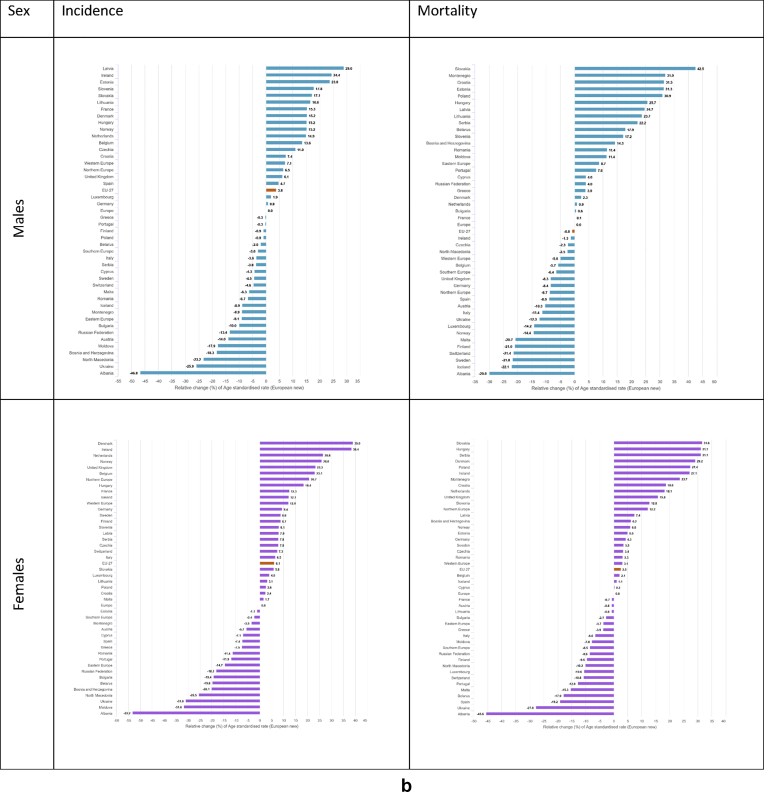
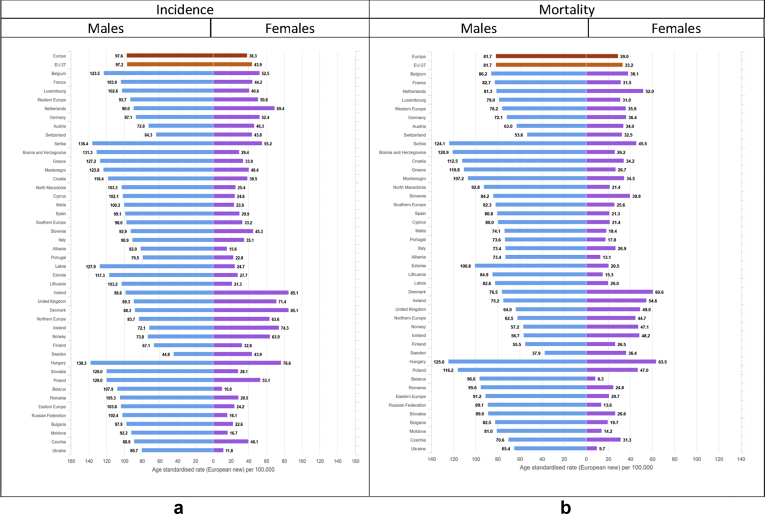
a: Age-standardised rates∗ (per 100,000) for all cancers excluding non-melanoma skin cancers by country and sex in Europe for 2020. b: Relative difference (percent) in age-standardised incidence and mortality rates for all cancers excluding non-melanoma skin cancers by country and sex in Europe for 2020, using the European average rate as reference. ∗European standard population 2013, based on estimated number of new cases or deaths.
Fig. 4
Fig. 4
a: Age-standardised rates∗ (per 100,000) for all cancers excluding non-melanoma skin cancers by country and sex in Europe for 2020. b: Relative difference (percent) in age-standardised incidence and mortality rates for all cancers excluding non-melanoma skin cancers by country and sex in Europe for 2020, using the European average rate as reference. ∗European standard population 2013, based on estimated number of new cases or deaths.
Fig. 5
Fig. 5
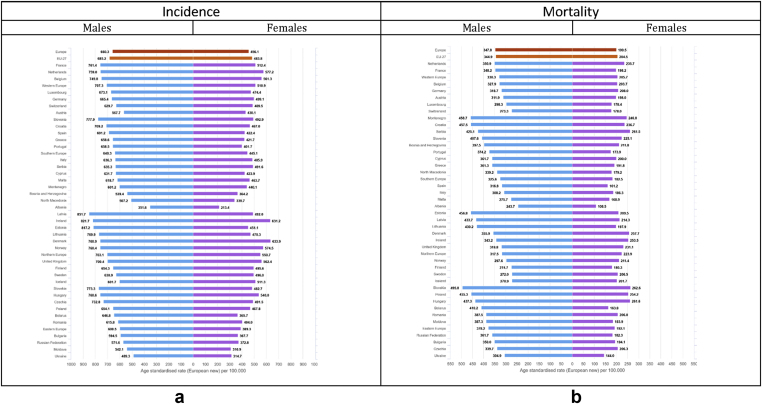
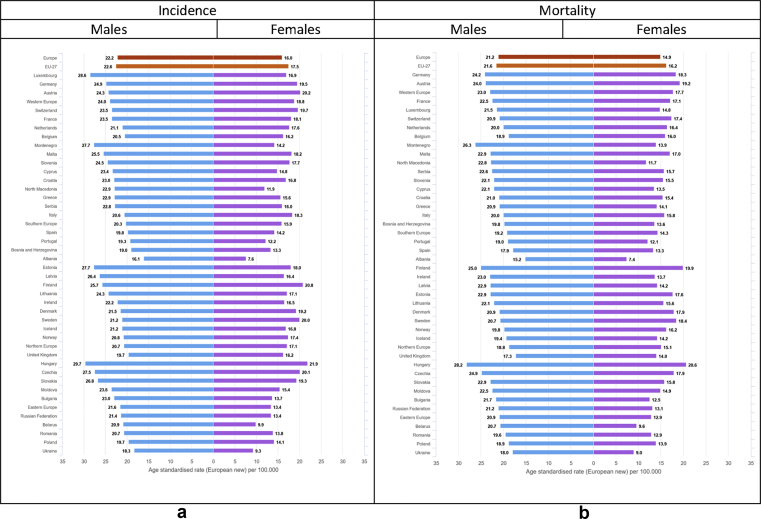
(a) Age-standardised incidence rates∗ (per 100,000) by sex, area and country in Europe for 2020 for all cancers excluding non-melanoma skin cancers. (b) Age-standardised mortality rates∗ (per 100,000) by sex, area and country in Europe for 2020 for all cancers excluding non-melanoma skin cancers. ∗European standard population 2013, based on estimated number of new cases or deaths.
Fig. 6
Fig. 6
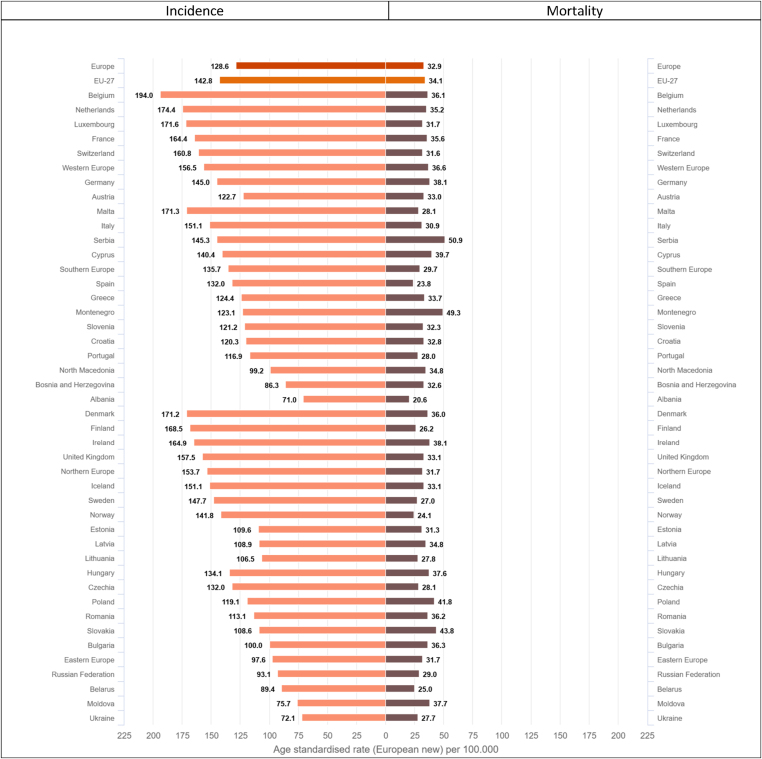
Age-standardised incidence and mortality rates∗ (per 100,000) by area and country in Europe for 2020 for breast cancer. ∗European standard population 2013, based on estimated number of new cases or deaths.
Fig. 7
Fig. 7
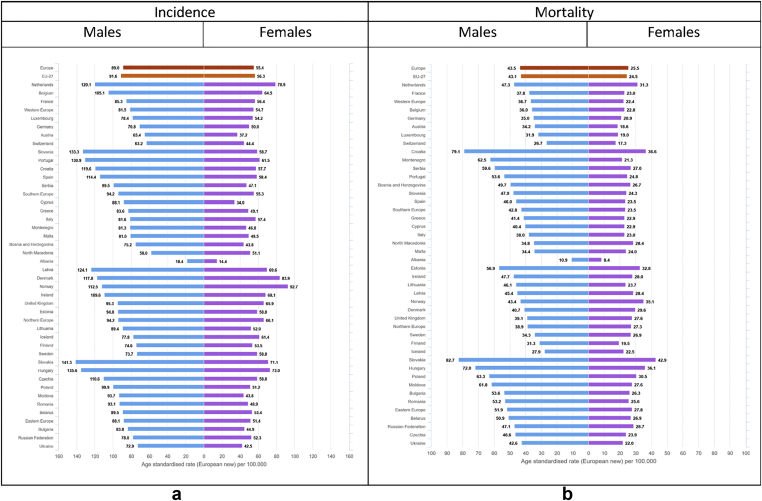
(a) Age-standardised incidence rates∗ (per 100,000) by sex, area and country in Europe for 2020 for colorectal cancer. (b) Age-standardised mortality rates∗ (per 100,000) by sex, area and country in Europe for 2020 for colorectal cancer. ∗European standard population 2013, based on estimated number of new cases or deaths.
Fig. 8
Fig. 8
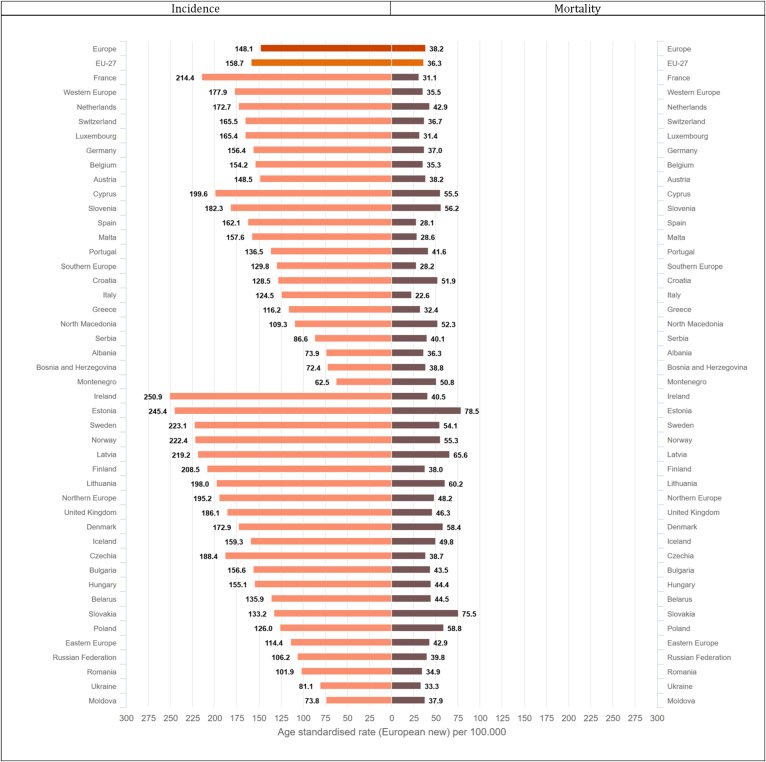
Age-standardised incidence and mortality rates∗ (per 100,000) by area and country in Europe for 2020 for prostate cancer. ∗European standard population 2013, based on estimated number of new cases or deaths.
Fig. 9
Fig. 9
(a) Age-standardised incidence rates∗ (per 100,000) by sex, area and country in Europe for 2020 for lung cancer. (b) Age-standardised mortality rates∗ (per 100,000) by sex, area and country in Europe for 2020 for lung cancer. ∗European standard population 2013, based on estimated number of new cases or deaths.
Fig. 10
Fig. 10
(a) Age-standardised incidence rates∗ (per 100,000) by sex, area and country in Europe for 2020 for pancreatic cancer. (b) Age-standardised mortality rates∗ (per 100,000) by sex, area and country in Europe for 2020 for pancreatic cancer. ∗European standard population 2013, based on estimated number of new cases or deaths.

References

    1. Eurostat. Causes of Death statistics (hlth_cd_asdr2). Available at: https://ec.europa.eu/eurostat/web/main/data/database. [Last accessed 1 April 2021].
    1. Ferlay J., Colombet M., Soerjomataram I., Mathers C., Parkin D.M., Piñeros M. Estimating the global cancer incidence and mortality in 2018: GLOBOCAN sources and methods. Int J Canc. 2019;144(8):1941–1953. doi: 10.1002/ijc.31937. Epub 2018 Dec 6. PMID: 30350310. - DOI - PubMed
    1. United Nations, Population division. World Population Prospects, the 2017 revision. https://esa.un.org/unpd/wpp/. [Accessed March 2021].
    1. Hofmarcher T., Lindgren P., Wilking N., Jönsson B. The cost of cancer in Europe 2018. Eur J Canc. 2020;129:41–49. doi: 10.1016/j.ejca.2020.01.011. Epub 2020 Feb 28. PMID: 32120274. - DOI - PubMed
    1. Jensen O.M., Estève J., Møller H., Renard H. Cancer in the European Community and its member states. Eur J Canc. 1990;26(11–12):1167–1256. doi: 10.1016/0277-5379(90)90278-2. Erratum in: Eur J Cancer 1991;27(12):1717. PMID: 2150000. - DOI - PubMed