


Dissociated Responses in Patients with Metastatic Solid Tumors Treated with Immunotherapy
- PMID: 34562258
- PMCID: PMC8602606
- DOI: 10.1007/s40268-021-00362-3
Dissociated Responses in Patients with Metastatic Solid Tumors Treated with Immunotherapy
Abstract
Background: Immune checkpoint inhibitors have been demonstrated to improve overall survival. Atypical patterns of response have been reported, including dissociated response (DR). We evaluated the prevalence of DR.
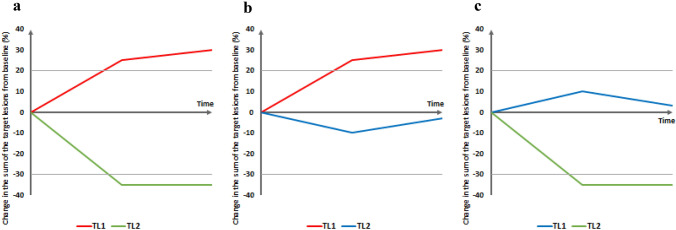
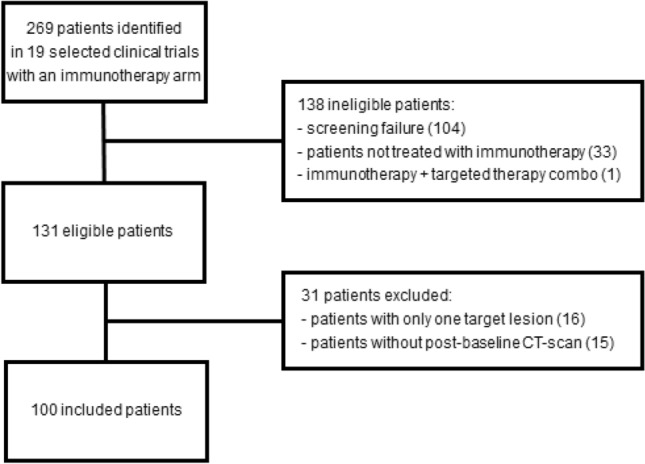
Patients and methods: Patients had to have a baseline computed tomography (CT) scan and at least one follow-up CT scan and two target lesions (TLs). Three types of DR were evaluated using RECIST1.1: DR1, defined as at least one progressive and one responding TL; DR2, defined as at least one progressive and one stable TL; and DR3, defined as at least one stable and one responding TL.
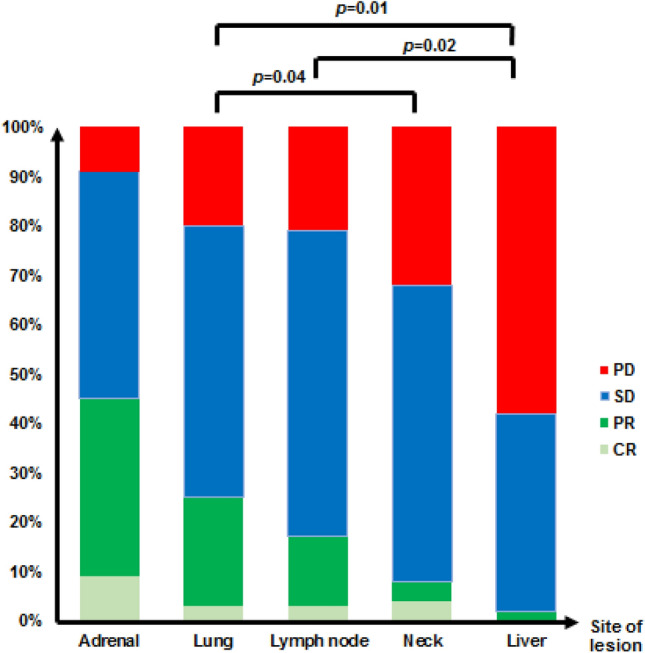
Results: A total of 1244 measurements of 272 TLs were performed in 100 patients. Forty-nine out of the 272 TLs (18%) had received old or recent radiotherapy, and 42 (15%) had been biopsied. An objective response was observed in 22 patients (22%) and on 52 TLs (19%). DR1 were observed in 8% of patients. At the tumor measurement level, the response rate was lower in the case of prior radiotherapy (29% vs 34%, p = 0.01) and higher in the case of prior biopsy (40% vs 32%, p = 0.02).
Conclusions: A DR was observed in 8% of patients. Response rate was lower in the case of prior radiotherapy and higher in the case of prior biopsy.
© 2021. The Author(s).
Conflict of interest statement
Christophe Le Tourneau has participated in advisory boards from MSD, BMS, Merck Serono, Astra Zeneca, Roche, Amgen, Nanobiotix, GSK, Celgene, and Rakuten. Delphine Loirat has participated in advisory boards from MSD, Roche, BMS, Astra Zeneca, Novartis, and Nanobiotix. The other authors have declared no conflicts of interest.
Figures
References
MeSH terms
Substances
LinkOut - more resources
Full Text Sources
Medical
