Tracking development assistance for health and for COVID-19: a review of development assistance, government, out-of-pocket, and other private spending on health for 204 countries and territories, 1990-2050
- PMID: 34562388
- PMCID: PMC8457757
- DOI: 10.1016/S0140-6736(21)01258-7
Tracking development assistance for health and for COVID-19: a review of development assistance, government, out-of-pocket, and other private spending on health for 204 countries and territories, 1990-2050
Abstract
Background: The rapid spread of COVID-19 renewed the focus on how health systems across the globe are financed, especially during public health emergencies. Development assistance is an important source of health financing in many low-income countries, yet little is known about how much of this funding was disbursed for COVID-19. We aimed to put development assistance for health for COVID-19 in the context of broader trends in global health financing, and to estimate total health spending from 1995 to 2050 and development assistance for COVID-19 in 2020.
Methods: We estimated domestic health spending and development assistance for health to generate total health-sector spending estimates for 204 countries and territories. We leveraged data from the WHO Global Health Expenditure Database to produce estimates of domestic health spending. To generate estimates for development assistance for health, we relied on project-level disbursement data from the major international development agencies' online databases and annual financial statements and reports for information on income sources. To adjust our estimates for 2020 to include disbursements related to COVID-19, we extracted project data on commitments and disbursements from a broader set of databases (because not all of the data sources used to estimate the historical series extend to 2020), including the UN Office of Humanitarian Assistance Financial Tracking Service and the International Aid Transparency Initiative. We reported all the historic and future spending estimates in inflation-adjusted 2020 US$, 2020 US$ per capita, purchasing-power parity-adjusted US$ per capita, and as a proportion of gross domestic product. We used various models to generate future health spending to 2050.
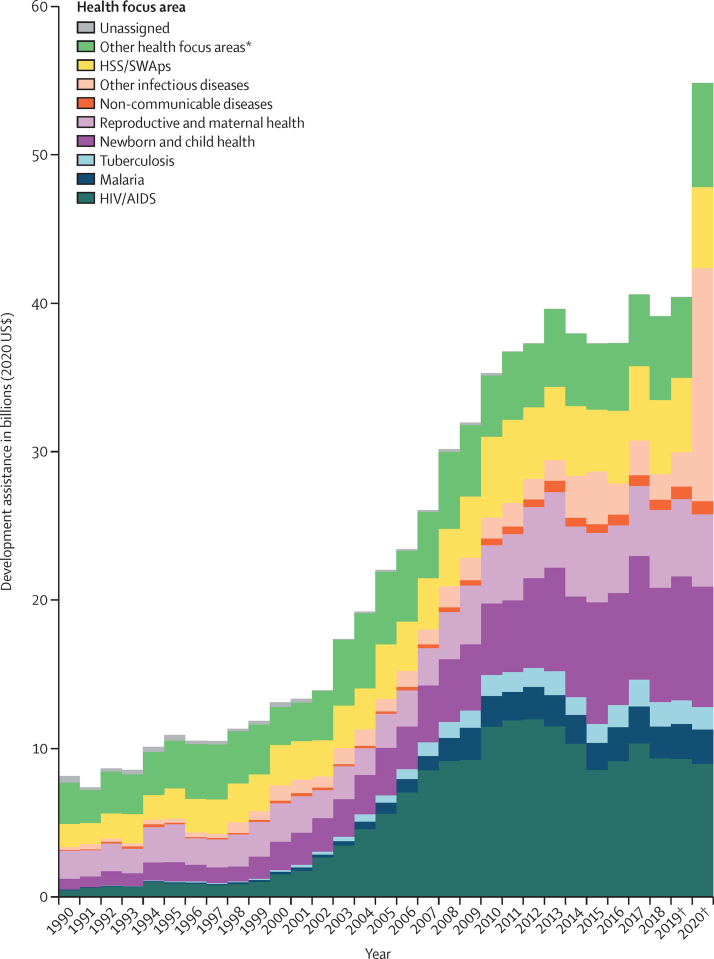
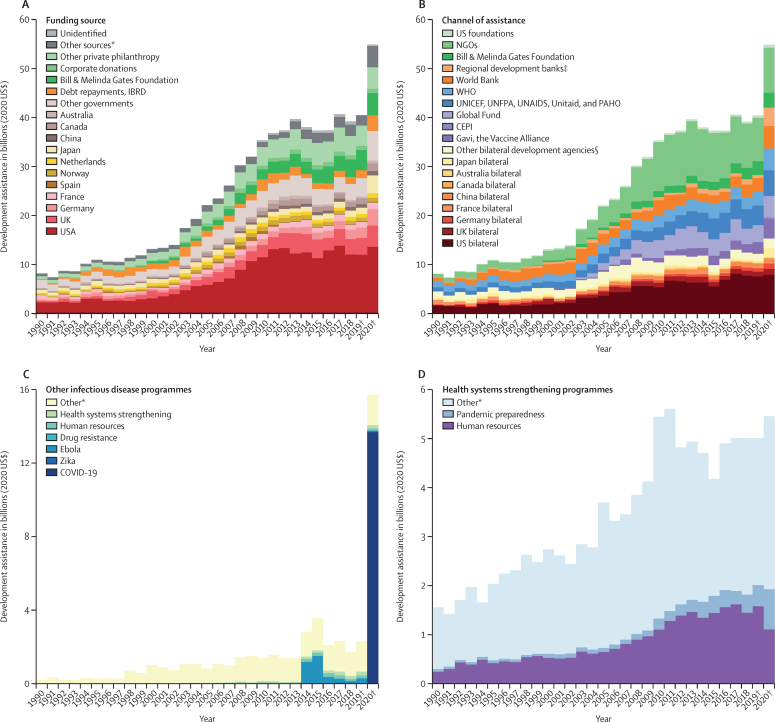
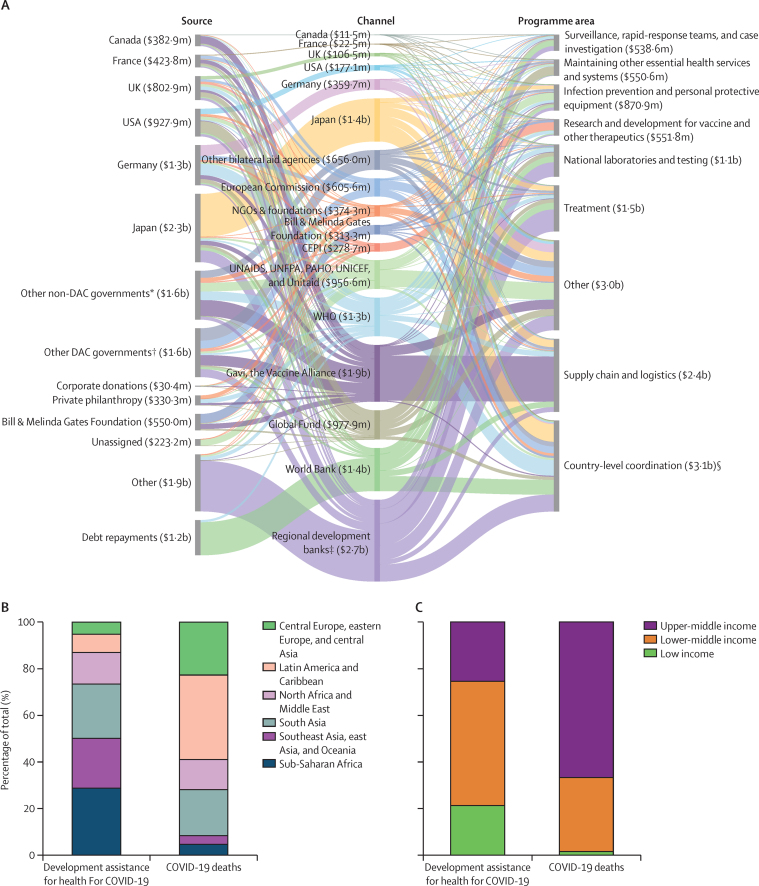
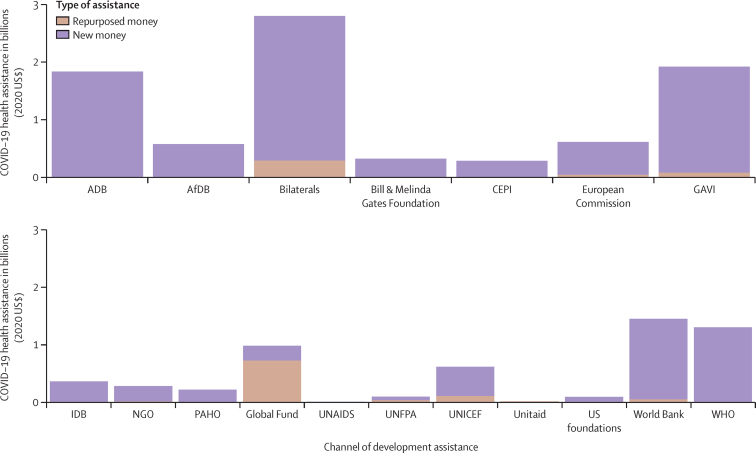
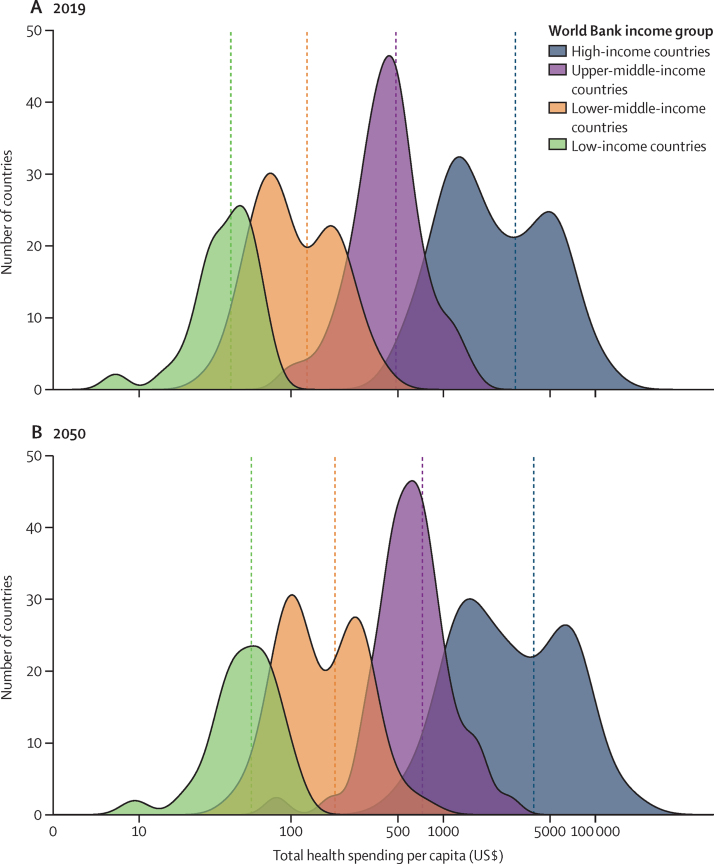
Findings: In 2019, health spending globally reached $8·8 trillion (95% uncertainty interval [UI] 8·7-8·8) or $1132 (1119-1143) per person. Spending on health varied within and across income groups and geographical regions. Of this total, $40·4 billion (0·5%, 95% UI 0·5-0·5) was development assistance for health provided to low-income and middle-income countries, which made up 24·6% (UI 24·0-25·1) of total spending in low-income countries. We estimate that $54·8 billion in development assistance for health was disbursed in 2020. Of this, $13·7 billion was targeted toward the COVID-19 health response. $12·3 billion was newly committed and $1·4 billion was repurposed from existing health projects. $3·1 billion (22·4%) of the funds focused on country-level coordination and $2·4 billion (17·9%) was for supply chain and logistics. Only $714·4 million (7·7%) of COVID-19 development assistance for health went to Latin America, despite this region reporting 34·3% of total recorded COVID-19 deaths in low-income or middle-income countries in 2020. Spending on health is expected to rise to $1519 (1448-1591) per person in 2050, although spending across countries is expected to remain varied.
Interpretation: Global health spending is expected to continue to grow, but remain unequally distributed between countries. We estimate that development organisations substantially increased the amount of development assistance for health provided in 2020. Continued efforts are needed to raise sufficient resources to mitigate the pandemic for the most vulnerable, and to help curtail the pandemic for all.
Funding: Bill & Melinda Gates Foundation.
Copyright © 2021 The Author(s). Published by Elsevier Ltd. This is an Open Access article under the CC BY 4.0 license. Published by Elsevier Ltd.. All rights reserved.
Conflict of interest statement
Declaration of interests D McCracken's position was supported in part through the Wellcome Trust, and by the Department of Health and Social Care using UK aid funding managed by the Fleming Fund. R Ancuceanu reports consulting fees from AbbVie and AstraZeneca; payment or honoraria for lectures, presentations, speakers bureaus, manuscript writing, or educational events from Sandoz, AbbVie, and Braun Medical; and support for attending meetings or travel from AbbVie and AstraZeneca, all outside the submitted work. M Ausloos and C Herteliu report grants or contracts from the Romanian National Authority for Scientific Research and Innovation (CNDS-UEFISCDI), project number PN-III-P4-ID-PCCF-2016-0084, outside the submitted work. C Herteliu reports grants or contracts from CNDS-UEFISCDI, project number PN-III-P2-2.1-SOL-2020-2-0351, outside the submitted work. S Bhaskar reports an unpaid leadership or fiduciary role in a board, society, committee or advocacy group, with the Rotary Club of Sydney Board of Directors, outside the submitted work. R Busse reports grants or contracts from Berlin University Alliance (COVID pre-exploration project), outside the submitted work. S M S Islam reports grants or contracts from National Health and Medical Research Council (NHMRC) and the National Heart Foundation of Australia, all outside the submitted work. K Krishan reports non-financial support from UGC Centre of Advanced Study phase II, Department of Anthropology, Panjab University, Chandigarh, India, outside the submitted work. M J Postma reports grants or contacts from Merck Sharp & DDohme, GlaxoSmithKline, Pfizer, Boehringer Ingelheim, Novavax, Bayer, Bristol Myers Squibb, AstraZeneca, Sanofi, IQVIA, BioMerieux, WHO, EU, Seqirus, FIND, Antilope, DIKTI, LPDP, and Budi; consulting fees from Merk Sharp & Dohme, GlaxoSmithKline, Pfizer, Boehringer Ingelheim, Novavax, Quintiles, Bristol Myers Squibb, Astra Zeneca, Sanofi, Novartis, Pharmerit, IQVIA, and Seqirus; participation on a Data Safety Monitoring Board or Advisory Board to Asc Academics as Advisor; and stock or stock options in Health-Ecore and PAG, all outside the submitted work. M G Shrime reports grants or contracts from the Iris O'Brien Foundation; payment or honoraria for lectures, presentations, speakers bureaus, manuscript writing or educational events from Brightsight speakers; and leadership or fiduciary role in board, society, committee or advocacy group, paid or unpaid with Pharos Global Health Advisors as a board member. J A Singh reports consulting fees from Crealta/Horizon, Medisys, Fidia, Two labs, Adept Field Solutions, Clinical Care options, Clearview healthcare partners, Putnam associates, Focus forward, Navigant consulting, Spherix, MedIQ, UBM, Trio Health, Medscape, WebMD, and Practice Point communications, and the National Institutes of Health and the American College of Rheumatology; payment or honoraria for lectures, presentations, speakers bureaus, manuscript writing, or educational events from Simply Speaking; support for attending meetings and travel from OMERACT; leadership or fiduciary role in other board, society, committee, or advocacy group, paid or unpaid, with OMERACT as a member of the steering committee, with the US Food and Drug Administration Arthritis Advisory Committee, with the Veterans Affairs Rheumatology Field Advisory Committee as a member, and with the UAB Cochrane Musculoskeletal Group Satellite Center on Network Meta-analysis as a Director and Editor; stock or stock options in TPT Global Tech, Vaxart pharmaceuticals, and Charlotte's Web Holdings; and previously owned stock options in Amarin, Viking, and Moderna pharmaceuticals, all outside the submitted work. All other authors declare no competing interests.
Figures
Comment in
-
The long-term impact of COVID-19 on development assistance for health is still uncertain.Lancet. 2021 Oct 9;398(10308):1280-1281. doi: 10.1016/S0140-6736(21)01448-3. Epub 2021 Sep 22. Lancet. 2021. PMID: 34562394 Free PMC article. No abstract available.
References
-
- Portnoy A, Ozawa S, Grewal S. Costs of vaccine programs across 94 low- and middle-income countries. Vaccine. 2015;33(suppl 1):A99–108. - PubMed
-
- WHO . Word Health Organization; Geneva: 2020. Global spending on health: weathering the storm.https://www.who.int/publications/i/item/9789240017788
Publication types
MeSH terms
Grants and funding
LinkOut - more resources
Full Text Sources
Medical