


Determining the Prevalence, Implementation Approaches, and Opinions of Above Cuff Vocalization: A Survey of Health Care Professionals
- PMID: 34562433
- PMCID: PMC8890002
- DOI: 10.1016/j.apmr.2021.08.016
Determining the Prevalence, Implementation Approaches, and Opinions of Above Cuff Vocalization: A Survey of Health Care Professionals
Abstract
Objective: To conduct an international survey to investigate the use of above cuff vocalization (ACV) and how practice and opinion differs.
Design: Observational, cross-sectional online survey.
Setting: Critical care, acute, rehabilitation, long-term care, and community.
Participants: Health care professionals involved in tracheostomy care or weaning (N=243).
Interventions: Not applicable.
Main outcome measures: Tracheostomy management, prevalence, personal experiences and opinions, and barriers to use. Quantitative data were reported descriptively, and content analysis was conducted with qualitative data.
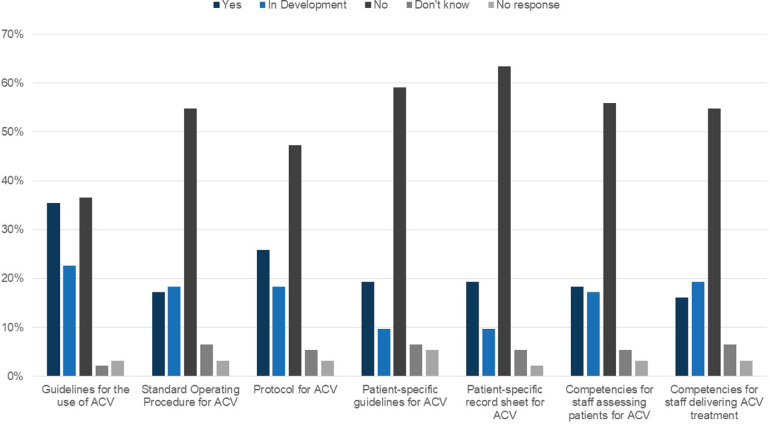
Results: The survey was completed by 243 health care professionals from 9 professional groups and 25 countries, with most responses from the United Kingdom (54%) and speech and language therapists (55%). ACV was used in 39% of services (n=93). Sixty percent (n=50/83) of health care professionals with direct experience of ACV had used it with <10 people. Implementation of ACV varied widely concerning procedures, contraindications, safety processes, professionals involved, competencies, staff training, delivery, and outcome measures. The top benefits were communication (n=76/93; 82%), mood (n=62/93; 67%), and laryngeal sensation (n=49/93; 53%). Complications included discomfort (n=54/93; 58%) and strained vocal quality (n=39/93; 42%). Barriers to ACV implementation included lack of knowledgeable staff (n=92/238; 39%) and lack of access to training (n=73/238; 31%).
Conclusions: ACV uptake varies internationally with no standardized approach to ACV delivery. Diversity of opinions on approaches and benefits exist. Serious complications are infrequent, but minor complications are common. Future research is needed to establish optimal ACV implementation to maximize benefits and minimize risks.
Keywords: Communication; Critical care; Deglutition; Rehabilitation; Surveys and questionnaires; Tracheostomy; Voice.
Copyright © 2021 The Authors. Published by Elsevier Inc. All rights reserved.
Figures


References
-
- Nakarada-Kordic I, Patterson N, Wrapson J, Reay SD. A systematic review of patient and caregiver experiences with a tracheostomy. Patient. 2018;11:175–191. - PubMed
-
- Rose L, Nonoyama M, Rezaie S, Fraser I. Psychological wellbeing, health related quality of life and memories of intensive care and a specialised weaning centre reported by survivors of prolonged mechanical ventilation. Intensive Crit Care Nurs. 2014;30:145–151. - PubMed
-
- Kjeldsen CL, Hansen MS, Jensen K, Holm A, Haahr A, Dreyer P. Patients’ experience of thirst while being conscious and mechanically ventilated in the intensive care unit. Nurs Crit Care. 2017;23:75–81. - PubMed
-
- Freeman-Sanderson AL, Togher L, Elkins M, Kenny B. Quality of life improves for tracheostomy patients with return of voice: a mixed methods evaluation of the patient experience across the care continuum. Intensive Crit Care Nurs. 2018;46:10–16. - PubMed
Publication types
MeSH terms
Grants and funding
LinkOut - more resources
Full Text Sources
