Review
. 2021 Sep 10;9(9):127.
doi: 10.3390/sports9090127.

Muscle Fiber Type Transitions with Exercise Training: Shifting Perspectives

Affiliations
Review

Muscle Fiber Type Transitions with Exercise Training: Shifting Perspectives

Daniel L Plotkin et al. Sports (Basel). .

Abstract

Human muscle fibers are generally classified by myosin heavy chain (MHC) isoforms characterized by slow to fast contractile speeds. Type I, or slow-twitch fibers, are seen in high abundance in elite endurance athletes, such as long-distance runners and cyclists. Alternatively, fast-twitch IIa and IIx fibers are abundant in elite power athletes, such as weightlifters and sprinters. While cross-sectional comparisons have shown marked differences between athletes, longitudinal data have not clearly converged on patterns in fiber type shifts over time, particularly between slow and fast fibers. However, not all fiber type identification techniques are created equal and, thus, may limit interpretation. Hybrid fibers, which express more than one MHC type (I/IIa, IIa/IIx, I/IIa/IIx), may make up a significant proportion of fibers. The measurement of the distribution of fibers would necessitate the ability to identify hybrid fibers, which is best done through single fiber analysis. Current evidence using the most appropriate techniques suggests a clear ability of fibers to shift between hybrid and pure fibers as well as between slow and fast fiber types. The context and extent to which this occurs, along with the limitations of current evidence, are discussed herein.

Keywords: endurance training; fast-twitch fibers; slow-twitch fibers; strength training.


Conflict of interest statement

The authors declare no conflict of interest.

Figures
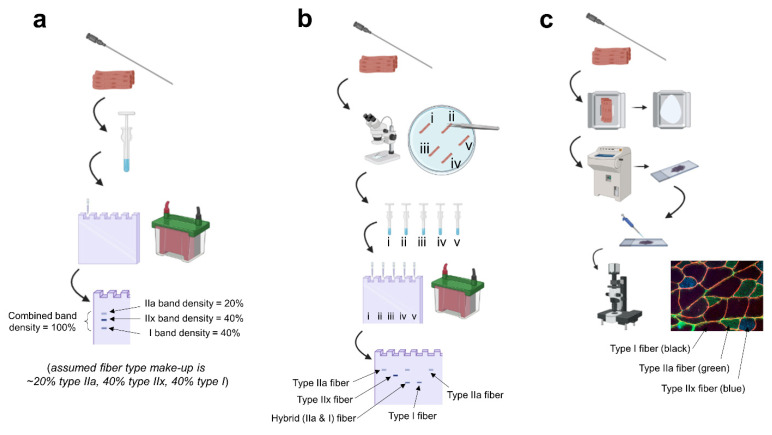
Figure 1
Figure 1
Summary of techniques. Legend: (a) fiber type estimation based on biopsied homogenates: a biopsy is obtained, the tissue is homogenized in specialized buffers and prepped for electrophoresis, and the gel is stained post-electrophoresis to visualize the percentage of each myosin isoform band. (b) singe fiber analysis: a biopsy is obtained, the tissue is teased apart under a stereoscope in a physiological digestion buffer, every single fiber is placed in a tube and homogenized, and electrophoresis is performed with back-end gel staining; this allows for the confident detection of hybrid fibers (example being “fiber iii”). (c) immunohistochemistry: a biopsy is obtained, the tissue is slow-frozen in a cryomold (or on cork) using freezing media, the frozen tissue is sectioned onto microscope slides using a cryostat, primary antibody solutions against various myosin isoforms are pipetted onto the slide, secondary antibody solutions against the primary antibodies are pipetted onto the slide, and the slide is mounted and imaged on a fluorescent microscope. Note, this image was generated using BioRender.com, and the fluorescent image is from the laboratory of MDR.

References

    1. Smerdu V., Karsch-Mizrachi I., Campione M., Leinwand L., Schiaffino S. Type IIx Myosin Heavy Chain Transcripts Are Expressed in Type IIb Fibers of Human Skeletal Muscle. Am. J. Physiol. 1994;267:C1723–C1728. doi: 10.1152/ajpcell.1994.267.6.C1723. - DOI - PubMed
    1. Tihanyi J., Apor P., Fekete G. Force-Velocity-Power Characteristics and Fiber Composition in Human Knee Extensor Muscles. Eur. J. Appl. Physiol. Occup. Physiol. 1982;48:331–343. doi: 10.1007/BF00430223. - DOI - PubMed
    1. Tesch P.A., Karlsson J. Muscle Fiber Types and Size in Trained and Untrained Muscles of Elite Athletes. J. Appl. Physiol. (1985) 1985;59:1716–1720. doi: 10.1152/jappl.1985.59.6.1716. - DOI - PubMed
    1. Serrano N., Colenso-Semple L.M., Lazauskus K.K., Siu J.W., Bagley J.R., Lockie R.G., Costa P.B., Galpin A.J. Extraordinary Fast-Twitch Fiber Abundance in Elite Weightlifters. PLoS ONE. 2019;14:e0207975. doi: 10.1371/journal.pone.0207975. - DOI - PMC - PubMed
    1. Trappe S., Luden N., Minchev K., Raue U., Jemiolo B., Trappe T.A. Skeletal Muscle Signature of a Champion Sprint Runner. J. Appl. Physiol. (1985) 2015;118:1460–1466. doi: 10.1152/japplphysiol.00037.2015. - DOI - PMC - PubMed
