


Relationship between Occupational Exposure to Airborne Nanoparticles, Nanoparticle Lung Burden and Lung Diseases
- PMID: 34564355
- PMCID: PMC8473390
- DOI: 10.3390/toxics9090204
Relationship between Occupational Exposure to Airborne Nanoparticles, Nanoparticle Lung Burden and Lung Diseases
Abstract
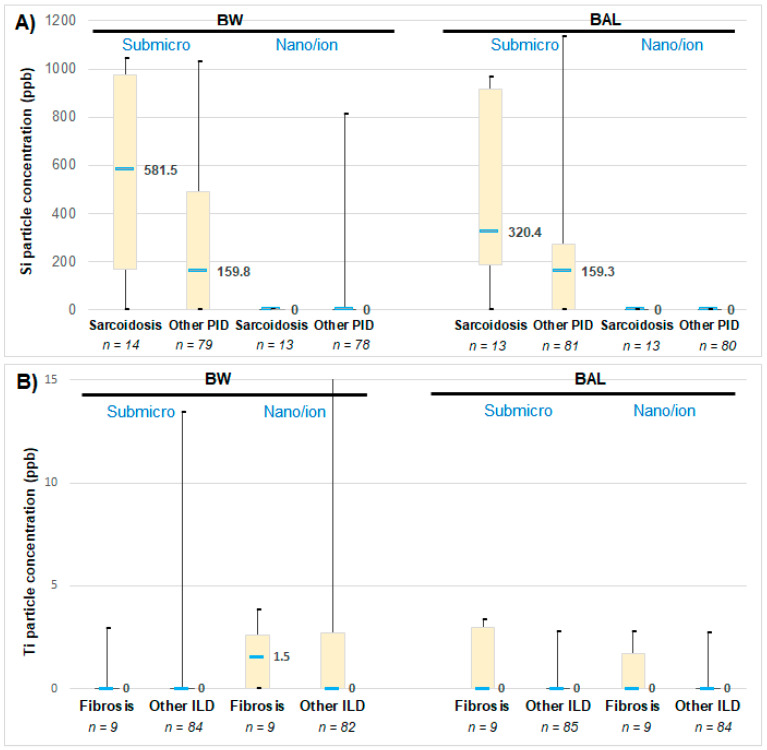
The biomonitoring of nanoparticles in patients' broncho-alveolar lavages (BAL) could allow getting insights into the role of inhaled biopersistent nanoparticles in the etiology/development of some respiratory diseases. Our objective was to investigate the relationship between the biomonitoring of nanoparticles in BAL, interstitial lung diseases and occupational exposure to these particles released unintentionally. We analyzed data from a cohort of 100 patients suffering from lung diseases (NanoPI clinical trial, ClinicalTrials.gov Identifier: NCT02549248) and observed that most of the patients showed a high probability of exposure to airborne unintentionally released nanoparticles (>50%), suggesting a potential role of inhaled nanoparticles in lung physiopathology. Depending on the respiratory disease, the amount of patients likely exposed to unintentionally released nanoparticles was variable (e.g., from 88% for idiopathic pulmonary fibrosis to 54% for sarcoidosis). These findings are consistent with the previously performed mineralogical analyses of BAL samples that suggested (i) a role of titanium nanoparticles in idiopathic pulmonary fibrosis and (ii) a contribution of silica submicron particles to sarcoidosis. Further investigations are necessary to draw firm conclusions but these first results strengthen the array of presumptions on the contribution of some inhaled particles (from nano to submicron size) to some idiopathic lung diseases.
Keywords: biomonitoring; lung diseases; mineralogical analysis of broncho-alveolar lavages; nanoparticles; occupational exposure.
Conflict of interest statement
The authors declare no conflict of interest. The funders had no role in the design of the study; in the collection, analyses, or interpretation of data; in the writing of the manuscript; or in the decision to publish the results.
Figures



References
-
- Stone V., Miller M.R., Clift M.J.D., Elder A., Mills N.L., Møller P., Schins R.P.F., Vogel U., Kreyling W.G., Alstrup Jensen K., et al. Nanomaterials Versus Ambient Ultrafine Particles: An Opportunity to Exchange Toxicology Knowledge. Environ. Health Perspect. 2017;125:106002. doi: 10.1289/EHP424. - DOI - PMC - PubMed
-
- De Vuyst P., Karjalainen A., Dumortier P., Pairon J.-C., Monsó E., Brochard P., Teschler H., Tossavainen A., Gibbs A. Guidelines for mineral fibre analyses in biological samples: Report of the ERS Working Group. European Respiratory Society. Eur. Respir. J. 1998;11:1416–1426. doi: 10.1183/09031936.98.11061416. - DOI - PubMed
-
- Case B.W., Abraham J.L., Meeker G., Pooley F.D., Pinkerton K.E. Applying Definitions of “Asbestos” to Environmental and “Low-Dose” Exposure Levels and Health Effects, Particularly Malignant Mesothelioma. J. Toxicol. Environ. Health B Crit. Rev. 2011;14:3–39. doi: 10.1080/10937404.2011.556045. - DOI - PMC - PubMed
Associated data
Grants and funding
LinkOut - more resources
Full Text Sources
Medical
