. 2021 Aug 31;8(9):177.
doi: 10.3390/vetsci8090177.

A Biological Study of Anisotropic Silver Nanoparticles and Their Antimicrobial Application for Topical Use

Affiliations

A Biological Study of Anisotropic Silver Nanoparticles and Their Antimicrobial Application for Topical Use

Saengrawee Thammawithan et al. Vet Sci. .

Abstract

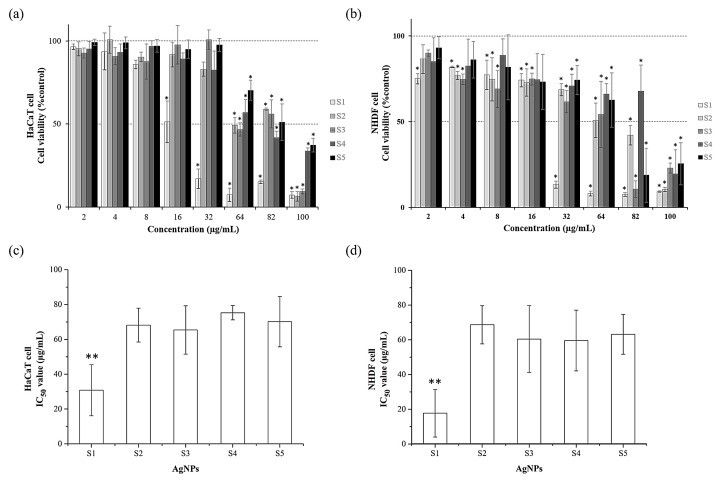
The excessive use of antibiotics in both human and veterinary medicine has contributed to the development and rapid spread of drug resistance in bacteria. Silver nanoparticles (AgNPs) have become a tool of choice that can be used to treat these resistant bacteria. Several studies have shown that AgNPs have antibacterial and wound healing properties. In this study, we evaluated the biological activity of anisotropic AgNPs to develop an antimicrobial gel formulation for treating wound infections. We showed that some anisotropic AgNPs (S2) have an effective antibacterial activity against bacterial pathogens and low cytotoxicity to keratinocytes and fibroblasts in vitro. The MIC and MBC values were in the range of 2-32 µg/mL, and cytotoxicity had IC50 values of 68.20 ± 9.71 µg/mL and 68.65 ± 10.97 µg/mL against human keratinocyte and normal human dermal fibroblast cells, respectively. The anisotropic AgNPs (S2) were used as a gel component and tested for antibacterial activity, including long-term protection, compared with povidone iodine, a common antiseptic agent. The results show that the anisotropic AgNPs can inhibit the growth of most tested bacterial pathogens and provide protection longer than 48 h, whereas povidone iodine only inhibits the growth of some bacteria. This study suggests that anisotropic AgNPs could be used as an alternative antimicrobial agent for treating bacterial skin infection and as a wound healing formulation.

Keywords: Staphylococcus pseudintermedius; alternatives to antimicrobials; anisotropic silver nanoparticles; antimicrobial resistance; silver nanoparticles.


Conflict of interest statement

The authors declare no conflict of interest.

Figures
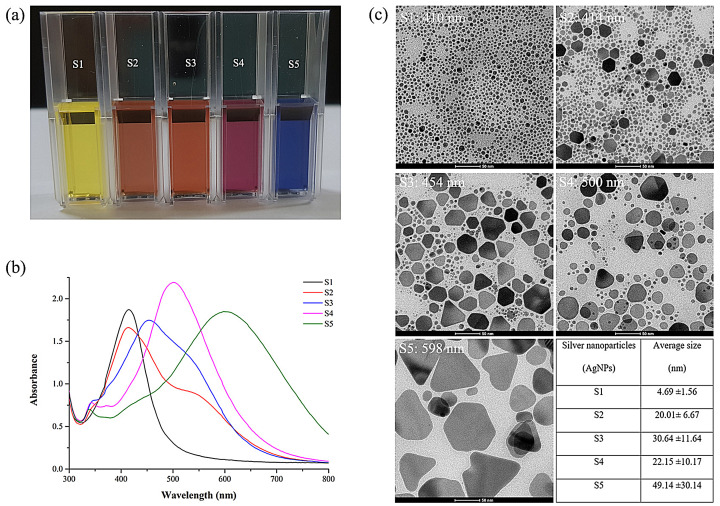
Figure 1
Figure 1
Characterization of AgNPs produced by chemical synthesis. (a) AgNP solution (S1–S5), (b) UV-Vis absorption spectrum of solutions containing AgNPs and (c) TEM image of AgNPs (scale 50 nm). The table for particle size distribution was produced using Image J software.
Figure 2
Figure 2
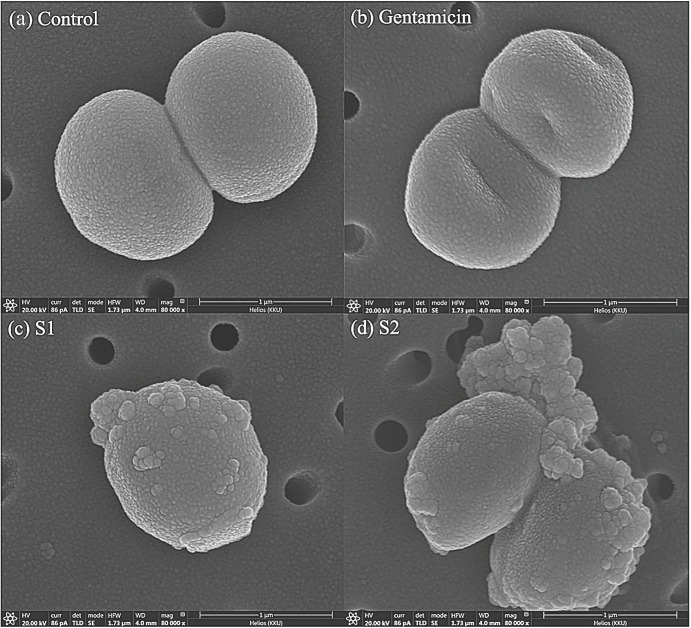
Cell morphological change of S. pseudintermedius MIC 411 observed by FIB-FESEM. Control cell (a). The bacterial cells were treated at concentration of MBC level for 1.5 h with gentamicin (b), AgNSs (c), and anisotropic AgNPs (d).Bacterial cell treated AgNPs (c,d) show the distorted cell, membrane blebbing, membrane damage, and clumping around the cell.
Figure 3
Figure 3
Cytotoxicity of AgNPs evaluated by MTT assay. Cell viability of HaCaT and NHDF cells (a,b) and IC50 of AgNPs in HaCaT and NHDF cells (c,d). The cells were incubated with five types of AgNPs (S1–S5) at 2–100 µg/mL for 24 h. The cell without AgNPs was the control with 100% viability. Data represent mean value ± SD (error bar) from two independent experiments carried out in triplicate (n = 6). An asterisk (*) indicates significant differences in comparison to the control without AgNPs (p < 0.05). ** Asterisks denote a significantly different p-value (p < 0.05) comparing AgNSs with other groups.
Figure 4
Figure 4
AgNPs containing formulation (AgNPs gels). (a) Control gel (without AgNPs), (b) AgNPs gels of S1, (c) S2 and (d) S3.
Figure 5
Figure 5
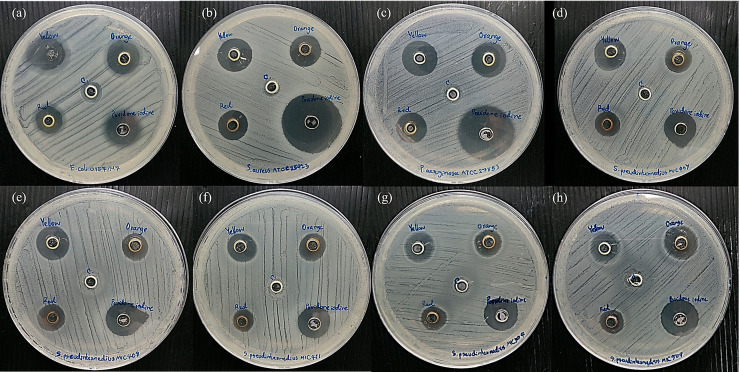
Antimicrobial activity of the AgNP gel determined by the well diffusion method. The AgNP gel (S1 [yellow], S2 [orange], S3 [red]), povidone iodine and control gel were dropped into wells and incubated with pathogens for 24 h at 37 °C. The inhibition zones were measured in mm in diameter. (a) E. coli, (b) S. aureus, (c) P. aeruginosa, (dh) S. pseudintermedius MIC 407, 408, 411, 504, 509, respectively.
Figure 6
Figure 6
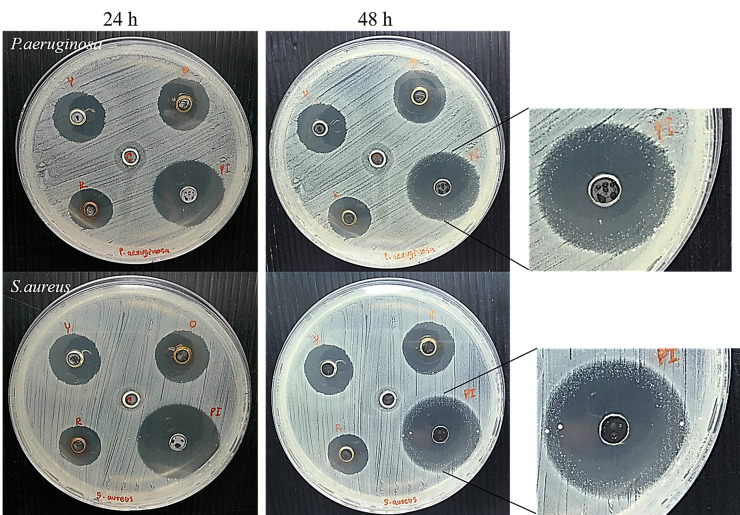
Antimicrobial activity of the AgNPs gel determined by the well diffusion method. The AgNP gels (S1 [yellow], S2 [orange], S3 [red]), povidone iodine and control gel were dropped into wells and incubated with pathogens for 48 h at 37 °C. The inhibition zones were measured in mm in diameter at 24 h and 48 h.

References

    1. Wimmerstedt A., Kahlmeter G. Associated Antimicrobial Resistance in Escherichia Coli, Pseudomonas Aeruginosa, Staphylococcus Aureus, Streptococcus Pneumoniae and Streptococcus Pyogenes. Clin. Microbiol. Infect. 2008;14:315–321. doi: 10.1111/j.1469-0691.2007.01946.x. - DOI - PubMed
    1. Saputra S., Jordan D., Worthing K.A., Norris J.M., Wong H.S., Abraham R., Trott D.J., Abraham S. Antimicrobial Resistance in Coagulase-Positive Staphylococci Isolated from Companion Animals in Australia: A One Year Study. PLoS ONE. 2017;12:e0176379. doi: 10.1371/journal.pone.0176379. - DOI - PMC - PubMed
    1. Yoon J.W., Lee K.-J., Lee S.-Y., Chae M.-J., Park J.-K., Yoo J.-H., Park H.-M. Antibiotic Resistance Profiles of Staphylococcus Pseudintermedius Isolates from Canine Patients in Korea. J. Microbiol. Biotechnol. 2010;20:1764–1768. - PubMed
    1. Lee A.S., de Lencastre H., Garau J., Kluytmans J., Malhotra-Kumar S., Peschel A., Harbarth S. Methicillin-Resistant Staphylococcus Aureus. Nat. Rev. Dis. Prim. 2018;4:18033. doi: 10.1038/nrdp.2018.33. - DOI - PubMed
    1. van Duijkeren E., Catry B., Greko C., Moreno M.A., Pomba M.C., Pyorala S., Ruzauskas M., Sanders P., Threlfall E.J., Torren-Edo J., et al. Review on Methicillin-Resistant Staphylococcus Pseudintermedius. J. Antimicrob. Chemother. 2011;66:2705–2714. doi: 10.1093/jac/dkr367. - DOI - PubMed

LinkOut - more resources