Review
. 2020 Dec 14:6:113.
doi: 10.1038/s41378-020-00218-x. eCollection 2020.

Viscoelastic microfluidics: progress and challenges

Affiliations
Review

Viscoelastic microfluidics: progress and challenges

Jian Zhou et al. Microsyst Nanoeng. .

Abstract

The manipulation of cells and particles suspended in viscoelastic fluids in microchannels has drawn increasing attention, in part due to the ability for single-stream three-dimensional focusing in simple channel geometries. Improvement in the understanding of non-Newtonian effects on particle dynamics has led to expanding exploration of focusing and sorting particles and cells using viscoelastic microfluidics. Multiple factors, such as the driving forces arising from fluid elasticity and inertia, the effect of fluid rheology, the physical properties of particles and cells, and channel geometry, actively interact and compete together to govern the intricate migration behavior of particles and cells in microchannels. Here, we review the viscoelastic fluid physics and the hydrodynamic forces in such flows and identify three pairs of competing forces/effects that collectively govern viscoelastic migration. We discuss migration dynamics, focusing positions, numerical simulations, and recent progress in viscoelastic microfluidic applications as well as the remaining challenges. Finally, we hope that an improved understanding of viscoelastic flows in microfluidics can lead to increased sophistication of microfluidic platforms in clinical diagnostics and biomedical research.

Keywords: 3D focusing; Elastic and inertial force; Microfluidics; Numerical modeling; Particle separation and cell sorting; Viscoelastic flow.


Conflict of interest statement

Conflict of interestThe authors declare that they have no conflict of interest.

Figures
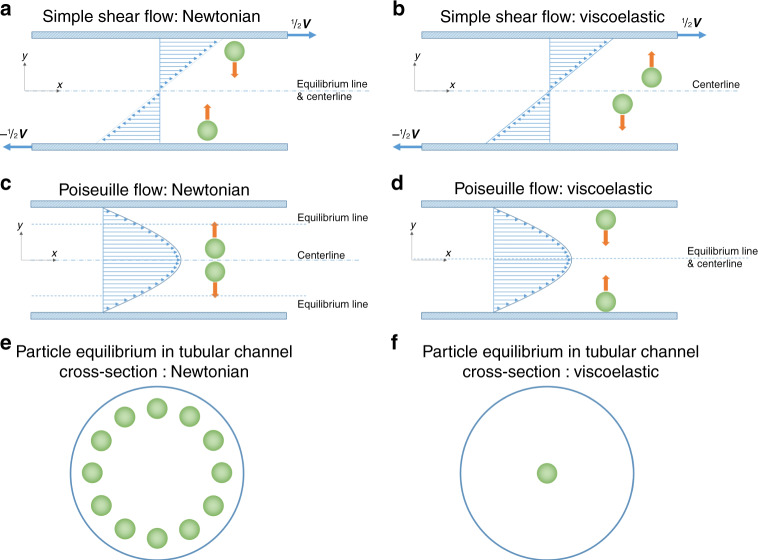
Fig. 1
Fig. 1. Illustrations of particle dynamics in simple shear flow and Poiseuille flow.
In the case of simple shear flow, a particles migrate toward equilibrium positions at the centerline in Newtonian fluid dominated by inertial force, but b migrate toward the walls in viscoelastic fluid,, regardless of particle initial position. c Particles laterally migrate to equilibrium positions near walls in Newtonian Poiseuille flow under the control of inertial forces. d Particle laterally migrates to the centerline in viscoelastic Poiseuille flow undergoing elastic force,. e Particles equilibrate into an annulus near the sidewall of the circular channel in Newtonian flow undergoing inertial force. f Particles equilibrate into the center of the circular channel in viscoelastic flow dominated by elastic force
Fig. 2
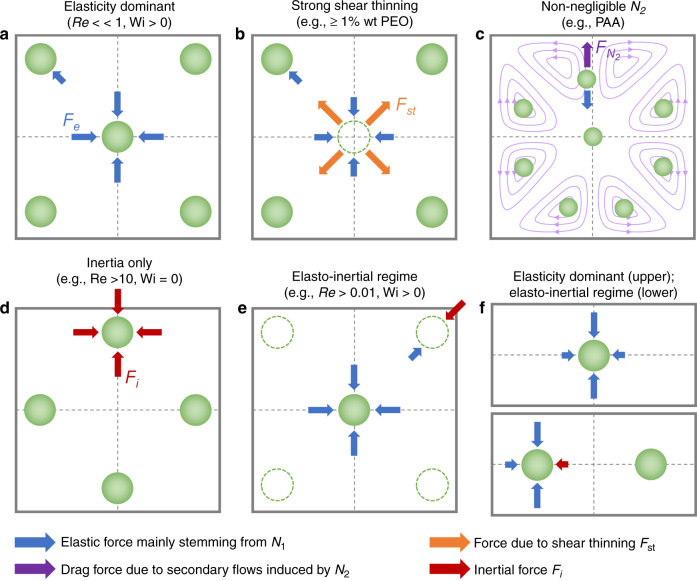
Fig. 2. Particle migration and focusing governed by forces stemming from fluid elasticity, inertia, shear thinning, and their interactions in channels with square and rectangular cross sections.
a Five focusing positions dominated by elastic force (Fe) in inertialess viscoelastic flows without the shear thinning effect (e.g., Re < 0.01 and Wi > 0). b Shear thinning of fluid leading to defocusing of particles in the center and leaving four focusing positions near the corners. Here, Fst represents the effect of shear thinning driving particles toward the walls. c Strong secondary flows induced by the second normal stress difference (N2) causing dispersion of small particles. Here, FN2 represents the drag force acting on particles due to secondary flows. The dispersion of particles due to secondary flows induced by N2 was reported experimentally. However, positions in the centers of vortices were suggested only in simulations and have not been experimentally observed. d Four focusing positions resulted from the balance of inertial forces (grouped as Fi) in Newtonian inertial flows (e.g., 10 ≤ Re ≤ 100 and Wi = 0). e Interaction of elastic force (Fe) and inertial force (Fi) leading to elimination of the corner positions in viscoelastic flows with nonnegligible inertia (e.g., Re > 0.01 and Wi > 0). f Single focusing position and two positions in rectangular channels depending on the interaction of elastic and inertial forces. When the inertia is small (e.g., low flow rate), a single focusing position is present in the center; when the flow rate increases, two positions emerge as inertia becomes relevant
Fig. 3
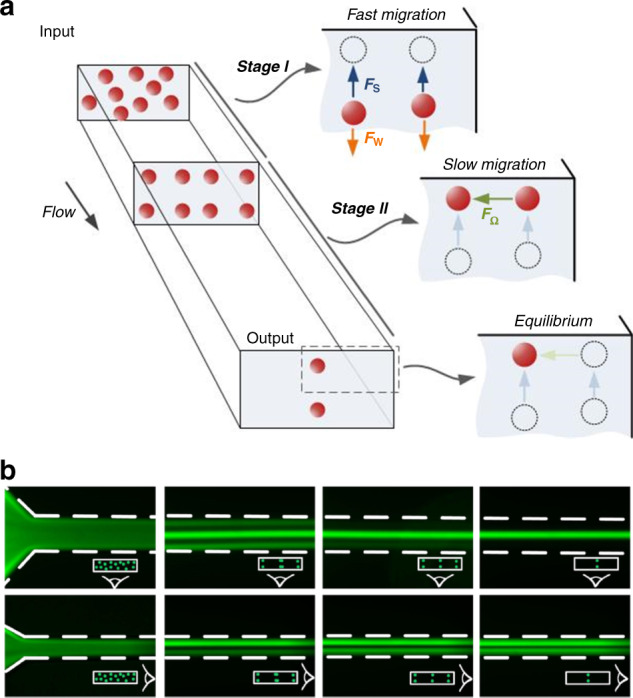
Fig. 3. Two-stage migration of particles in inertia-dominant Newtonian flow and various focusing patterns in different inertial microchannels.
a Fast migration of particles toward channel walls in the first stage dominated by shear-induced lift force (Fs) and slow migration toward the stable positions in the second stage undergoing rotation-induced lift force (FΩ). Reproduced with permission from ref. . Copyright © Royal Society of Chemistry. b Fluorescent images of particle migration inside a rectangular channel validating the two-stage migration. Reproduced with permissions from ref. . Copyright © AIP Publishing
Fig. 4
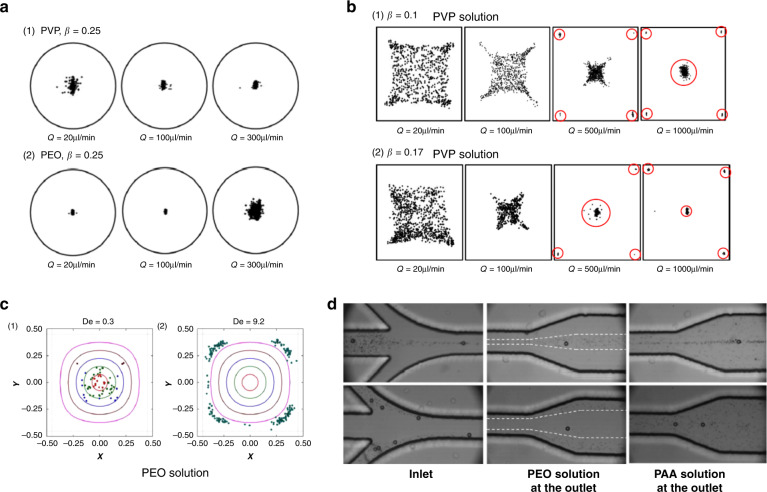
Fig. 4. Particle dynamics in viscoelastic microchannels with negligible inertia.
Particle focusing into the micropipe axis in PVP fluid with negligible inertia and particle defocusing in PEO solution due to the shear thinning effect at a high flow rate. The channel length is 30 cm. Reproduced with permission from ref. . Copyright © Royal Society of Chemistry. b Four focusing positions near the corners in addition to channel axis in square microchannel and effect of particle blockage ratio on focusing in 8% PVP solution. The channel length is 30 cm. Reproduced with permission from ref. . Copyright © AIP Publishing. c Four focusing positions near corners of a square channel due to strong shear thinning (1.6% wt PEO). The channel length is 8 cm. Reproduced with permission from ref. . Copyright © Springer Nature. d Effect of secondary flow on particle migration due to second normal stress difference in PAA solution (strong second normal stress difference N2) compared to the migration in PEO solution. Reproduced with permissions from ref. . Copyright © Springer Nature
Fig. 5
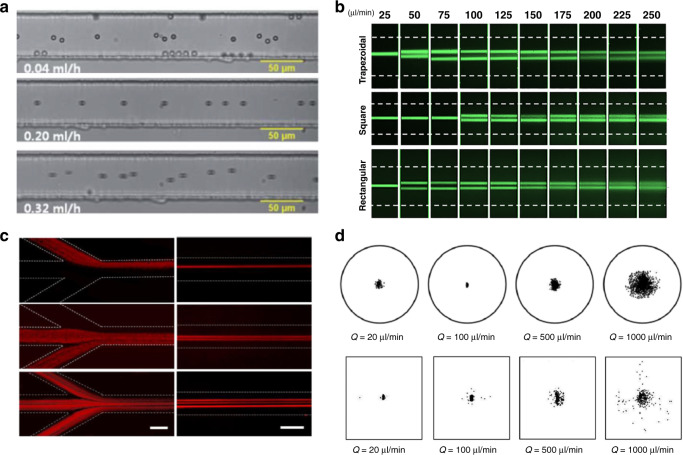
Fig. 5. Particle dynamics in viscoelastic microfluidics with effects of inertia and shear thinning.
a Inertial force necessary to eliminate the four corner positions in the square channel. A single stream of particles was observed at an increased flow rate where inertial force was sufficient to repel particles from four corners. The channel length is 4 cm. Reproduced with permission from ref. . Copyright © Royal Society of Chemistry. b One and two streams observed in rectangular, square and trapezoid channels when both elastic and inertial effects are present. The channel length is 5 cm. Reproduced with permission from ref. . Copyright © AIP Publishing. c One, two and three focused streams observed in the rectangular channel. The channel length is 4 cm. Reproduced with permission from ref. . Copyright © 2017, American Chemical Society. d Defocusing of particles observed in both circular micropipes (β = 0.1) and square microchannels (β = 0.17) when the shear thinning effect was strong (1% wt PEO). The channel length is 30 cm. Reproduced with permission from ref. . Copyright © AIP Publishing
Fig. 6
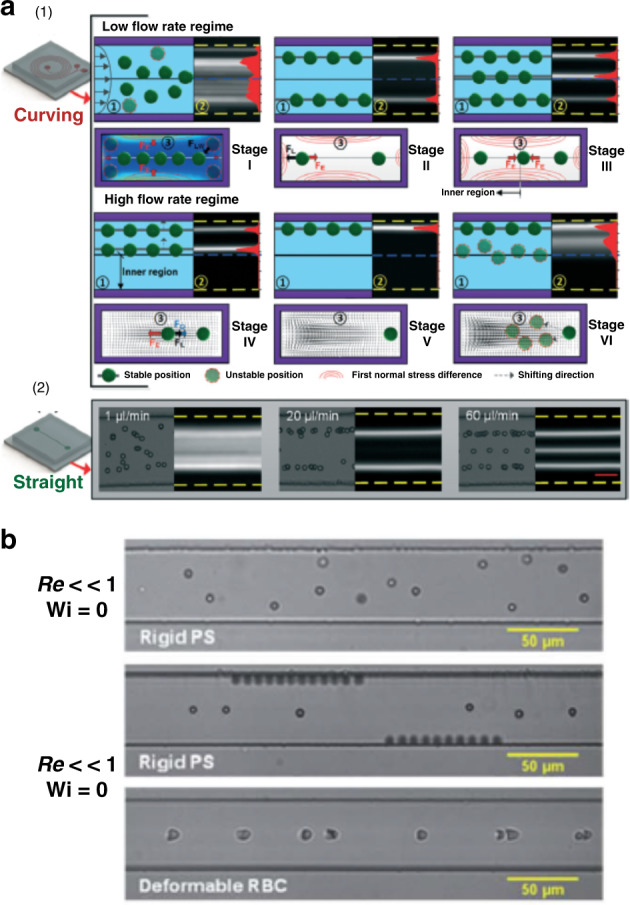
Fig. 6. Effects of channel geometry and particle deformability on lateral migration and focusing.
a Various focused streams observed both in spiral and straight rectangular microchannels when inertia was relevant. Reproduced with permission from ref. . Copyright © Royal Society of Chemistry. b Single position focusing of red blood cells attributed to the interaction of the elastic force and deformability-induced lift force. Reproduced with permission from ref. . Copyright © Royal Society of Chemistry
Fig. 7
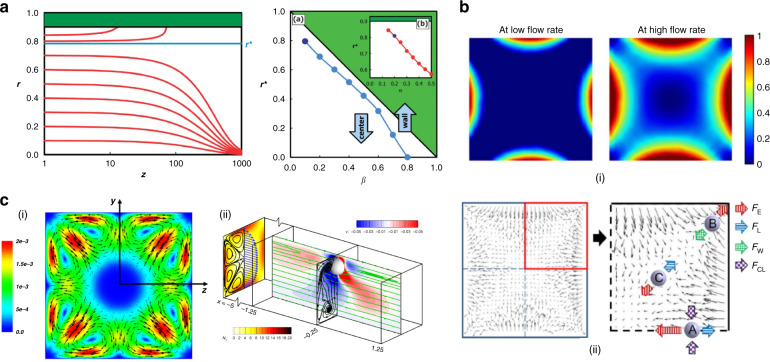
Fig. 7. Numerical simulations predicting particle migration and focusing in viscoelastic channel flows.
a Giesekus model used to predict particle downstream trajectories (red curves) and the dependence of migration direction on particle blockage ratio (β) in a micropipe flow. Reproduced with permission from ref. . Copyright © Royal Society of Chemistry. b COMSOL Multiphysics® was used to predict the distribution of the first normal stress difference (N1) and the vector of lateral force in a square channel cross-section. Reproduced with permission from ref. . Copyright © AIP Publishing. c Simulations of the effect of secondary flow induced by the second normal stress difference (N2) on particle migration in square microchannels using the Giesekus model,. Reproduced with permission from refs. ,. Copyright © Elsevier and copyright © Cambridge University Press, respectively
Fig. 8
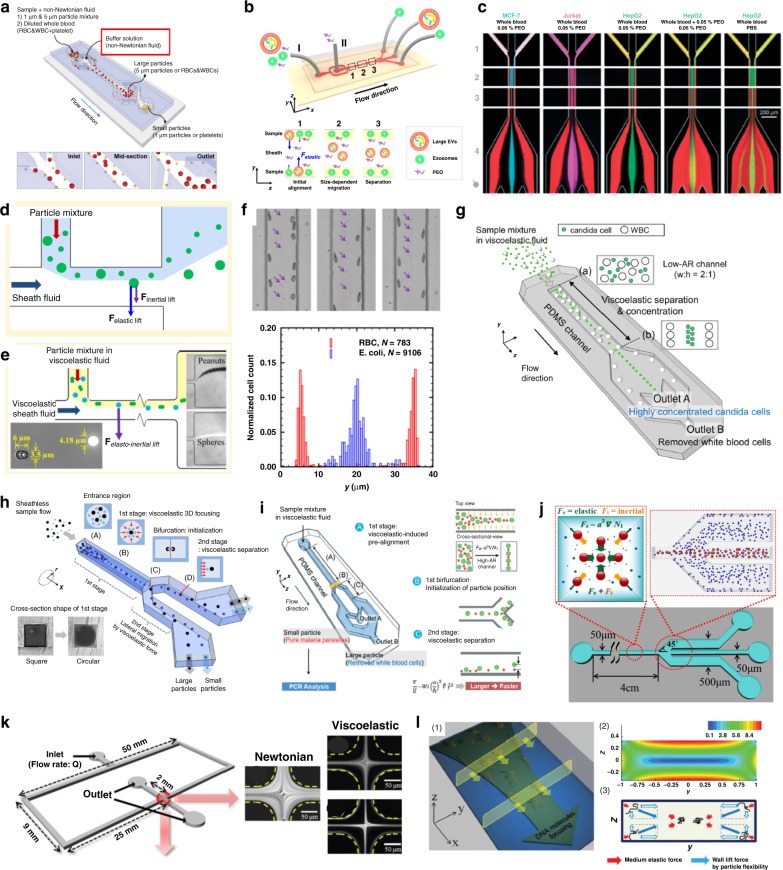
Fig. 8. Recent applications of viscoelastic microfluidics.
a Size-selective particle, cell and exosome separations based on elastic force achieved in microchannels with sheath flow in the center. Reproduced with permission from ref. . Copyright © Royal Society of Chemistry. b Viscoelastic coflow for exosome separation. Reproduced with permission from ref. . Copyright © 2017, American Chemical Society. c Tumor cell-line cell separation from blood using PEO core flow. Reproduced with permission from ref. . Copyright © Royal Society of Chemistry. d Combination of viscoelasticity and inertia for pinched flow fractionation (eiPFF). Reproduced with permission from ref. . Copyright © 2015, American Chemical Society. e Shape-based separation of peanut particles in a viscoelastic PFF device. f Sheathless separation of RBCs and E. coli in viscoelastic fluid flowing in a rectangular microchannel. Reproduced with permission from ref. . Copyright © 2015, American Chemical Society. g Separation of fungus from blood in a rectangular viscoelastic channel. Reproduced under a Creative Commons Attribution 4.0. h Microchannels consisting of two segments for sheathless particle separation. Reproduced with permission from ref. . Copyright © Elsevier. i Separation of malaria parasites from WBCs in a two-segment channel. Reproduced with permission from ref. . Copyright © Royal Society of Chemistry. j Filtration of particles in a square microchannel using both elastic and inertial forces. Reproduced with permission from ref. . Copyright © Elsevier. k Single-stream focusing of cells in viscoelastic microflow used for measurements and monitoring of cell deformability. Reproduced with permission from ref. . Copyright © 2012, American Chemical Society. l Focusing of DNA molecules in a low-AR rectangular microchannel based on the elastic force and flexibility-induced lift force. Reproduced with permission from ref. . Copyright © 2012, American Chemical Society

References

    1. Alix-Panabieres C, Pantel K. Challenges in circulating tumour cell research. Nat. Rev. Cancer. 2014;14:623–631. - PubMed
    1. Watanabe M, et al. Isolation and molecular analysis of circulating tumor cells from lung cancer patients using a microfluidic chip type cell sorter. Cancer Sci. 2018;109:2539–2548. - PMC - PubMed
    1. Thiele J, Bethel K, Králíčková M, Kuhn P. Circulating tumor cells: fluid surrogates of solid tumors. Annu Rev. Pathol.-Mech. 2017;12:419–447. - PMC - PubMed
    1. J. Zhou, et al. Microfluidic separation of particles from whole blood using shear induced diffusion. In Proceedings of Microfluidics, BioMEMS, and Medical Microsystems XV, 100610X, https://www.spiedigitallibrary.org/conferenceproceedings-of-spie/10061/1.... - DOI
    1. Sajeesh P, Sen AK. Particle separation and sorting in microfluidic devices: a review. Microfluid. Nanofluid. 2014;17:1–52.