


Characteristics and outcomes of heart failure with recovered left ventricular ejection fraction
- PMID: 34569712
- PMCID: PMC8712904
- DOI: 10.1002/ehf2.13630
Characteristics and outcomes of heart failure with recovered left ventricular ejection fraction
Abstract
Aims: There is an emerging interest in elucidating the natural history and prognosis for patients with heart failure with reduced ejection fraction (HFrEF) in whom left ventricular ejection fraction (LVEF) subsequently improves. The characteristics and outcomes were compared between heart failure with recovered ejection fraction (HFrecEF) and persistent HFrEF.
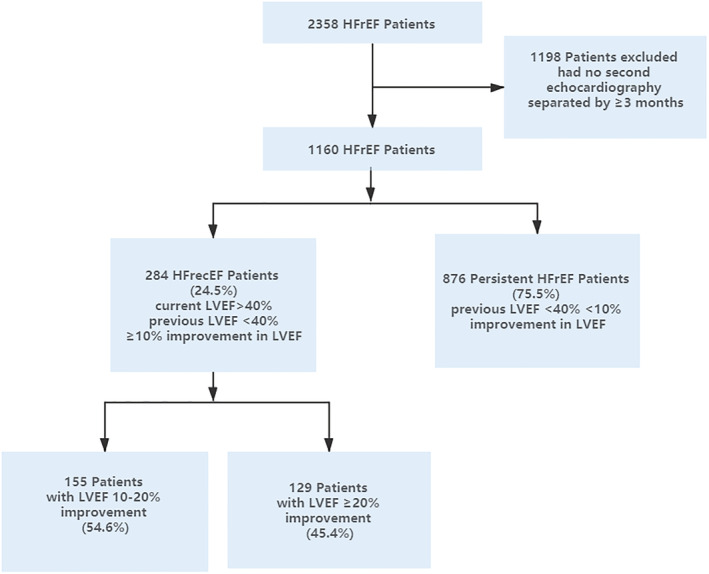
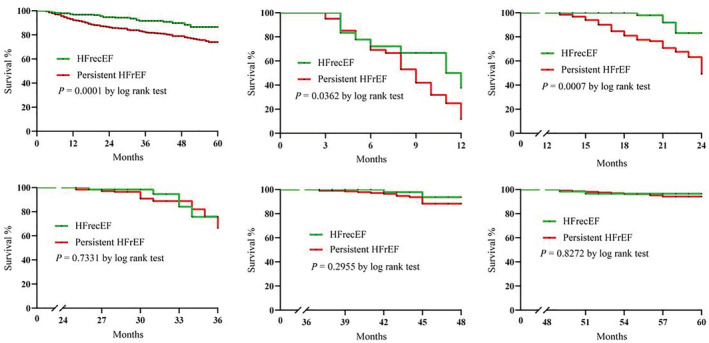
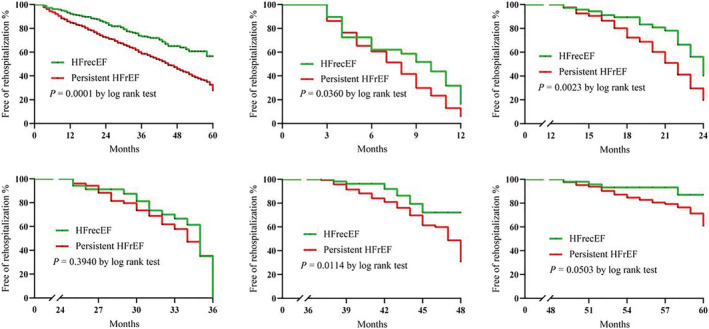
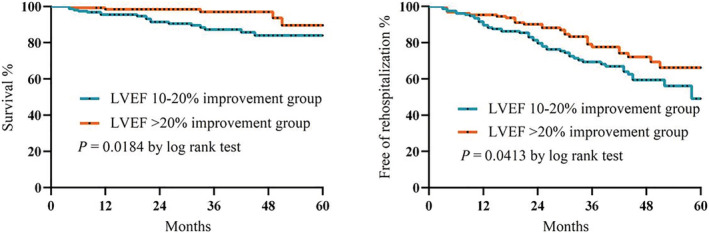
Methods and results: This is a retrospective study of adults who underwent at least two echocardiograms 3 months apart between 1 November 2015 and 31 October 2019 with an initial diagnosis of HFrEF. The subjects were divided into HFrecEF group (second LVEF > 40%, ≥10% absolute improvement in LVEF) and persistent HFrEF group (<10% absolute improvement in LVEF) according to the second LVEF. To further study the characteristics of HFrecEF patients, the cohort was further divided into LVEF improvement of 10-20% and >20% subgroups. The primary outcomes were all-cause mortality and rehospitalization. A total of 1160 HFrEF patients were included [70.2% male, mean (standard deviation) age: 62 ± 13 years]. On the second echocardiogram, 284 patients (24.5%) showed HFrecEF and 876 patients (75.5%) showed persistent HFrEF. All-cause mortality was identified in 23 (8.10%) HFrecEF and 165 (18.84%) persistent HFrEF, whilst 76 (26.76%) and 426 (48.63%) showed rehospitalizations, respectively. Survival analysis showed that the persistent HFrEF subgroup experienced a significantly higher mortality at 12 and 24 months and a higher hospitalization at 12, 24, 48, and more than 48 months following discharge. Multivariate Cox regression showed that persistent HFrEF had a higher risk of all-cause mortality [hazard ratio (HR) 2.30, 95% confidence interval (CI) 1.49-3.56, P = 0.000] and rehospitalization (HR 1.85, 95% CI 1.45-2.36, P = 0.000) than the HFrecEF group. Subgroup analysis showed that the LVEF ≥ 20% improvement subgroup had lower rates of adverse outcomes compared with those with less improvement of 10-20%.
Conclusions: Heart failure with recovered ejection fraction is a distinct HF phenotype with better clinical outcomes compared with those with persistent HFrEF. HFrecEF patients have a relatively better short-term mortality at 24 months but not thereafter.
Keywords: Echocardiography; Heart failure; Left ventricular ejection fraction; Prognosis.
© 2021 The Authors. ESC Heart Failure published by John Wiley & Sons Ltd on behalf of European Society of Cardiology.
Conflict of interest statement
None declared.
Figures
References
-
- Wilcox JE, Fang JC, Margulies KB, Mann DL. Heart Failure With Recovered Left Ventricular Ejection Fraction: JACC Scientific Expert Panel. J Am Coll Cardiol. 2020; 76: 719–734. - PubMed
-
- Ponikowski P, Voors AA, Anker SD, Bueno H, Cleland JGF, Coats AJS, Falk V, González‐Juanatey JR, Harjola VP, Jankowska EA, Jessup M, Linde C, Nihoyannopoulos P, Parissis JT, Pieske B, Riley JP, Rosano GMC, Ruilope LM, Ruschitzka F, Rutten FH, van der Meer P. 2016 ESC Guidelines for the Diagnosis and Treatment of Acute and Chronic Heart Failure. Rev Esp Cardiol (Engl Ed). 2016; 69: 1167. - PubMed
-
- Punnoose LR, Givertz MM, Lewis EF, Pratibhu P, Stevenson LW, Desai AS. Heart failure with recovered ejection fraction: a distinct clinical entity. J Card Fail. 2011; 17: 527–532. - PubMed
-
- da Silva R, Borges ASR, Silva NP, Resende ES, Tse G, Liu T, Roever L, Biondi‐Zoccai G. How Heart Rate Should Be Controlled in Patients with Atherosclerosis and Heart Failure. Curr Atheroscler Rep. 2018; 20: 54. - PubMed
-
- Gomes‐Neto M, Duraes AR, Conceicao LSR, Roever L, Liu T, Tse G, Biondi‐Zoccai G, Goes ALB, Alves IGN, Ellingsen Ø, Carvalho VO. Effect of Aerobic Exercise on Peak Oxygen Consumption, VE/VCO2 Slope, and Health‐Related Quality of Life in Patients with Heart Failure with Preserved Left Ventricular Ejection Fraction: a Systematic Review and Meta‐Analysis. Curr Atheroscler Rep. 2019; 21: 45. - PubMed
Publication types
MeSH terms
LinkOut - more resources
Full Text Sources
Medical
Research Materials
Miscellaneous
