Review
. 2021 Nov:193:114786.
doi: 10.1016/j.bcp.2021.114786. Epub 2021 Sep 24.

Role of glutamate excitotoxicity and glutamate transporter EAAT2 in epilepsy: Opportunities for novel therapeutics development

Affiliations
Review

Role of glutamate excitotoxicity and glutamate transporter EAAT2 in epilepsy: Opportunities for novel therapeutics development

Jennifer Leigh Green et al. Biochem Pharmacol. 2021 Nov.

Abstract

Epilepsy is a complex neurological syndrome characterized by seizures resulting from neuronal hyperexcitability and sudden and synchronized bursts of electrical discharges. Impaired astrocyte function that results in glutamate excitotoxicity has been recognized to play a key role in the pathogenesis of epilepsy. While there are 26 drugs marketed as anti-epileptic drugs no current treatments are disease modifying as they only suppress seizures rather than the development and progression of epilepsy. Excitatory amino acid transporters (EAATs) are critical for maintaining low extracellular glutamate concentrations and preventing excitotoxicity. When extracellular glutamate concentrations rise to abnormal levels, glutamate receptor overactivation and the subsequent excessive influx of calcium into the post-synaptic neuron can trigger cell death pathways. In this review we discuss targeting EAAT2, the predominant glutamate transporter in the CNS, as a promising approach for developing therapies for epilepsy. EAAT2 upregulation via transcriptional and translational regulation has proven successful in vivo in reducing spontaneous recurrent seizures and offering neuroprotective effects. Another approach to regulate EAAT2 activity is through positive allosteric modulation (PAM). Novel PAMs of EAAT2 have recently been identified and are under development, representing a promising approach for the advance of novel therapeutics for epilepsy.

Keywords: Astrocytes; EAAT2; Epilepsy; Excitotoxicity; Glutamate; Glutamate transporter.


Conflict of interest statement

Financial Interests

Authors have no conflicts of interest.

Figures
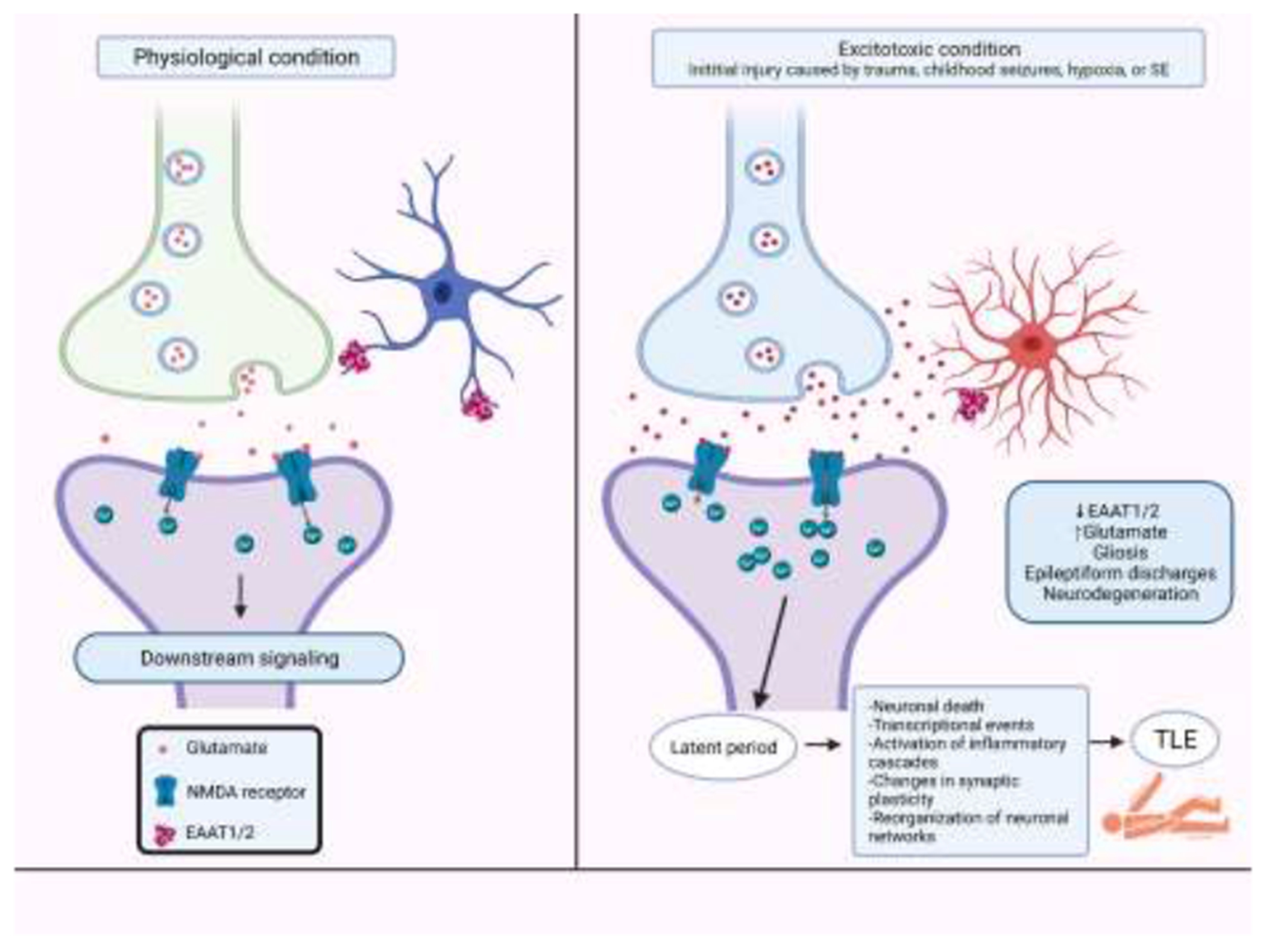
Figure 1.
Figure 1.. Representation of a tri-partite glutamatergic synapse, under physiological and excitotoxicity conditions, leading to the development of epilepsy.
The intense seizure activity seen in SE causes excessive glutamate release resulting in overstimulation of glutamate receptors leading to massive influxes of Ca2+, subsequently triggering mass neuronal death via glutamate excitotoxicity mechanisms. Following the initial insult or injury there is a latent period that may last up to several years in which complex molecular, biochemical, and structural changes occur, including changes in synaptic plasticity and neuronal connectivity reorganization of neuronal networks. Within minutes to days following the initial insult, acute early changes include rapid alterations to ion channel kinetics, post-translational modifications to existing functional proteins, and activation of immediate early genes. Hours to weeks after the insult, subacute changes occur, including transcriptional events, neuronal death, and activation of inflammatory cascades. The chronic changes that follow over weeks to months include anatomical changes, such as neurogenesis, mossy fiber sprouting, network reorganization, and gliosis. These changes ultimately lead to neuronal networks being more susceptible to hyperexcitability and synchronous firing of these excitatory neurons, leading to more seizures and eventually spontaneous recurrent seizures This results in the emergence of chronic epilepsies such as TLE. Figure created with BioRender.com.
Figure 2.
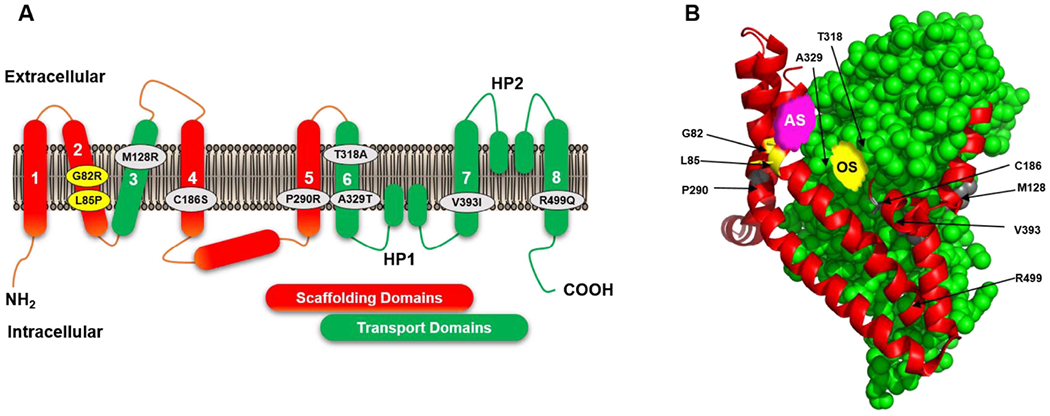
Figure 2.
A. Two-dimensional membrane topology diagram of a single protomer of glutamate transporter, depicting eight transmembrane domains and hairpin loops, and showing the spatial distribution of EA6 and epileptic encephalopathies associated missense mutations: M128R, C186S, P290R, T3128A, A329T, V393I, R499Q in EAAT1 (in grey circles) and G28R and L85P in EAAT2 (in yellow circles). The scaffolding and transport domains are shown in red and green, respectively. B. The tertiary structure of a single glutamate transporter protomer shown in the plane of the membrane, depicting scaffolding and transport domains in red and green, respectively, substrate and sodium binding sites (orthosteric site or OS, in yellow), a proposed allosteric site (AS in pink, from reference [188]), and positions of the EA6 and epileptic encephalopathies mutations. Structure was modelled using the crystal structure of EAAT1 in complex with L-aspartate (PDB 5LLM, ref [147]) as template, using PyMol Molecular Graphic Systems, version 2.4.1, Schrodinger, LLC. Note: Residues G82, L85 (EAAT2 numbering), M128, C186, P290 and V393 (EAAT1 numbering) are conserved between EAAT1 and EAAT2 transporter subtypes. However, T318 in EAAT1 is M317 in EAAT2, A329 in EAAT1 is G328 in EAAT2 and R499 in EAAT1 is K498 in EAAT2.

References

    1. Ali R, Connolly ID, Feroze AH, Awad AJ, Choudhri OA, Grant GA, Epilepsy: A Disruptive Force in History, World neurosurgery 90 (2016) 685–690. 10.1016/j.wneu.2015.11.060. - DOI - PubMed
    1. C.f.D. Control, Epilepsy Data and Statistics, https://www.cdc.gov/epilepsy/data/index.html. 2015. 2015).
    1. Takahashi KK, Glutamate transporter EAAT2: regulation, function, and potential as a therapeutic target for neurological and psychiatric disease, Cellular and molecular life sciences : CMLS 72 3489–3506. 10.1007/s00018-015-1937-8. - DOI - PMC - PubMed
    1. Patel DC, Tewari BP, Chaunsali L, Sontheimer H, Neuron-glia interactions in the pathophysiology of epilepsy, Nature reviews. Neuroscience 20 (2019) 282–297. 10.1038/s41583-019-0126-4. - DOI - PMC - PubMed
    1. Chapman AG, Glutamate and epilepsy, The Journal of nutrition 130 (2000) 1043s–1045s. - PubMed

Publication types

MeSH terms