


Acute Coronary Syndromes (ACS)-Unravelling Biology to Identify New Therapies-The Microcirculation as a Frontier for New Therapies in ACS
- PMID: 34571836
- PMCID: PMC8468909
- DOI: 10.3390/cells10092188
Acute Coronary Syndromes (ACS)-Unravelling Biology to Identify New Therapies-The Microcirculation as a Frontier for New Therapies in ACS
Abstract
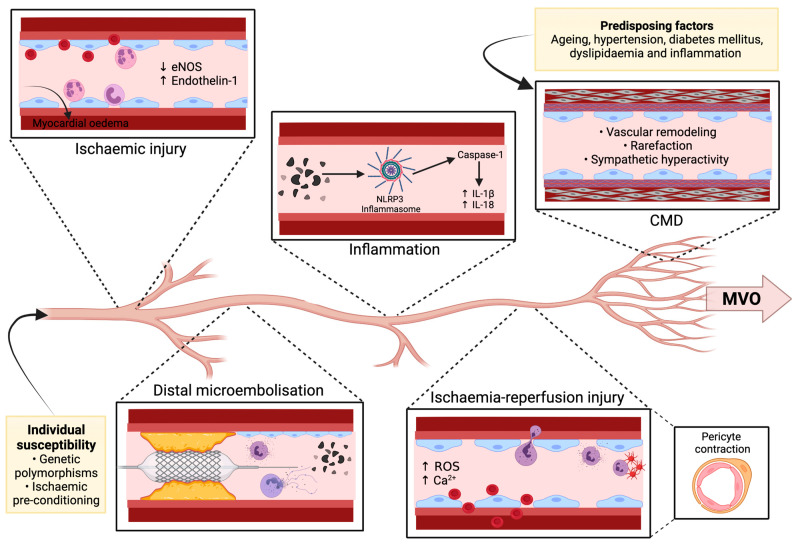
In acute coronary syndrome (ACS) patients, restoring epicardial culprit vessel patency and flow with percutaneous coronary intervention or coronary artery bypass grafting has been the mainstay of treatment for decades. However, there is an emerging understanding of the crucial role of coronary microcirculation in predicting infarct burden and subsequent left ventricular remodelling, and the prognostic significance of coronary microvascular obstruction (MVO) in mortality and morbidity. This review will elucidate the multifaceted and interconnected pathophysiological processes which underpin MVO in ACS, and the various diagnostic modalities as well as challenges, with a particular focus on the invasive but specific and reproducible index of microcirculatory resistance (IMR). Unfortunately, a multitude of purported therapeutic strategies to address this unmet need in cardiovascular care, outlined in this review, have so far been disappointing with conflicting results and a lack of hard clinical end-point benefit. There are however a number of exciting and novel future prospects in this field that will be evaluated over the coming years in large adequately powered clinical trials, and this review will briefly appraise these.
Keywords: acute coronary syndrome; index of microcirculatory resistance; microvascular obstruction; myocardial infarction; percutaneous coronary intervention.
Conflict of interest statement
The authors declare no conflict of interest.
Figures
References
-
- Pedersen F., Butrymovich V., Kelbæk H., Wachtell K., Helqvist S., Kastrup J., Holmvang L., Clemmensen P., Engstrøm T., Grande P., et al. Short- and Long-Term Cause of Death in Patients Treated With Primary PCI for STEMI. J. Am. Coll. Cardiol. 2014;64:2101–2108. doi: 10.1016/j.jacc.2014.08.037. - DOI - PubMed
-
- Wu K.C., Zerhouni E.A., Judd R.M., Lugo-Olivieri C.H., Barouch L.A., Schulman S.P., Blumenthal R.S., Lima J.A. Prognostic significance of microvascular obstruction by magnetic resonance imaging in patients with acute myocardial infarction. Circulation. 1998;97:765–772. doi: 10.1161/01.CIR.97.8.765. - DOI - PubMed
Publication types
MeSH terms
LinkOut - more resources
Full Text Sources
