Review
. 2021 Aug 28;10(9):2234.
doi: 10.3390/cells10092234.

The Potential of Tissue-Resident Memory T Cells for Adoptive Immunotherapy against Cancer

Affiliations
Review

The Potential of Tissue-Resident Memory T Cells for Adoptive Immunotherapy against Cancer

Ammarina Beumer-Chuwonpad et al. Cells. .

Abstract

Tissue-resident memory T cells (TRM) comprise an important memory T cell subset that mediates local protection upon pathogen re-encounter. TRM populations preferentially localize at entry sites of pathogens, including epithelia of the skin, lungs and intestine, but have also been observed in secondary lymphoid tissue, brain, liver and kidney. More recently, memory T cells characterized as TRM have also been identified in tumors, including but not limited to melanoma, lung carcinoma, cervical carcinoma, gastric carcinoma and ovarian carcinoma. The presence of these memory T cells has been strongly associated with favorable clinical outcomes, which has generated an interest in targeting TRM cells to improve immunotherapy of cancer patients. Nevertheless, intratumoral TRM have also been found to express checkpoint inhibitory receptors, such as PD-1 and LAG-3. Triggering of such inhibitory receptors could induce dysfunction, often referred to as exhaustion, which may limit the effectiveness of TRM in countering tumor growth. A better understanding of the differentiation and function of TRM in tumor settings is crucial to deploy these memory T cells in future treatment options of cancer patients. The purpose of this review is to provide the current status of an important cancer immunotherapy known as TIL therapy, insight into the role of TRM in the context of antitumor immunity, and the challenges and opportunities to exploit these cells for TIL therapy to ultimately improve cancer treatment.

Keywords: CD8+ memory T cells; Cytotoxic T cells; T cell exhaustion; adoptive cell therapy; immunotherapy; tissue-resident memory T cells.


Conflict of interest statement

All authors declare no conflicts of interest.

Figures
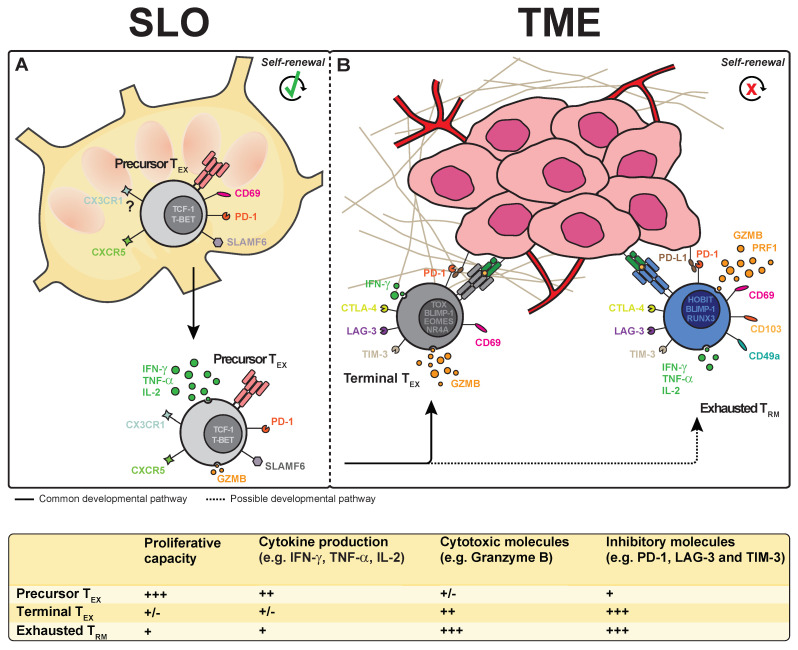
Figure 1
Figure 1
The differentiation pathway of exhausted T cells and tissue-resident memory T cells in the tumor microenvironment. (A) Upon activation, precursor exhausted T (TEX) cells expressing the surface molecules SLAMF6, CXCR5 and CD69 and the transcription factors TCF-1 and T-BET migrate from the T cell zones of the secondary lymphoid organs (SLO) towards the tumor microenvironment (TME). (B) In the TME, precursor TEX differentiate into terminal TEX, which express the transcription factors TOX, BLIMP-1, Eomes and NR4A, and have an impaired ability to produce cytokines (e.g., IFN-γ, TNF-α and IL-2), but an increased production of cytotoxic molecules (e.g., granzyme B). Terminal TEX also upregulate the expression of inhibitory receptors, such as PD-1, CTLA-4, LAG-3 and TIM-3. Precursor TEX may also give rise to intratumoral tissue-resident memory T (TRM) cells expressing the transcription factors BLIMP-1, HOBIT and RUNX3 and the extracellular molecules CD69, CD103 and CD49a. Similar to terminal TEX, TRM upregulate inhibitory receptors and downregulate cytokine responses. In contrast, TRM appear to maintain expression of cytotoxic molecules. Abbreviations: BLIMP-1, B lymphocyte-induced maturation protein 1; CTLA-4, cytotoxic T-lymphocyte-associated protein 4; CX3CR1, CX3C chemokine receptor 1; CXCR5, C-X-C chemokine receptor type 5; GZMB, granzyme B; HOBIT, homolog of Blimp-1 in T cells; IFN-γ, interferon gamma; IL-2, interleukin 2; LAG-3, lymphocyte-activation gene 3; NR4A, nuclear hormone receptor 4A; PD-1, programmed cell death protein 1; PRF1, perforin 1; RUNX3, runt-related transcription factor 3; SLAMF6, SLAM family member 6; T-BET, T-box transcription factor 21; TCF-1, T-cell factor 1; TIM-3, T-cell immunoglobulin and mucin domain 3; TNF-α, tumor necrosis factor alpha; TOX, thymocyte selection-associated high-mobility group box protein.
Figure 2
Figure 2
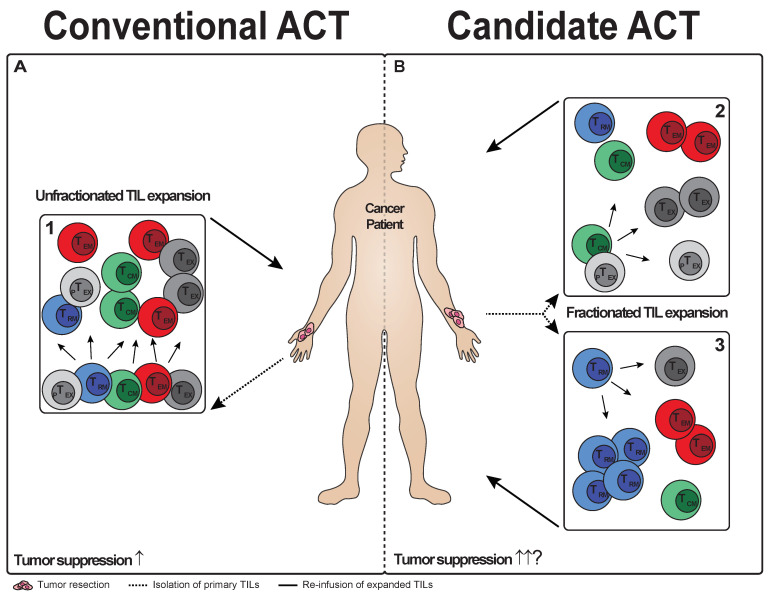
Strategies of conventional and candidate adoptive T cell therapy. (A) TIL therapy involves the isolation and expansion of tumor-infiltrating lymphocytes (TILs) from tumor tissue for reinfusion into the cancer patient. The current strategy employs unfractionated TILs that may include central memory T (TCM) cells, effector memory T (TEM) cells, tissue-resident memory T (TRM) cells and precursor and terminal exhausted T (TEX) cells (panel 1). (B) A potential novel strategy of TIL therapy is to select TCM or precursor TEX, which have high potential to form the complete spectrum of T cell subsets. However, these precursor cells may have limited potential to form TRM (panel 2). Therefore, another approach to establish improved TIL therapy may be to select TRM cells from tumor tissue, which have intrinsic capacity to reform TRM (panel 3). Both strategies may have the potential to improve the efficacy of TIL therapy to counter tumor growth.

References

    1. Rohaan M.W., Wilgenhof S., Haanen J.B.A.G. Adoptive cellular therapies: The current landscape. Virchows. 2018;474:449–461. doi: 10.1007/s00428-018-2484-0. - DOI - PMC - PubMed
    1. Chen D., Mellman I. Oncology Meets Immunology: The Cancer-Immunity Cycle. Immunity. 2013;39:1–10. doi: 10.1016/j.immuni.2013.07.012. - DOI - PubMed
    1. Beatty G.L., Gladney W.L. Immune Escape Mechanisms as a Guide for Cancer Immunotherapy. Clin. Cancer Res. 2014;21:687–692. doi: 10.1158/1078-0432.CCR-14-1860. - DOI - PMC - PubMed
    1. Schumacher T.N., Scheper W., Kvistborg P. Cancer Neoantigens. Annu. Rev. Immunol. 2019;37:173–200. doi: 10.1146/annurev-immunol-042617-053402. - DOI - PubMed
    1. Schumacher T.N., Schreiber R.D. Neoantigens in cancer immunotherapy. Science. 2015;348:69–74. doi: 10.1126/science.aaa4971. - DOI - PubMed

Publication types

MeSH terms

Substances