Observational Study
. 2021 Sep 2;10(9):2293.
doi: 10.3390/cells10092293.

Biological and Clinical Factors Contributing to the Metabolic Heterogeneity of Hospitalized Patients with and without COVID-19

Affiliations
Observational Study

Biological and Clinical Factors Contributing to the Metabolic Heterogeneity of Hospitalized Patients with and without COVID-19

Angelo D'Alessandro et al. Cells. .

Abstract

The Corona Virus Disease 2019 (COVID-19) pandemic represents an ongoing worldwide challenge. The present large study sought to understand independent and overlapping metabolic features of samples from acutely ill patients (n = 831) that tested positive (n = 543) or negative (n = 288) for COVID-19. High-throughput metabolomics analyses were complemented with antigen and enzymatic activity assays on plasma from acutely ill patients collected while in the emergency department, at admission, or during hospitalization. Lipidomics analyses were also performed on COVID-19-positive or -negative subjects with the lowest and highest body mass index (n = 60/group). Significant changes in amino acid and fatty acid/acylcarnitine metabolism emerged as highly relevant markers of disease severity, progression, and prognosis as a function of biological and clinical variables in these patients. Further, machine learning models were trained by entering all metabolomics and clinical data from half of the COVID-19 patient cohort and then tested on the other half, yielding ~78% prediction accuracy. Finally, the extensive amount of information accumulated in this large, prospective, observational study provides a foundation for mechanistic follow-up studies and data sharing opportunities, which will advance our understanding of the characteristics of the plasma metabolism in COVID-19 and other acute critical illnesses.

Keywords: COVID-19; acylcarnitine; amino acid; fatty acid; kynurenine; metabolomics; tryptophan.


Conflict of interest statement

Though unrelated to the contents of this manuscript, the authors declare that A.D. and T.N. are founders of Omix Technologies Inc and Altis Biosciences LLC. A.D. and S.L.S. are consultants for Hemanext Inc. S.L.S. is also a consultant for Tioma, Inc. and TCIP, Inc., and the Executive Director of the Worldwide Initiative for Rh Disease Eradication (WIRhE). A.D. is a consultant for FORMA LLC. All the other authors disclose that no conflict of interest exist.

Figures
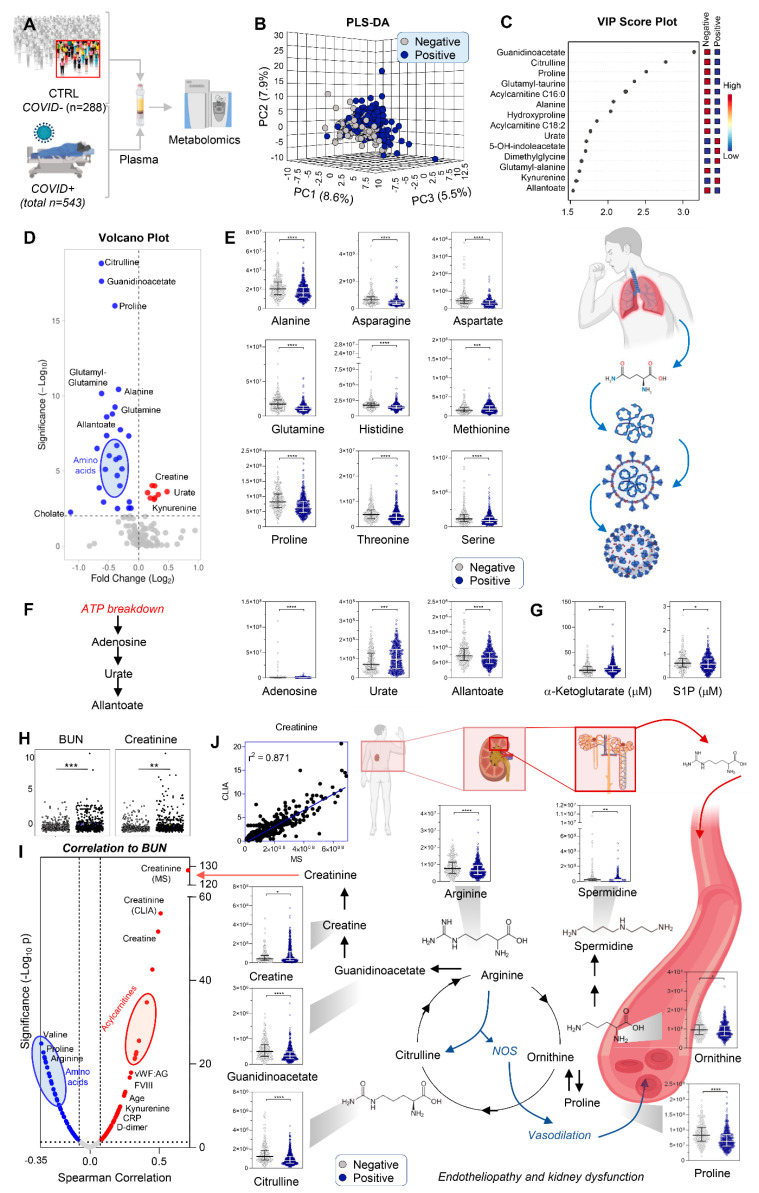
Figure 1
Figure 1
Metabolomics of hospitalized patients with (n = 543) and without (n = 288) COVID-19 (A). Partial least square-discriminant analysis of metabolomics data separated the two cohorts (B). Top 15 metabolites with the highest loading weights are indicated in the variable importance in projection (VIP) ranked list in (C). In (D), the volcano plot highlights significant effects of COVID-19 on plasma amino acid levels and purine oxidation. Violin plots (including median + ranges) are shown for amino acids (E) and purines (F) from relative quantitative analyses, and for two markers of mitochondrial dysfunction and hypoxia, alpha-ketoglutarate and sphingosine 1-phosphate (S1P), using absolute quantitative analyses against stable isotope-labeled internal standards in (G). In (H), blood urea nitrogen (BUN) and creatinine, markers of kidney dysfunction, were significantly increased in COVID-19 patients. Metabolic and clinical correlates of BUN (top positive correlate being creatinine) are in (I). A significant positive correlation (p < 0.0001; r2 = 0.871) was observed between creatinine measurements via CLIA-certified and mass spectrometry (MS)-based approaches (J). In (J), violin plots highlight metabolites in the arginine, proline, and creatine metabolism. Asterisks indicate significance (* p < 0.05; ** p < 0.01; *** p < 0.001; **** p < 0.0001).
Figure 2
Figure 2
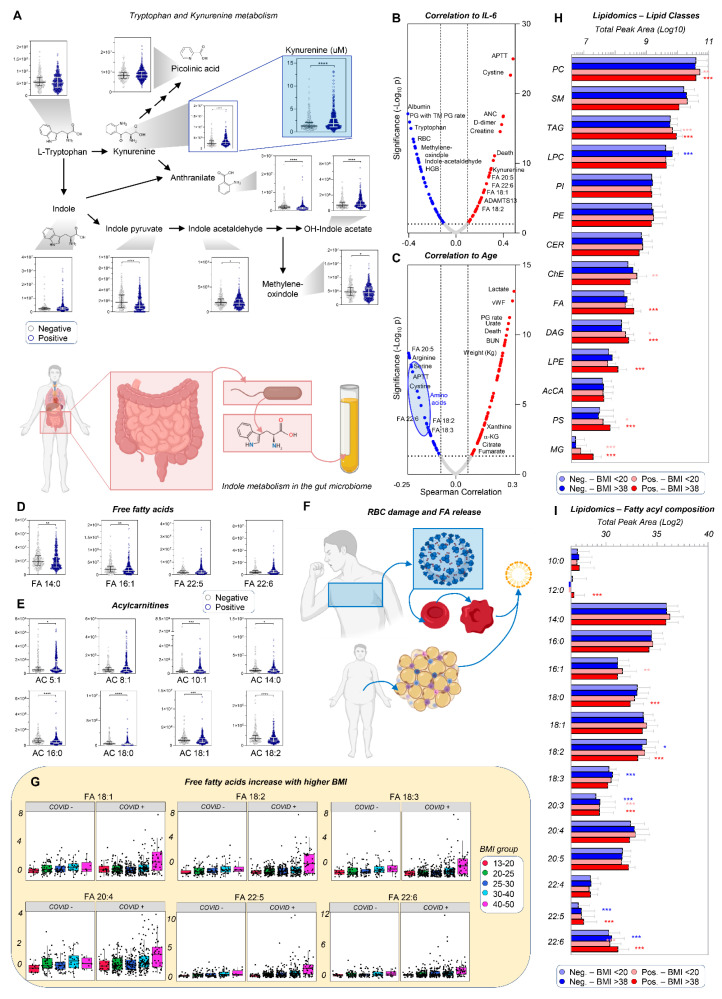
Alteration of tryptophan/kynurenine/indole metabolism as a function of inflammation, and dysregulation of lipid metabolism as a function of body mass index in hospitalized patients with and without COVID-19. In (A), violin plot of tryptophan metabolism as a function of COVID status (median + range). Metabolic and clinical correlates to interleukin 6 (IL-6) as a marker of inflammation (B) and patient age (C) indicate a strong correlation of this pathway and lipid metabolism, especially free fatty acids (D) and acylcarnitines (E), with disease state. Free fatty acids may derive from blood cell vesiculation and/or mobilization from white adipose tissue, a process that could fuel viral membrane formation (F). In (G), breakdown of free fatty acid levels as a function of patients’ body mass index (BMI) and COVID-19 status. Lipidomics analyses of COVID-19-positive and -negative patients with BMI lower than 20 or higher than 38 revealed a significant impact of these variables on lipid class (H) and fatty acyl composition (I). (p < 0.05; * p < 0.01; ** p < 0.001; *** p < 0.0001; **** p < 0.0001).
Figure 3
Figure 3
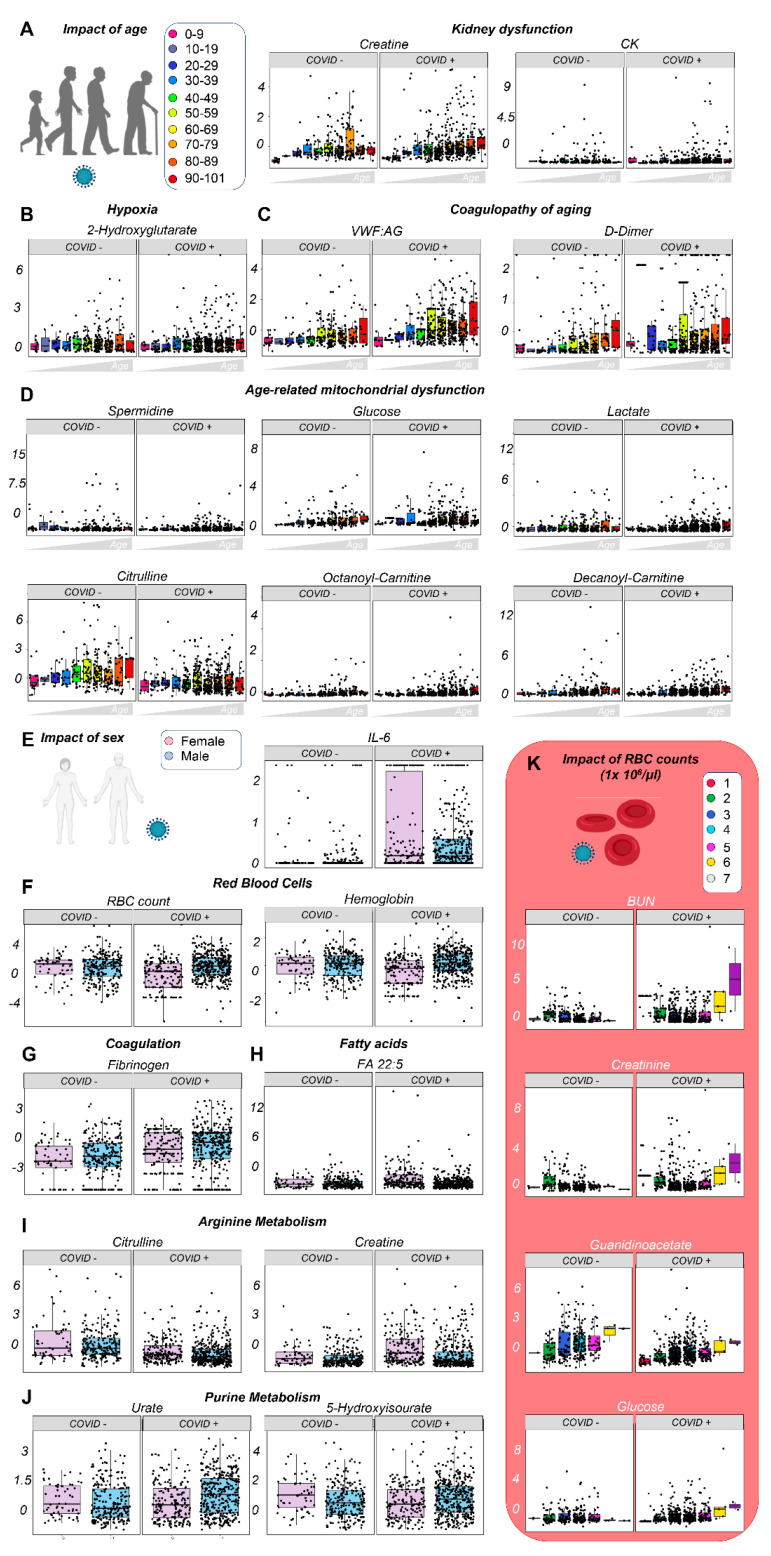
The impact of age and sex on the plasma metabolome of hospitalized patients with or without COVID-19. Patients were clustered into groups depending on their age (A). Significant correlates to age or COVID-19 status were identified through Spearman correlation and two-way ANOVA, with top variables including markers of kidney dysfunction (A), hypoxia (B), coagulopathy (C), and age-related mitochondrial dysfunction (D). Similar analyses were performed as a function of patients’ COVID-19 status and sex (E), with inflammatory markers being significantly affected by COVID-19, and RBC (F) and coagulation parameters (G) by sex. Similarly, sex affected fatty acid levels (especially poly- and highly unsaturated, long-chain fatty acids), and arginine and purine metabolism (HJ). Because of the impact of sex on RBC-related parameters, additional analyses were performed highlighting correlates to RBC counts and COVID-19 status, demonstrating a strong correlation with kidney dysfunction (K). All the metabolites shown in this figure as dot plots are significant by two-way ANOVA (FDR < 0.05).
Figure 4
Figure 4
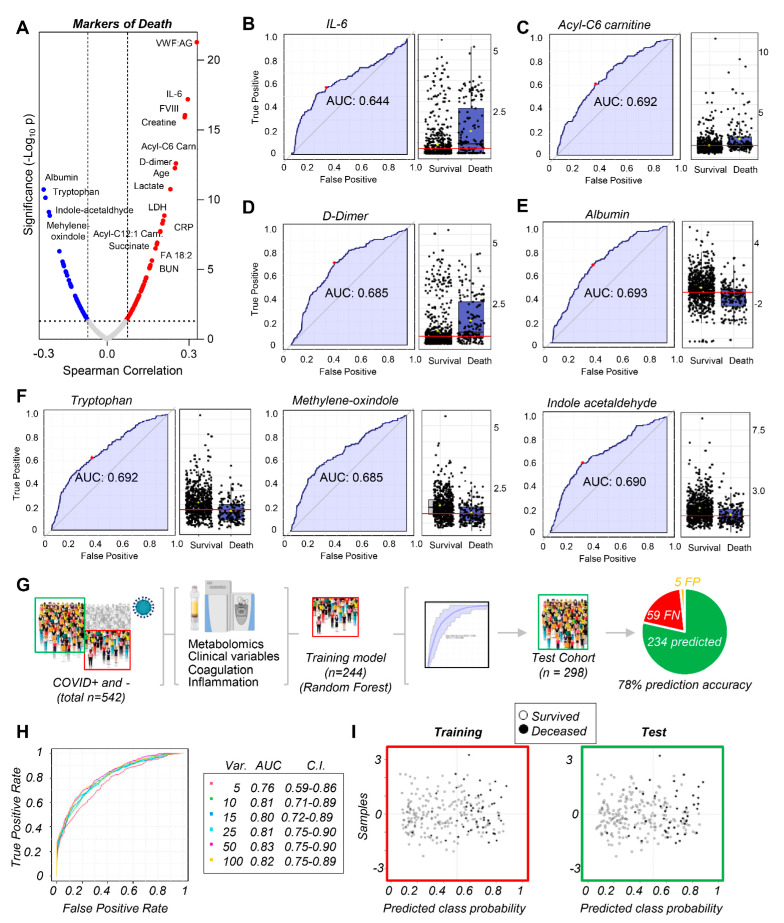
Markers of mortality in hospitalized patients, including COVID-19 patients. In (A), clinical and metabolic markers of mortality were ranked from Spearman correlation analyses (y axes indicate −log10 of p-values). Because mortality is a non-continuous variable, additional univariate (BF) and multivariate (G) biomarker analyses were performed to calculate ROC curves and train machine learning algorithms (random forest in this figure, supporting vector machine in the Supplement) to predict mortality in hospitalized COVID-19 patients based on the top 10 clinical and metabolic variables (H), a model that yielded 78% prediction accuracy (GI).
Figure 5
Figure 5
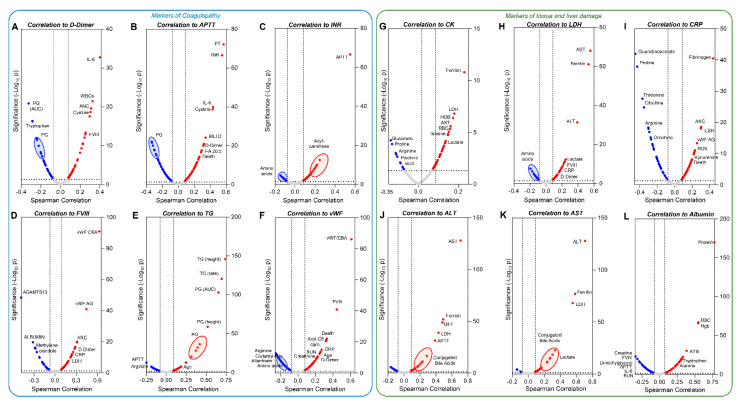
Metabolic correlates to coagulation parameters and markers of tissue and liver damage. Spearman correlation analyses correlated clinical and metabolic parameters to coagulation status (AF) or tissue damage (GL). Volcano plots represent metabolites that have significant (p < 0.05) positive (red) or negative (blue) correlations with any of the parameters. Parameters are abbreviated using standard clinical terms.
Figure 6
Figure 6
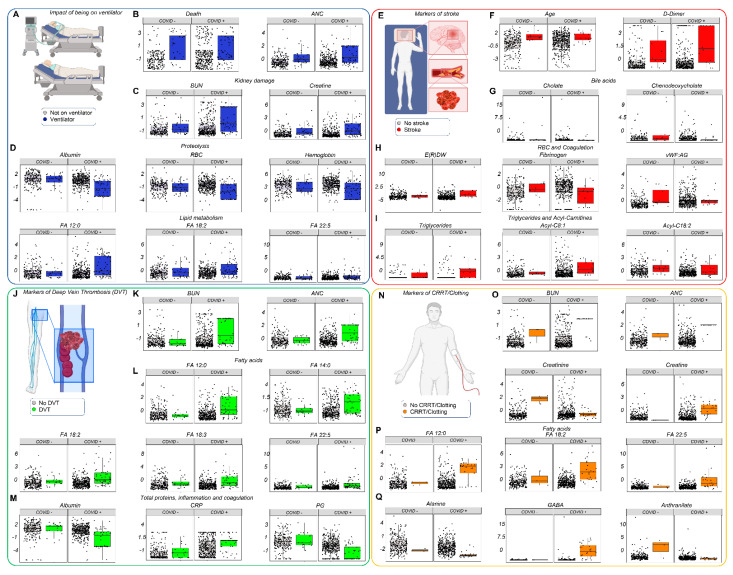
Clinical complications and metabolic/clinical markers. Hospitalized patients, with and without COVID-19, were divided into subgroups depending on clinical complications (e.g., stroke, deep vein thrombosis) and/or interventions (e.g., ventilators, hemodialysis). Mechanical ventilation (AE), stroke (FJ), DVT (KN), and hemodialysis (with or without coagulopathy; OQ ) in both COVID-19 patients and controls. All metabolites shown in this figure as dot plots are significant by two-way ANOVA (FDR < 0.05).
Figure 7
Figure 7
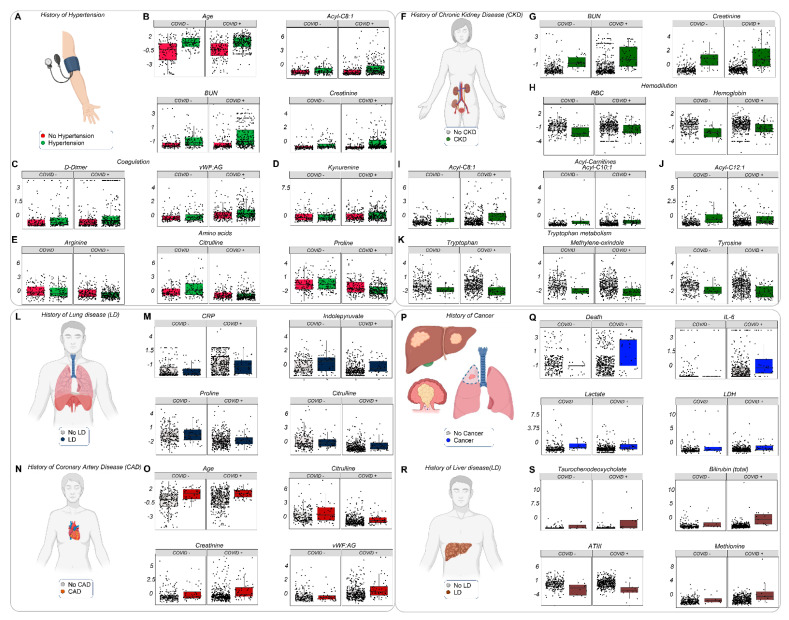
Pre-existing conditions and metabolic/clinical markers. Hospitalized patients, with and without COVID-19, were divided into subgroups depending on clinical history. Specifically, patients were identified who presented with a history of hypertension (AE), chronic kidney disease (FK), lung disease (LM), coronary artery disease (N,O), cancer (P,Q), or liver disease (R,S). All metabolite/clinical variables shown in this figure as dot plots are significant by two-way ANOVA (FDR < 0.05).
Figure 8
Figure 8
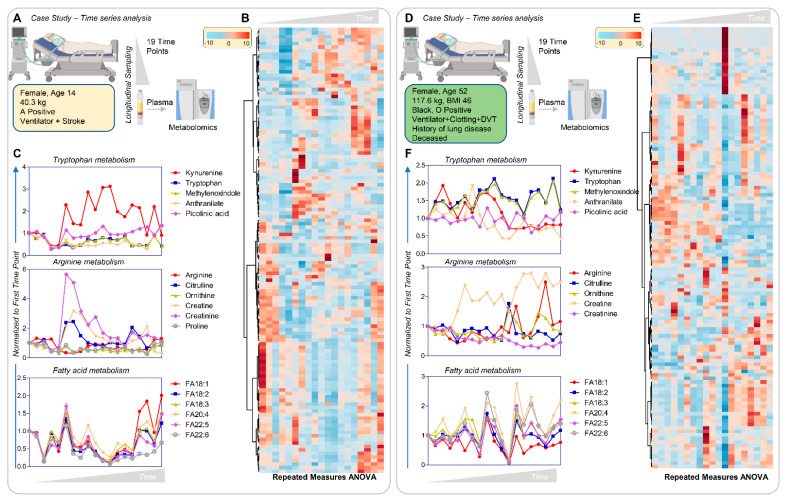
Time-course analysis of two patients with severe COVID-19, one surviving (AC) and one dying (DF) of disease. Both patients were ventilated with coagulopathic complications, either stroke or deep vein thrombosis. The first patient, a 14-year-old female with no pre-existing conditions, survived at the end of the time course and manifested transient activation of the kynurenine pathway and accumulation of creatinine (kidney dysfunction), which resolved early (C). This patient was also characterized by late accumulation of plasma free fatty acids (18C, 20C, and 22C poly- and highly unsaturated fatty acids). The second patient, a 52-year-old female with a history of obesity and lung disease, did not survive COVID-19; no activation of the kynurenine pathway was observed and creatine levels remained elevated.

Update of

References

    1. Thomas T., Stefanoni D., Reisz J.A., Nemkov T., Bertolone L., Francis R.O., Hudson K.E., Zimring J.C., Hansen K.C., Hod E.A., et al. COVID-19 infection alters kynurenine and fatty acid metabolism, correlating with IL-6 levels and renal status. JCI Insight. 2020;5:e140327. doi: 10.1172/jci.insight.140327. - DOI - PMC - PubMed
    1. Aggarwal S., Acharjee A., Mukherjee A., Baker M.S., Srivastava S. Role of Multiomics Data to Understand Host-Pathogen Interactions in COVID-19 Pathogenesis. J. Proteome. Res. 2021;20:1107–1132. doi: 10.1021/acs.jproteome.0c00771. - DOI - PubMed
    1. Zheng H., Jin S., Li T., Ying W., Ying B., Chen D., Ning J., Zheng C., Li Y., Li C., et al. Metabolomics reveals sex-specific metabolic shifts and predicts the duration from positive to negative in non-severe COVID-19 patients during recovery process. Comput. Struct. Biotechnol. J. 2021;19:1863–1873. doi: 10.1016/j.csbj.2021.03.039. - DOI - PMC - PubMed
    1. Xiao N., Nie M., Pang H., Wang B., Hu J., Meng X., Li K., Ran X., Long Q., Deng H., et al. Integrated cytokine and metabolite analysis reveals immunometabolic reprogramming in COVID-19 patients with therapeutic implications. Nat. Commun. 2021;12:1618. doi: 10.1038/s41467-021-21907-9. - DOI - PMC - PubMed
    1. Thomas T., Stefanoni D., Dzieciatkowska M., Issaian A., Nemkov T., Hill R.C., Francis R.O., Hudson K.E., Buehler P.W., Zimring J.C., et al. Evidence of Structural Protein Damage and Membrane Lipid Remodeling in Red Blood Cells from COVID-19 Patients. J. Proteome Res. 2020;19:4455–4469. doi: 10.1021/acs.jproteome.0c00606. - DOI - PMC - PubMed

Publication types