Review
. 2021 Sep 14;10(9):2417.
doi: 10.3390/cells10092417.

Remodeling of Ion Channel Trafficking and Cardiac Arrhythmias

Affiliations
Review

Remodeling of Ion Channel Trafficking and Cardiac Arrhythmias

Camille E Blandin et al. Cells. .

Abstract

Both inherited and acquired cardiac arrhythmias are often associated with the abnormal functional expression of ion channels at the cellular level. The complex machinery that continuously traffics, anchors, organizes, and recycles ion channels at the plasma membrane of a cardiomyocyte appears to be a major source of channel dysfunction during cardiac arrhythmias. This has been well established with the discovery of mutations in the genes encoding several ion channels and ion channel partners during inherited cardiac arrhythmias. Fibrosis, altered myocyte contacts, and post-transcriptional protein changes are common factors that disorganize normal channel trafficking during acquired cardiac arrhythmias. Channel availability, described notably for hERG and KV1.5 channels, could be another potent arrhythmogenic mechanism. From this molecular knowledge on cardiac arrhythmias will emerge novel antiarrhythmic strategies.

Keywords: arrhythmias; ion channel partners; ion channels; trafficking.


Conflict of interest statement

The authors declare no conflict of interest.

Figures
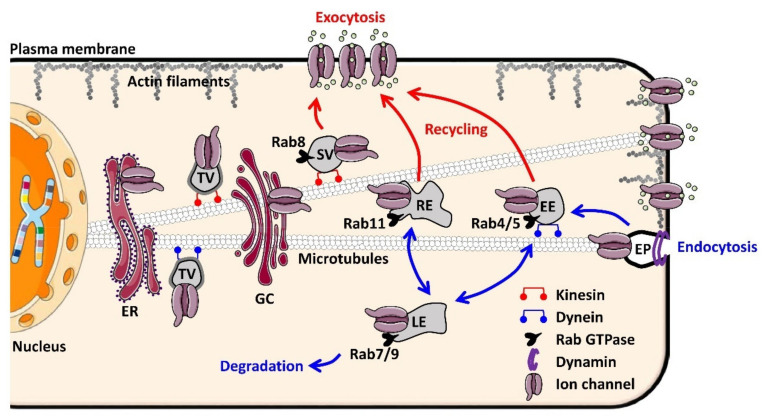
Figure 1
Figure 1
General diagram of the different steps and regulators involved in ion channel trafficking. Ion channels are directed to the plasma membrane via the anterograde and recycling pathways (red arrows). Due to their topology, proteins with multiple transmembrane domains, such as ion channels, have their C- and N-terminal domains exposed on the cytoplasmic side during transport. Endocytosis is ensured by membrane bending and fission of the endocytosis pit, mainly by dynamin (purple). Internalization signals (blue arrows) lead to degradation or recycling. Rab GTPases regulate specific steps of trafficking in the cytoplasm. Molecular motors, such as kinesin and dynein, ensure the transport of vesicles along microtubules, respectively, in the anterograde and retrograde directions. The molecular motors involved in transport along actin filaments are myosins: myosin V in the anterograde direction, myosin VI in the retrograde direction. Abbreviations: EE: early endosome; EP: endocytosis pit; ER: endoplasmic reticulum; LE: late endosome; GC: Golgi complex; RE: recycling endosome; SV: secretory vesicles (from neo-synthesis); TV: transition vesicles (shuttling between ER and the Golgi complex).
Figure 2
Figure 2
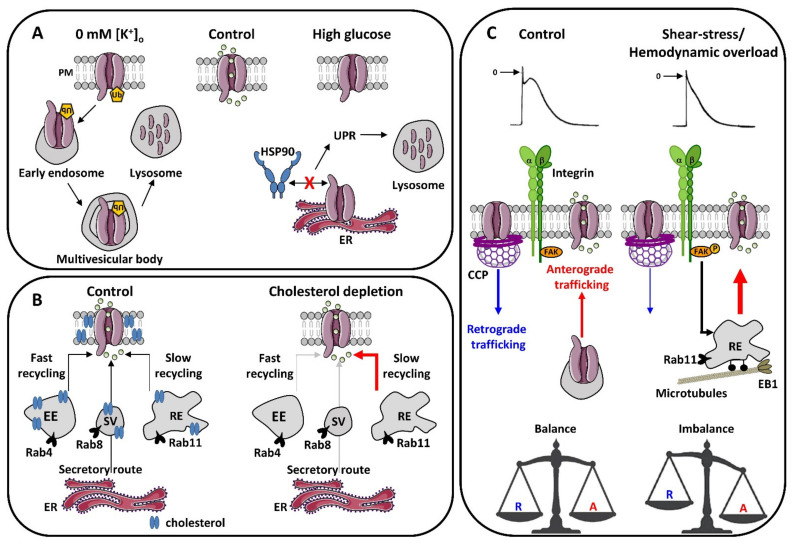
Summary diagram of alterations in the intracellular trafficking of cardiac potassium channels involved in acquired arrhythmias. (A) Regulation of hERG channel trafficking by hypokalemia and hyperglycemia. Decreased extracellular potassium triggers hERG channel ubiquitination, internalization, and degradation. Hyperglycemia interrupts the interaction between hERG and the chaperone HSP90 and prevents its anterograde trafficking to the membrane, activating the UPR and channel degradation. (B) Regulation of KV1.5 trafficking by cholesterol. Cholesterol depletion activates the recycling and exocytosis of the KV1.5 channel from the recycling endosome without affecting either the secretory route or the fast recycling pathway mediated by the early endosome. (C) Regulation of KV1.5 trafficking by mechanical constraint and atrial remodeling. In control condition, both anterograde and retrograde pathways are at equilibrium. Laminar shear stress stimulates the integrin/phospho-FAK signaling, which activates the recycling of KV1.5 channels accumulated in the recycling endosome. In remodeled atria and during AF, this recycling pathway is constitutively activated and the trafficking balance is altered in the direction of a favored anterograde traffic to the detriment of retrograde traffic. Abbreviations: A: anterograde; CCP: clathrin-coated pit (cleaved by dynamin); EB1: end-binding protein 1; EE: early endosome; ER: endoplasmic reticulum; FAK: focal adhesion kinase; HSP90: heat shock protein 90; P: phosphorylation; PM: plasma membrane; RE: recycling endosome; R: retrograde; SV: secretory vesicle; Ub: ubiquitylation; UPR: unfolded protein response.

References

    1. Hatem S.N., Coulombe A., Balse E. Specificities of Atrial Electrophysiology: Clues to a Better Understanding of Cardiac Function and the Mechanisms of Arrhythmias. J. Mol. Cell. Cardiol. 2010;48:90–95. doi: 10.1016/j.yjmcc.2009.08.029. - DOI - PubMed
    1. Douglas P.M., Cyr D.M. Interplay Between Protein Homeostasis Networks in Protein Aggregation and Proteotoxicity. Biopolymers. 2010;93:229–236. doi: 10.1002/bip.21304. - DOI - PMC - PubMed
    1. Shikano S., Coblitz B., Wu M., Li M. 14-3-3 Proteins: Regulation of Endoplasmic Reticulum Localization and Surface Expression of Membrane Proteins. Trends Cell Biol. 2006;16:370–375. doi: 10.1016/j.tcb.2006.05.006. - DOI - PubMed
    1. Yuan H., Michelsen K., Schwappach B. 14-3-3 Dimers Probe the Assembly Status of Multimeric Membrane Proteins. Curr. Biol. CB. 2003;13:638–646. doi: 10.1016/S0960-9822(03)00208-2. - DOI - PubMed
    1. Glembotski C.C. Endoplasmic Reticulum Stress in the Heart. Circ. Res. 2007;101:975–984. doi: 10.1161/CIRCRESAHA.107.161273. - DOI - PubMed

Publication types

MeSH terms