Review
. 2021 Sep 15;10(9):2435.
doi: 10.3390/cells10092435.

T Cell Immunosenescence in Aging, Obesity, and Cardiovascular Disease

Affiliations
Review

T Cell Immunosenescence in Aging, Obesity, and Cardiovascular Disease

Kohsuke Shirakawa et al. Cells. .

Abstract

Although advances in preventive medicine have greatly improved prognosis, cardiovascular disease (CVD) remains the leading cause of death worldwide. This clearly indicates that there remain residual cardiovascular risks that have not been targeted by conventional therapies. The results of multiple animal studies and clinical trials clearly indicate that inflammation is the most important residual risk and a potential target for CVD prevention. The immune cell network is intricately regulated to maintain homeostasis. Ageing associated changes to the immune system occurs in both innate and adaptive immune cells, however T cells are most susceptible to this process. T-cell changes due to thymic degeneration and homeostatic proliferation, metabolic abnormalities, telomere length shortening, and epigenetic changes associated with aging and obesity may not only reduce normal immune function, but also induce inflammatory tendencies, a process referred to as immunosenescence. Since the disruption of biological homeostasis by T cell immunosenescence is closely related to the development and progression of CVD via inflammation, senescent T cells are attracting attention as a new therapeutic target. In this review, we discuss the relationship between CVD and T cell immunosenescence associated with aging and obesity.

Keywords: T cell; cardiovascular disease; immunosenescence; obesity.


Conflict of interest statement

Both authors have read the journal authorship agreement and policy on disclosure of potential conflict of interest and have nothing to disclose.

Figures
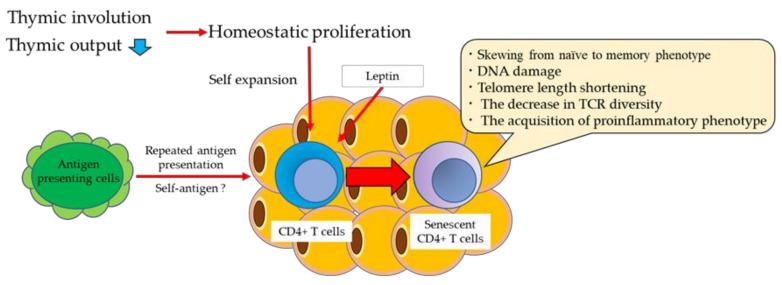
Figure 1
Figure 1
T cell senescence during obesity. Obesity leads to the skewing of the T cell subset from naïve to memory phenotypes, accelerates thymic involution, and restricts TCR diversity. Obesity-induced reduction of thymic output leads to extensive homeostatic proliferation of peripheral T cells, which may contribute to T cell senescence. VAT T cells show a senescent phenotype, including telomere length shortening, restricted TCR diversity, and production of proinflammatory cytokines.
Figure 2
Figure 2
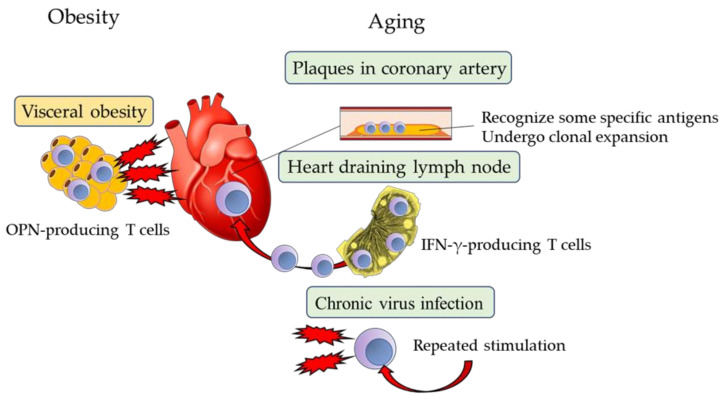
CVD pathogenesis from the perspective of immunosenescence. Proinflammatory senescent T cells recognize specific antigens, undergo clonal expansion, and infiltrate unstable coronary plaques. IFN-γ-producing T cells accumulate in the heart-draining lymph nodes of aged mice, which infiltrate the myocardium and cardiac fibrosis. Chronic viral infections, such as those by cytomegalovirus, may contribute to the development of T cell senescence. Visceral obesity accelerates T cell senescence. Senescent T cells may contribute to the pathogenesis of CVD.

References

    1. Golia E., Limongelli G., Natale F., Fimiani F., Maddaloni V., Pariggiano I., Bianchi R., Crisci M., D’Acierno L., Giordano R., et al. Inflammation and Cardiovascular Disease: From Pathogenesis to Therapeutic Target. Curr. Atheroscler. Rep. 2014;16:1–7. doi: 10.1007/s11883-014-0435-z. - DOI - PubMed
    1. Lutgens E., Atzler D., Döring Y., Duchene J., Steffens S., Weber C. Immunotherapy for cardiovascular disease. Eur. Heart J. 2019;40:3937–3946. doi: 10.1093/eurheartj/ehz283. - DOI - PubMed
    1. Hervas S.M., González-Navarro H. Anti-inflammatory Therapies for Cardiovascular Disease: Signaling Pathways and Mecanisms. Rev. Española Cardiol. (Engl. Ed.) 2019;72:767–773. doi: 10.1016/j.rec.2019.03.007. - DOI - PubMed
    1. Nidorf S.M., Fiolet A.T.L., Mosterd A., Eikelboom J.W., Schut A., Opstal T.S.J., The S.H.K., Xu X.-F., Ireland M.A., Lenderink T., et al. Colchicine in Patients with Chronic Coronary Disease. N. Engl. J. Med. 2020;383:1838–1847. doi: 10.1056/NEJMoa2021372. - DOI - PubMed
    1. Ridker P.M. Clinical Application of C-Reactive Protein for Cardiovascular Disease Detection and Prevention. Circulation. 2003;107:363–369. doi: 10.1161/01.CIR.0000053730.47739.3C. - DOI - PubMed

Publication types

LinkOut - more resources