


Design and Prototyping of Genetically Encoded Arsenic Biosensors Based on Transcriptional Regulator AfArsR
- PMID: 34572489
- PMCID: PMC8470949
- DOI: 10.3390/biom11091276
Design and Prototyping of Genetically Encoded Arsenic Biosensors Based on Transcriptional Regulator AfArsR
Abstract
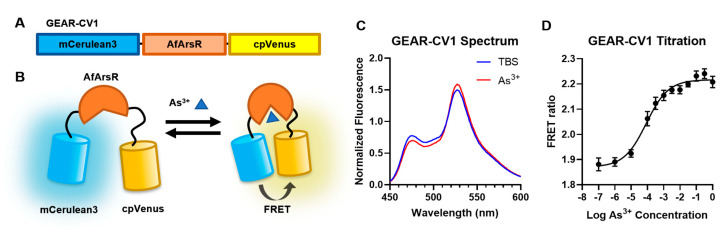
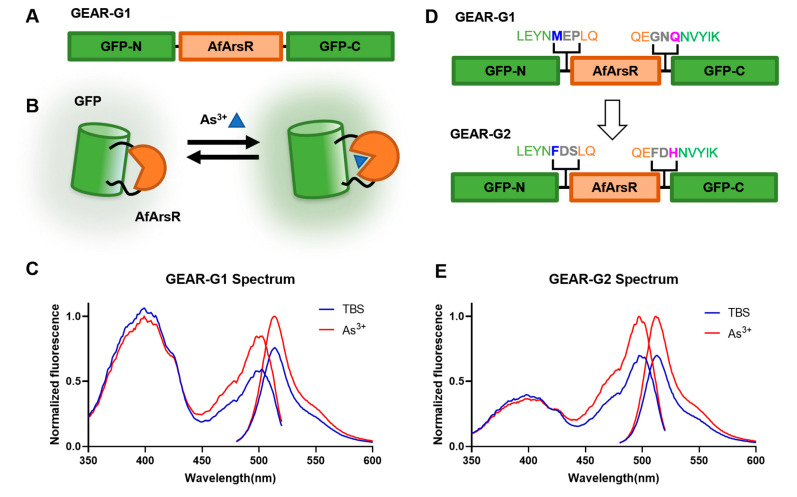
Genetically encoded biosensors based on engineered fluorescent proteins (FPs) are essential tools for monitoring the dynamics of specific ions and molecules in biological systems. Arsenic ion in the +3 oxidation state (As3+) is highly toxic to cells due to its ability to bind to protein thiol groups, leading to inhibition of protein function, disruption of protein-protein interactions, and eventually to cell death. A genetically encoded biosensor for the detection of As3+ could potentially facilitate the investigation of such toxicity both in vitro and in vivo. Here, we designed and developed two prototype genetically encoded arsenic biosensors (GEARs), based on a bacterial As3+ responsive transcriptional factor AfArsR from Acidithiobacillus ferrooxidans. We constructed FRET-based GEAR biosensors by insertion of AfArsR between FP acceptor/donor FRET pairs. We further designed and engineered single FP-based GEAR biosensors by insertion of AfArsR into GFP. These constructs represent prototypes for a new family of biosensors based on the ArsR transcriptional factor scaffold. Further improvements of the GEAR biosensor family could lead to variants with suitable performance for detection of As3+ in various biological and environmental systems.
Keywords: FRET and FP-based arsenic biosensors; arsenic biosensors (GEARs); genetically encoded biosensor.
Conflict of interest statement
The authors declare no conflict of interest.
Figures
References
Publication types
MeSH terms
Substances
Supplementary concepts
LinkOut - more resources
Full Text Sources
Medical
Research Materials
Miscellaneous
