Review
. 2021 Sep 14;13(18):4601.
doi: 10.3390/cancers13184601.

Precision Oncology with Drugs Targeting the Replication Stress, ATR, and Schlafen 11

Affiliations
Review

Precision Oncology with Drugs Targeting the Replication Stress, ATR, and Schlafen 11

Ukhyun Jo et al. Cancers (Basel). .

Abstract

Precision medicine aims to implement strategies based on the molecular features of tumors and optimized drug delivery to improve cancer diagnosis and treatment. DNA replication is a logical approach because it can be targeted by a broad range of anticancer drugs that are both clinically approved and in development. These drugs increase deleterious replication stress (RepStress); however, how to selectively target and identify the tumors with specific molecular characteristics are unmet clinical needs. Here, we provide background information on the molecular processes of DNA replication and its checkpoints, and discuss how to target replication, checkpoint, and repair pathways with ATR inhibitors and exploit Schlafen 11 (SLFN11) as a predictive biomarker.

Keywords: ATR; Adavoserib; Camptothecin; Ceralasertib; PARP; Rucaparib; berzosertib; cisplatin; niraparib; olaparib; replication stress; schlafen 11; talazoparib; temozolomide.


Conflict of interest statement

The authors declare no conflict of interest.

Figures
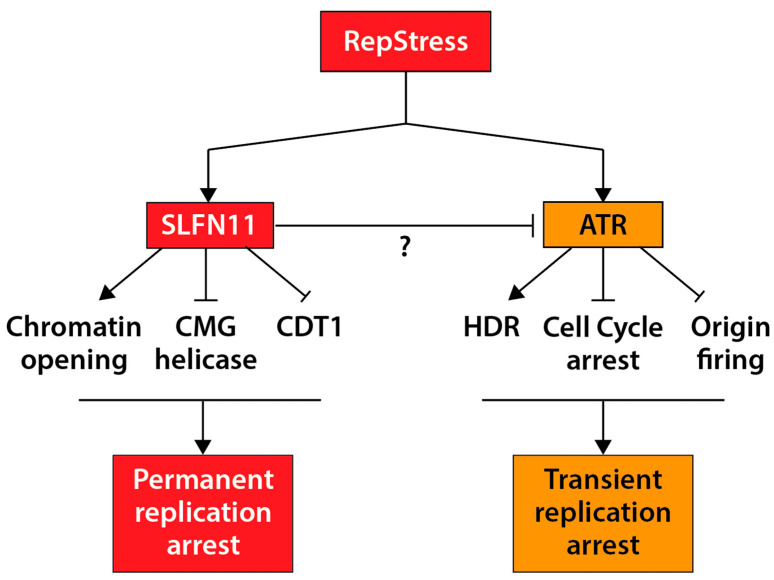
Figure 1
Figure 1
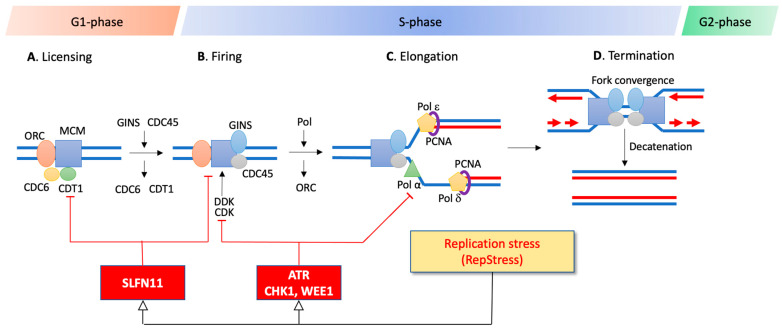
The SLFN11 and ATR pathways in response to RepStress. SLFN11 irreversibly blocks DNA replication under RepStress by promoting chromatin opening, blocking the CMG helicase complex, and promoting the degradation of CDT1 (see Section 5.1 for details). In contrast, ATR transiently halts DNA replication by arresting cell cycle and prohibiting origin firing, thereby enabling homology-directed repair (HDR).
Figure 2
Figure 2
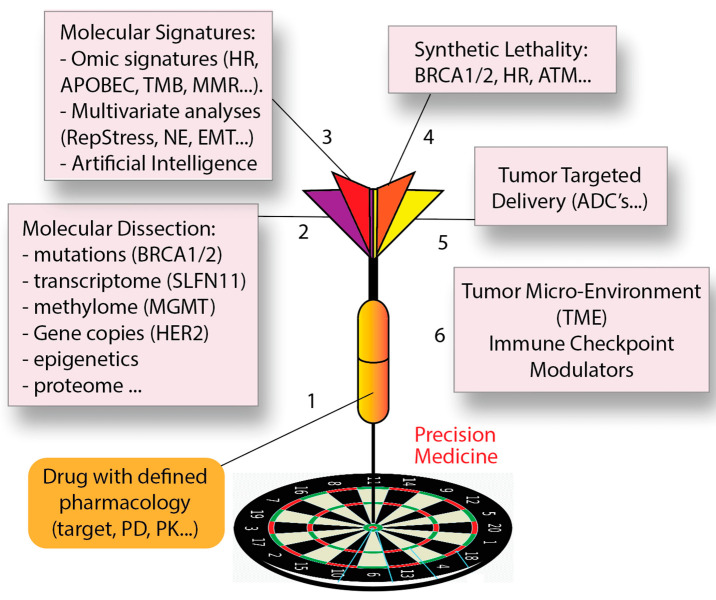
Precision medicine in the context of DNA-targeted therapies. Critical steps are: (1) Defining the molecular and clinical pharmacology of the drugs; (2) molecular dissection of tumors by multi-omics approaches; (3) identification of molecular signatures combining omic parameters; (4) determination of synthetic lethal interactions; (5) Targeted-delivery of drugs to cancer cells; and (6) adjuvant therapy by targeting the tumor microenvironment and immune checkpoints.
Figure 3
Figure 3
Schematic representation of the DNA replication steps in the context of the cell cycle and of the ATR and SLFN11 replication checkpoints. DNA replication is initiated by recognition of replication origins scattered along the genome. A, In G1, active origins of replication are licensed by ORC, CDC6, CDT1, and MCM2-7, forming the pre-replication complex (pre-RC). B, At the G1-S transition, the pre-RC complex is fired by activation of kinases (DDK and CDK) and loading GINS and CDC45, thereby unwinding the DNA duplex and initiating the replication by DNA polymerases. C, Active replication forks are elongated by the replication machinery including helicases, PCNA and DNA polymerases throughout S-phase. D, The replication process is terminated when the bidirectional replication forks merge. The RepStress is monitored and modulated by replication checkpoints, ATR and SLFN11, which are both recruited to RPA filaments. While ATR produces a transient cell cycle arrest allowing DNA repair, SLFN11 produces an irreversible replication arrest.
Figure 4
Figure 4
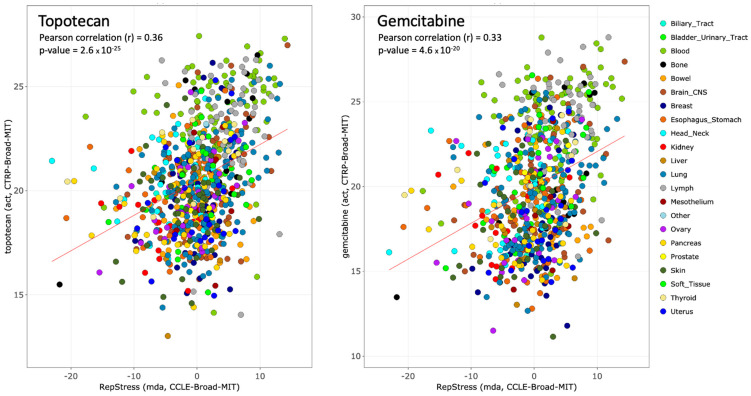
Predictive value of the RepStress genomic signature in the CCLE-CTRP Broad Institute cancer cell line databases for the TOP1 inhibitor topotecan (left) and the replication inhibitor gemcitabine (right). Data were generated from CellMinerCDB (https://discover.nci.nih.gov/cellminercdb/ (accessed on 9 February 2021)).
Figure 5
Figure 5
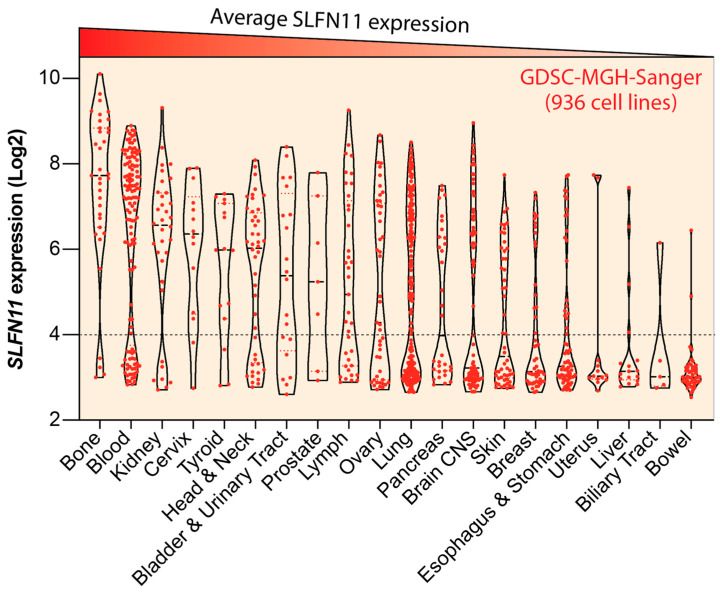
Expression status of SLFN11 across cancer cell types. Violin plot of SLFN11 expression for the GDSC-MGH-Sanger cancer cell line dataset (https://discover.nci.nih.gov/cellminercdb/ (accessed on 9 February 2021)) (total of 936 cancer cell lines). Individual cell lines are represented as red dots. The cell lines are grouped by cancer type in decreasing order (from left to right) of SLFN11 expression. Note the bimodal expression in most tissue types. Value below 4 (dotted line) indicate background (lack of) SLFN11 expression.
Figure 6
Figure 6
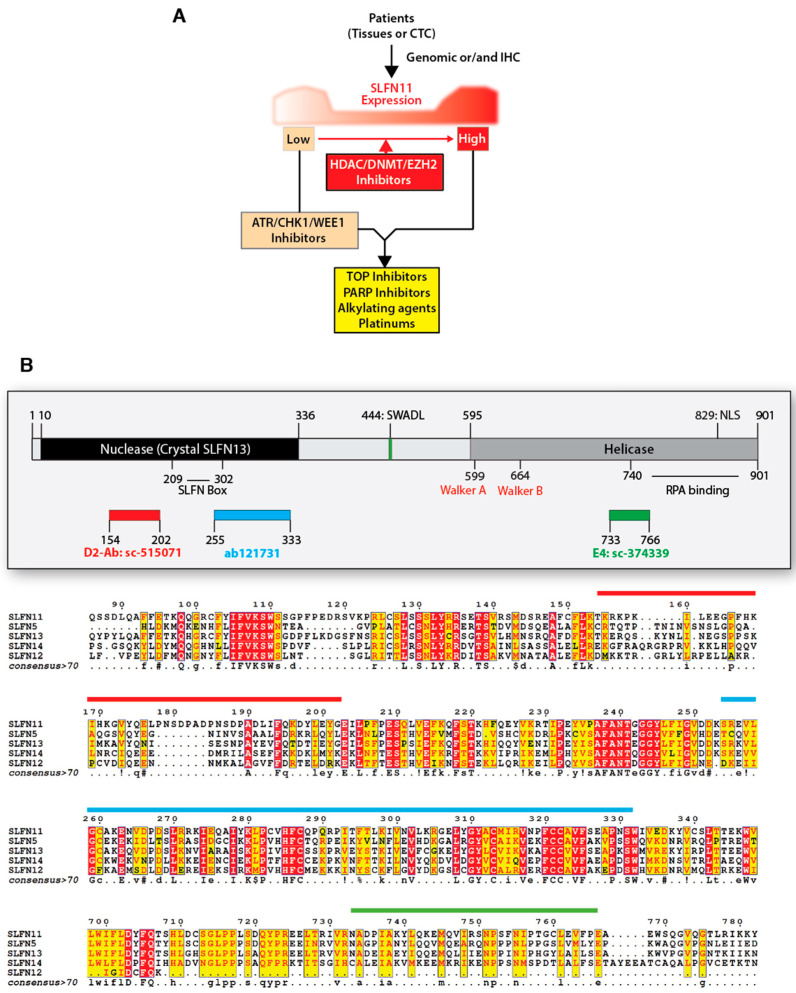
Translating SLFN11 to the clinic. (A) Guidance of SLFN11-coupled cancer therapy. Profiling SLFN11 expression levels in tumor tissues and circulating tumor cells (CTC) provides a predictive biomarker. SLFN11 expression can be reactivated by the inhibitors of epigenetic modulators (HDAC, DNMT, or EZH2). Low SLFN11 tumors are generally resistant to DNA damaging agents. Resistance of low SLFN11 tumors can be overcome synergistically by combination with replication checkpoint inhibitors (ATR/CHK1/WEE1 inhibitors). (B) Schematics of the SLFN11 polypeptide with its two main functional domains, its nuclear localization signal (NLS), its putative helicase Walker domains, and the epitopes for the commonly used antibodies. The bottom part shows the sequence alignment of human SLFNs with the targeted sequences for the available SLFN11 antibodies used for IHC detection. (D-2 and E-4: Santa Cruz Biotechnology, Dallas, TX, USA, ab121731: Abcam, Cambridge, UK).

References

    1. Kohn K.W. Beyond DNA cross-linking: History and prospects of DNA-targeted cancer treatment—Fifteenth Bruce F. Cain Memorial Award Lecture. Cancer Res. 1996;56:5533–5546. - PubMed
    1. Pommier Y., Leo E., Zhang H., Marchand C. DNA Topoisomerases and Their Poisoning by Anticancer and Antibacterial Drugs. Chem. Biol. 2010;17:421–433. doi: 10.1016/j.chembiol.2010.04.012. - DOI - PMC - PubMed
    1. Pommier Y., Marchand C. Interfacial inhibitors: Targeting macromolecular complexes. Nat. Rev. Drug Discov. 2011;11:25–36. doi: 10.1038/nrd3404. - DOI - PMC - PubMed
    1. Gaillard H., Garcia-Muse T., Aguilera A. Replication stress and cancer. Nat. Rev. Cancer. 2015;15:276–289. doi: 10.1038/nrc3916. - DOI - PubMed
    1. Ubhi T., Brown G.W. Exploiting DNA Replication Stress for Cancer Treatment. Cancer Res. 2019;79:1730–1739. doi: 10.1158/0008-5472.CAN-18-3631. - DOI - PubMed

LinkOut - more resources