Review
. 2021 Sep 14;10(9):1463.
doi: 10.3390/antiox10091463.

Nrf2 and Heme Oxygenase-1 Involvement in Atherosclerosis Related Oxidative Stress

Affiliations
Review

Nrf2 and Heme Oxygenase-1 Involvement in Atherosclerosis Related Oxidative Stress

Jose Angel Alonso-Piñeiro et al. Antioxidants (Basel). .

Abstract

Atherosclerosis remains the underlying process responsible for cardiovascular diseases and the high mortality rates associated. This chronic inflammatory disease progresses with the formation of occlusive atherosclerotic plaques over the inner walls of vascular vessels, with oxidative stress being an important element of this pathology. Oxidation of low-density lipoproteins (ox-LDL) induces endothelial dysfunction, foam cell activation, and inflammatory response, resulting in the formation of fatty streaks in the atherosclerotic wall. With this in mind, different approaches aim to reduce oxidative damage as a strategy to tackle the progression of atherosclerosis. Special attention has been paid in recent years to the transcription factor Nrf2 and its downstream-regulated protein heme oxygenase-1 (HO-1), both known to provide protection against atherosclerotic injury. In the current review, we summarize the involvement of oxidative stress in atherosclerosis, focusing on the role that these antioxidant molecules exert, as well as the potential therapeutic strategies applied to enhance their antioxidant and antiatherogenic properties.

Keywords: Nrf2; atherosclerosis; heme oxygenase-1; oxidative stress.


Conflict of interest statement

The authors declare no conflict of interest.

Figures
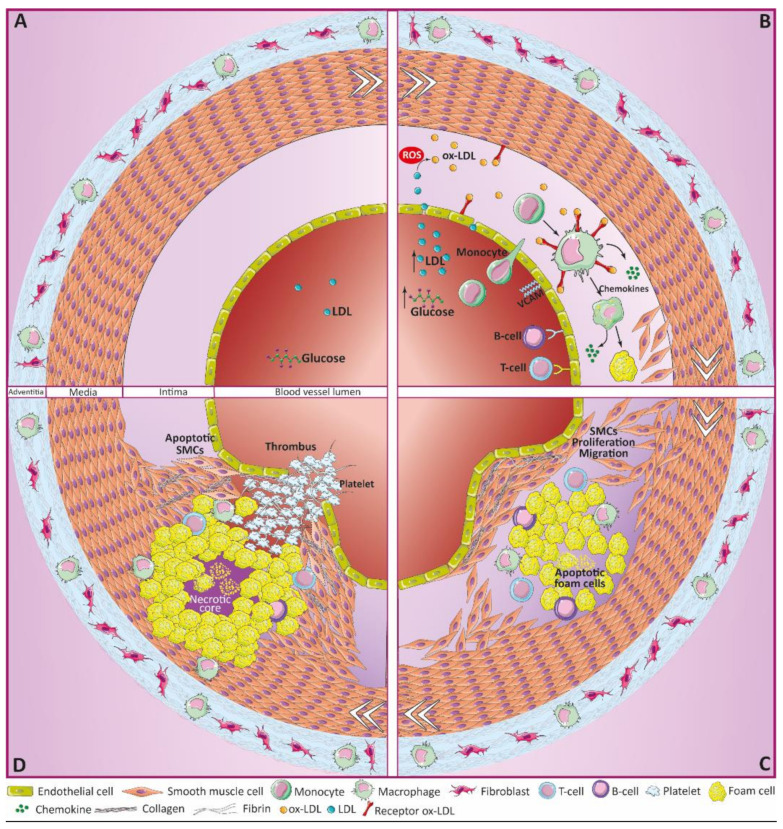
Figure 1
Figure 1
Atherosclerosis progression. (A) Different factors promote the initiation of atherosclerosis, including hyperglycemia or oxidative stress. (B) ox-LDL phagocytosis by monocyte/macrophages derives in accumulation and deposit of foam cells, and the recruitment of B and T lymphocytes. (C) Formation of fatty streaks, as well as proliferation and migration of SMCs towards the injured area, generate complex structures known as atherosclerotic plaques. Atherosclerotic plaques partially block the internal lumen of vascular vessels, reducing blood flow and oxygen/nutrient supply to surrounding tissues. (D) Plaque rupture activates thrombotic events, fully blocking the circulation, which might result in brain stroke or myocardial infarctions.
Figure 2
Figure 2
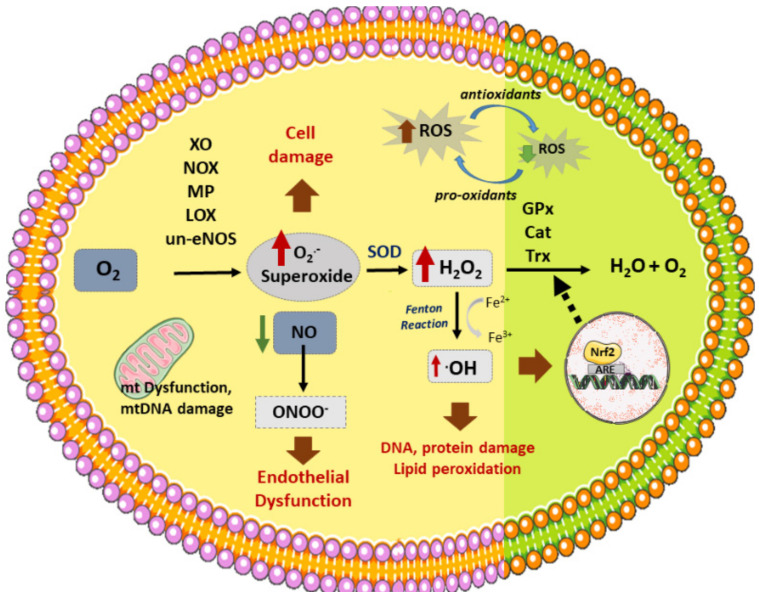
Vascular sources of ROS and related enzymes. Different enzymes participate in the formation of ROS: NOX (NADPH oxidase), XO (xanthine oxidase), un-eNOS (uncoupled nitric oxide synthase), LOX (lipoxygenase), MP (myeloperoxidase), generating superoxide (O2.-) from O2. In addition, dysfunctional mitochondrial (mt) respiratory chain is another source of (O2.₋). On the other hand, SOD (superoxide dismutase) produces H2O2 (hydrogen peroxide) from superoxide, which can then be converted to H2O by several antioxidant enzymes: GPx (glutathione peroxidase), Cat (catalase), or Trx (Thyoredoxin). H2O2 reacts with transition metals such as Fe2+ (through the Fenton reaction) to produce hydroxyl radicals (.OH). Nitric oxide (NO) reacts with O2.₋ to produce peroxynitrite (ONOO₋). ROS stimulates Nrf2 activation and translocation to the nucleus, activating the synthesis of antioxidant enzymes. ROS production induces cell death, DNA and lipid peroxidation, and endothelial dysfunction, among other effects, which triggers the atherosclerotic process.
Figure 3
Figure 3
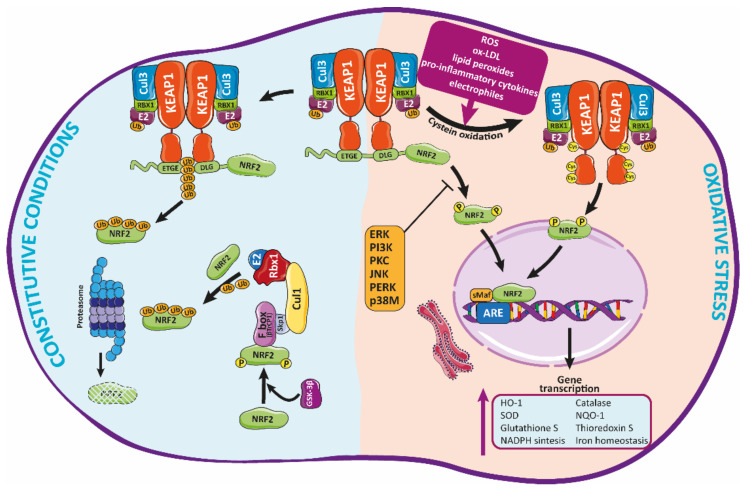
Regulation of Nrf2 signaling and HO-1 expression. Under basal conditions, Nrf2 is trapped into the cytosol associated with the Kelch-like ECH-associated protein-1 (KEAP-1) through the N-terminal (Neh2 domain). Herein, Nrf2 is transferred to proteasomal degradation after being ubi-quinylated. In response to pathological agents such as ROS, Nrf2 is released from this complex after oxidation of Keap1 cysteine residues, moving toward the nucleus, where it binds to ARE regions, inducing the expression of antioxidant enzymes such as HO-1.
Figure 4
Figure 4
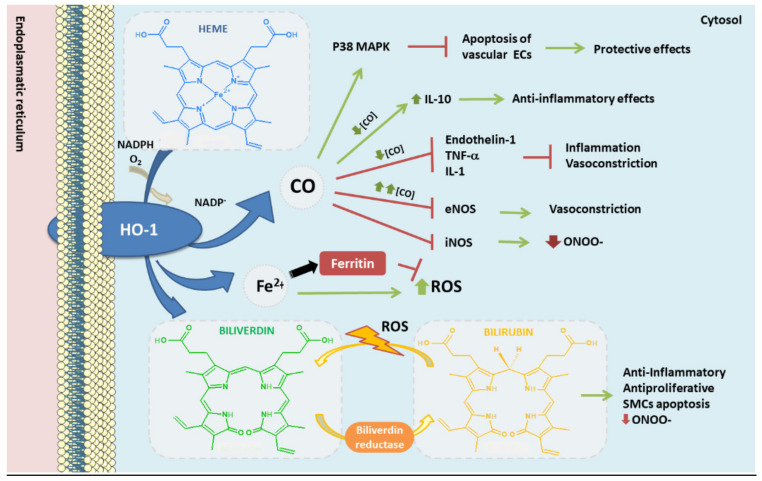
Heme oxygenase-1 antioxidant products derived from heme degradation. Heme oxyge-nase-1 (HO-1) catabolizes heme degradation into equimolar amounts of carbon monoxide (CO), Fe2+ and biliverdin. Biliverdin is converted to bilirubin by biliverdin reductase (BVR). All these products have shown antioxidant, anti-thrombotic and anti-inflammatory properties. In addition, HO-1 induces the production of ferritin, an iron storing protein—reducing the levels of Fe2+ which could derive into ROS via Fenton reaction.

References

    1. Hansson G.K., Hermansson A. The immune system in atherosclerosis. Nat. Immunol. 2011;12:204–212. doi: 10.1038/ni.2001. - DOI - PubMed
    1. Libby P., Aikawa M. Stabilization of atherosclerotic plaques: New mechanisms and clinical targets. Nat. Med. 2002;8:1257–1262. doi: 10.1038/nm1102-1257. - DOI - PubMed
    1. Soehnlein O., Libby P. Targeting inflammation in atherosclerosis-from experimental insights to the clinic. Nat. Rev. Drug Discov. 2021 doi: 10.1038/s41573-021-00198-1. - DOI - PMC - PubMed
    1. Yazdani S.K., Vorpahl M., Ladich E., Virmani R. Pathology and vulnerability of atherosclerotic plaque: Identification, treatment options, and individual patient differences for prevention of stroke. Curr. Treat. Options Cardiovasc. Med. 2010;12:297–314. doi: 10.1007/s11936-010-0074-9. - DOI - PubMed

    1. Yang X., Li Y., Li Y., Ren X., Zhang X., Hu D., Gao Y., Xing Y., Shang H. Oxidative Stress-Mediated Atherosclerosis: Mechanisms and Therapies. Front. Physiol. 2017;8:600. doi: 10.3389/fphys.2017.00600. - DOI - PMC - PubMed