. 2021 Aug 25;11(9):1127.
doi: 10.3390/brainsci11091127.

Pomegranate Juice Ameliorates Dopamine Release and Behavioral Deficits in a Rat Model of Parkinson's Disease

Affiliations

Pomegranate Juice Ameliorates Dopamine Release and Behavioral Deficits in a Rat Model of Parkinson's Disease

Małgorzata Kujawska et al. Brain Sci. .

Abstract

Pomegranate juice (PJ) is a rich source of ellagitannins (ETs), precursors of colonic metabolite urolithin A, which are believed to contribute to pomegranate's neuroprotective effect. While many experimental studies involving PJ's role in Alzheimer's disease and hypoxic-ischemic brain injury have been conducted, our knowledge of pomegranate's effects against Parkinson's disease (PD) is very limited. Previously, we have reported that PJ treatment improved postural stability, which correlated well with enhancement of neuronal survival, protection against oxidative damage, and α-synuclein aggregation. Since olfactory and motor deficits are typical symptoms of PD, in this study, we aimed to investigate the capability of PJ to protect against olfactory, motoric, and neurochemical alterations. To evaluate its efficiency, Wistar rats were given a combined treatment with ROT (1.3 mg/kg b.w./day, s.c.) and PJ (500 mg/kg/day, p.o.) for 35 days. After this, we assessed the olfactory discrimination index (DI) and vertical and horizontal activities as well as levels of dopamine and its main metabolite 3,4-Dihydroxyphenylacetic acid (DOPAC) in the dissected midbrain of animals. Our findings provide the first evidence that PJ treatment protects against ROT-induced DA depletion in the midbrain, which correlates well with improved olfactory function and vertical activity as well as with the presence of urolithin A in the brain.

Keywords: Parkinson’s disease; dopamine; ellagitannins; motor symptoms; non-motor symptoms; olfactory impairment; pomegranate juice; urolithin; α-synuclein.


Conflict of interest statement

The authors declare no conflict of interest.

Figures
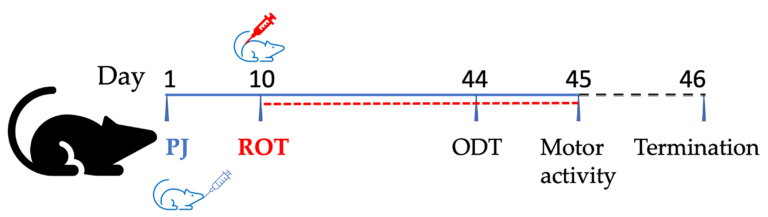
Figure 1
Figure 1
Graphical presentation of the experimental design used in the study.
Figure 2
Figure 2
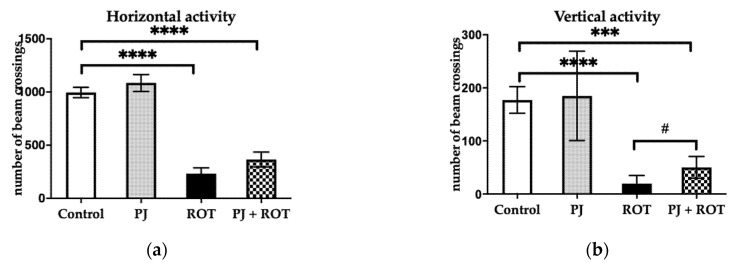
Effect of pomegranate juice treatment (PJ) on: (a) horizontal activity; (b) vertical activity in rotenone (ROT)-injected rats. Data are presented as mean values ± SEM of eight rats per group and analyzed using one-way analysis of variance (ANOVA) followed by Fisher’s LSD test. **** p < 0.0001 vs. Control; *** p < 0.001 vs. Control B; # p < 0.05 vs. ROT.
Figure 3
Figure 3
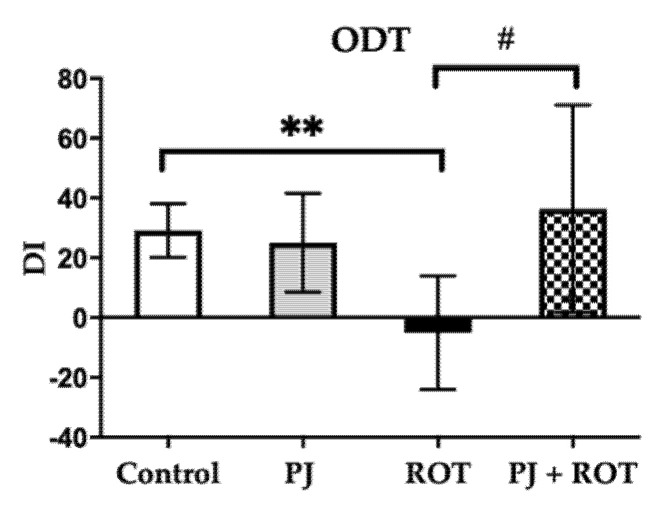
Effect of pomegranate juice treatment (PJ) on olfactory discrimination task (ODT) expressed as olfactory discrimination index (DI) in rotenone (ROT)-injected rats. Data are presented as mean values ± SEM of eight rats per group and analyzed using one-way analysis of variance (ANOVA) followed by Fisher’s LSD test. ** p < 0.01 vs. Control. # p < 0.05 vs. ROT.
Figure 4
Figure 4
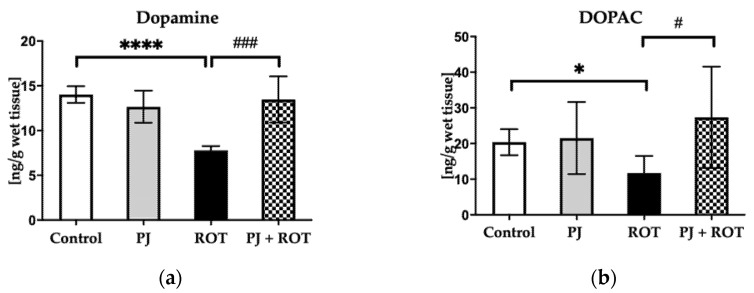
Effect of pomegranate juice treatment (PJ) on: (a) dopamine (DA); (b) DOPAC levels in the midbrains of rotenone (ROT)-injected rats. Data are presented as mean values ± SEM of eight rats per group and analyzed using one-way analysis of variance (ANOVA) followed by Fisher’s LSD test. **** p < 0.0001 vs. Control; * p < 0.05 vs. Control, ### p < 0.001 vs. ROT; # p < 0.05 vs. ROT.

References

    1. Kalia L.V., Lang A.E. Parkinson’s disease. Lancet. 2015;386:896–912. doi: 10.1016/S0140-6736(14)61393-3. - DOI - PubMed
    1. Kujawska M., Jodynis-Liebert J. What is the Evidence That Parkinson’s Disease is a Prion Disorder, Which Originates in the Gut? Int. J. Mol. Sci. 2018;19:3573. doi: 10.3390/ijms19113573. - DOI - PMC - PubMed
    1. Melis M., Haehner A., Mastinu M., Hummel T., Tomassini Barbarossa I. Molecular and Genetic Factors Involved in Olfactory and Gustatory Deficits and Associations with Microbiota in Parkinson’s Disease. Int. J. Mol. Sci. 2021;22:4286. doi: 10.3390/ijms22084286. - DOI - PMC - PubMed
    1. Hawkes C.H., Del Tredici K., Braak H. A timeline for Parkinson’s disease. Parkinsonism Relat. Disord. 2010;16:79–84. doi: 10.1016/j.parkreldis.2009.08.007. - DOI - PubMed
    1. Haehner A., Hummel T., Reichmann H. A clinical approach towards smell loss in Parkinson’s disease. J. Parkinsons Dis. 2014;4:189–195. doi: 10.3233/JPD-130278. - DOI - PubMed

LinkOut - more resources