Review
. 2021 Aug 27;12(9):1330.
doi: 10.3390/genes12091330.

Chromosomal Aberrations in Cattle

Affiliations
Review

Chromosomal Aberrations in Cattle

Beáta Holečková et al. Genes (Basel). .

Abstract

Chromosomal aberrations and their mechanisms have been studied for many years in livestock. In cattle, chromosomal abnormalities are often associated with serious reproduction-related problems, such as infertility of carriers and early mortality of embryos. In the present work, we review the mechanisms and consequences of the most important bovine chromosomal aberrations: Robertsonian translocations and reciprocal translocations. We also discuss the application of bovine cell cultures in genotoxicity studies.

Keywords: Robertsonian translocations; aberrations; cattle; chromosomes; genotoxic agents; reciprocal translocations.


Conflict of interest statement

The authors declare no conflict of interest. The funders had no role in the design of the study; in the collection, analyses, or interpretation of data; in the writing of the manuscript, or in the decision to publish the results.

Figures
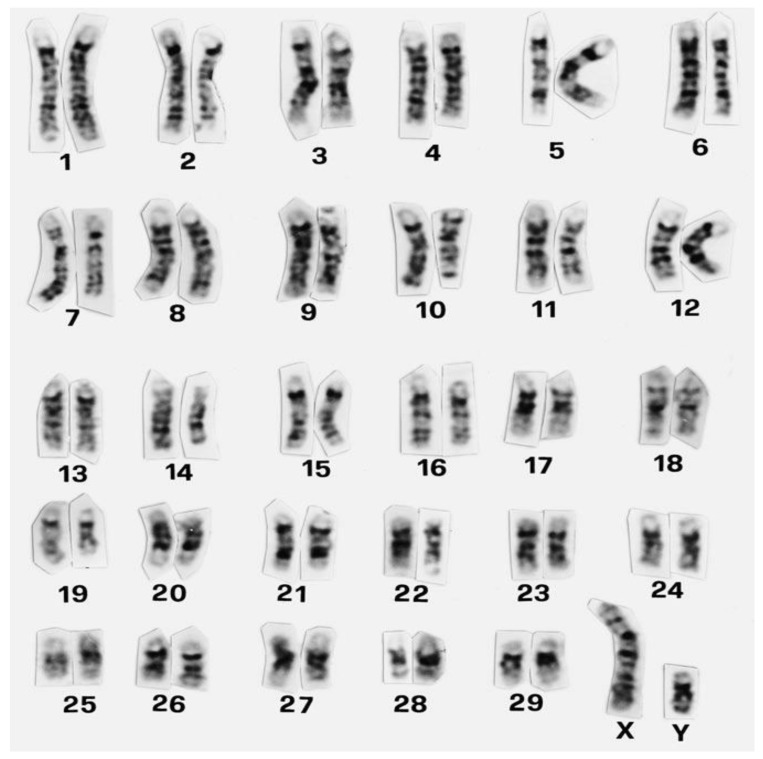
Figure 1
Figure 1
Standard GTG-banded karyotype of cattle (Cribiu et al., 2001). Reprinted with permission from ref. [11]. Copyright 2001 S. Karger AG.
Figure 2
Figure 2
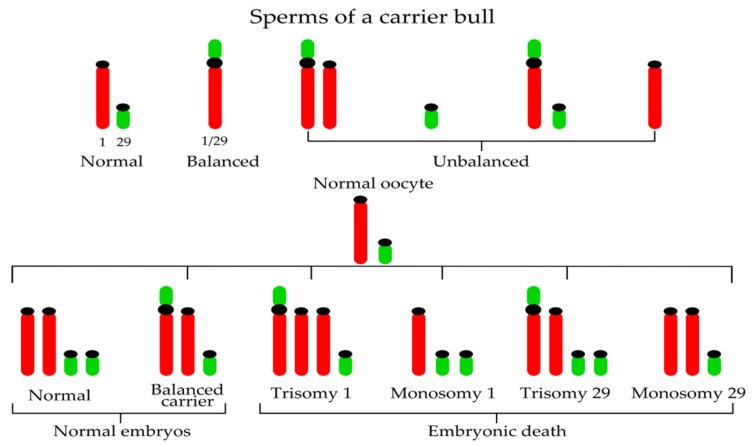
Examples of chromosomal combinations in embryos resulting from the mating of a heterozygous carrier bull 1;29 and a normal cow.
Figure 3
Figure 3
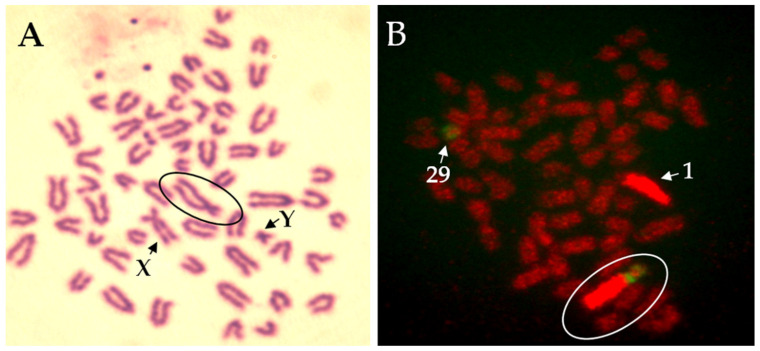
Robertsonian translocation 1;29 in bull (Slovak spotted breed). (A) Giemsa staining of chromosomes. (B) Fluorescence in-situ hybridisation (FISH) with whole chromosome painting probes for bovine chromosome 1 (BTA1, red) and 29 (BTA29, green). Circle indicates a fusion.
Figure 4
Figure 4
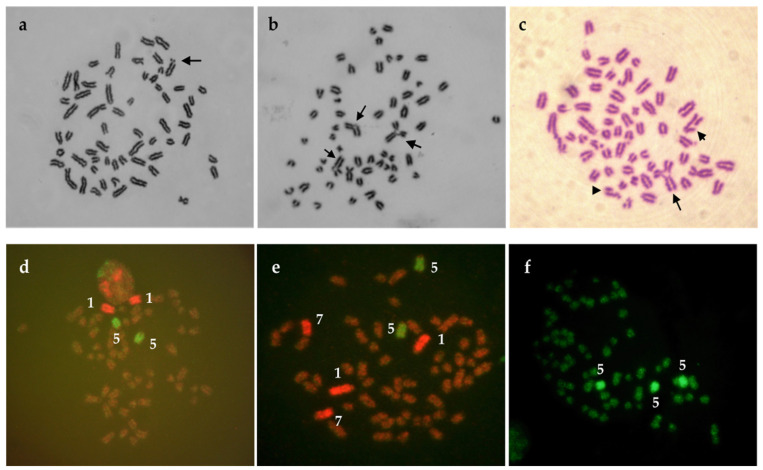
Bull metaphases exposed to pesticides in vitro. (a) Isochromatid break after exposure to tebuconazole/prothioconazole-based fungicide formulation indicated by an arrow (b) Chromatid exchanges after exposure to tebuconazole-based fungicide marked with three separate arrows (c) Chromatid exchange (the longest arrow), breaks (shorter arrow and arrowhead), and fragmentation (many breaks in the metaphase) after tebuconazole-based fungicide exposure. (d) Normal metaphase hybridised with WCP probes BTA 1 and BTA 5. (e) Normal metaphase hybridised with WCP probes BTA 1, BTA 5, and BTA 7. (f) Aneuploidy. Three copies of chromosome 5 (BTA 5) are visible in the metaphase plate. Metaphase originates from cultures treated with tebuconazole-based fungicide formulation.

References

    1. Philips C.J.C. Principles of Cattle Production. 2nd ed. CABI Publishing; Cambridge, UK: 2010.
    1. Scheu A., Powell A., Bollongino R., Vigne J.D., Tresset A., Cakirlar C., Benecke N., Burger J. The genetic prehistory of domesticated cattle from their origin to the spread across Europe. BMC Genet. 2015;16:54. doi: 10.1186/s12863-015-0203-2. - DOI - PMC - PubMed
    1. Deb R., Singh U., Kumar S., Sharma A. Analysis of Cattle Genome. A Tool Manual. 1st ed. Satish Serial Publishing House; Delhi, India: 2013.
    1. Elsik C.G., Tellam R.L., Worley K.C. The genome sequence of Taurine cattle. A window to ruminant biology and evolution. Science. 2009;324:522–528. - PMC - PubMed
    1. Childers A., Reese J.T., Sundaram J.P., Vile D.C., Dickens C.M., Childs K.L., Salih H., Bennett A.K., Hagen D.E., Adelson D.L., et al. Bovine genome database: Integrated tools for genome annotation and discovery. Nucleic Acid Res. 2011;39:D830–D834. doi: 10.1093/nar/gkq1235. - DOI - PMC - PubMed

LinkOut - more resources