


Non-Invasive Respiratory Assessment in Duchenne Muscular Dystrophy: From Clinical Research to Outcome Measures
- PMID: 34575096
- PMCID: PMC8468718
- DOI: 10.3390/life11090947
Non-Invasive Respiratory Assessment in Duchenne Muscular Dystrophy: From Clinical Research to Outcome Measures
Abstract
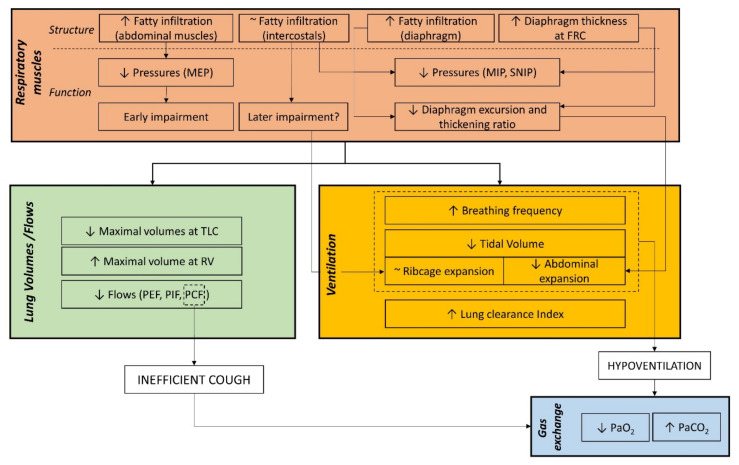
Ventilatory failure, due to the progressive wasting of respiratory muscles, is the main cause of death in patients with Duchenne muscular dystrophy (DMD). Reliable measures of lung function and respiratory muscle action are important to monitor disease progression, to identify early signs of ventilatory insufficiency and to plan individual respiratory management. Moreover, the current development of novel gene-modifying and pharmacological therapies highlighted the urgent need of respiratory outcomes to quantify the effects of these therapies. Pulmonary function tests represent the standard of care for lung function evaluation in DMD, but provide a global evaluation of respiratory involvement, which results from the interaction between different respiratory muscles. Currently, research studies have focused on finding novel outcome measures able to describe the behavior of individual respiratory muscles. This review overviews the measures currently identified in clinical research to follow the progressive respiratory decline in patients with DMD, from a global assessment to an individual structure-function muscle characterization. We aim to discuss their strengths and limitations, in relation to their current development and suitability as outcome measures for use in a clinical setting and as in upcoming drug trials in DMD.
Keywords: DMD; imaging; pulmonary function testing; respiratory function; respiratory muscles.
Conflict of interest statement
The authors declare no conflict of interest.
Figures
References
-
- Bushby K., Finkel R., Birnkrant D., Case L., Clemens P.R., Cripe L., Kaul A., Kinnett K., McDonald C., Pandya S., et al. Diagnosis and management of Duchenne muscular dystrophy, part 2: Implementation of multidisciplinary care. Lancet Neurol. 2010;9:177–189. doi: 10.1016/S1474-4422(09)70272-8. - DOI - PubMed
-
- Birnkrant D.J., Bushby K., Bann C.M., Alman B.A., Apkon S.D., Blackwell A., Case L.E., Cripe L., Hadjiyannakis S., Olson A.K., et al. Diagnosis and management of Duchenne muscular dystrophy, part 2: Respiratory, cardiac, bone health, and orthopaedic management. Lancet Neurol. 2018;17:347–361. doi: 10.1016/S1474-4422(18)30025-5. - DOI - PMC - PubMed
-
- Birnkrant D.J., Bushby K.M., Amin R.S., Bach J.R., Benditt J.O., Eagle M., Finder J.D., Kalra M.S., Kissel J.T., Koumbourlis A.C., et al. The respiratory management of patients with duchenne muscular dystrophy: A DMD care considerations working group specialty article. Pediatr. Pulmonol. 2010;45:739–748. doi: 10.1002/ppul.21254. - DOI - PubMed
Publication types
LinkOut - more resources
Full Text Sources
