Review
. 2021 Sep 9;22(18):9769.
doi: 10.3390/ijms22189769.

Protocadherin 19 Clustering Epilepsy and Neurosteroids: Opportunities for Intervention

Affiliations
Review

Protocadherin 19 Clustering Epilepsy and Neurosteroids: Opportunities for Intervention

Rebekah de Nys et al. Int J Mol Sci. .

Abstract

Steroids yield great influence on neurological development through nuclear hormone receptor (NHR)-mediated gene regulation. We recently reported that cell adhesion molecule protocadherin 19 (encoded by the PCDH19 gene) is involved in the coregulation of steroid receptor activity on gene expression. PCDH19 variants cause early-onset developmental epileptic encephalopathy clustering epilepsy (CE), with altered steroidogenesis and NHR-related gene expression being identified in these individuals. The implication of hormonal pathways in CE pathogenesis has led to the investigation of various steroid-based antiepileptic drugs in the treatment of this disorder, with mixed results so far. Therefore, there are many unmet challenges in assessing the antiseizure targets and efficiency of steroid-based therapeutics for CE. We review and assess the evidence for and against the implication of neurosteroids in the pathogenesis of CE and in view of their possible clinical benefit.

Keywords: androgen receptor; epilepsy; estrogen receptors; hormones; neurosteroids; nuclear hormone receptor; progesterone receptor; protocadherin; variant.


Conflict of interest statement

The authors declare no conflict of interest.

Figures
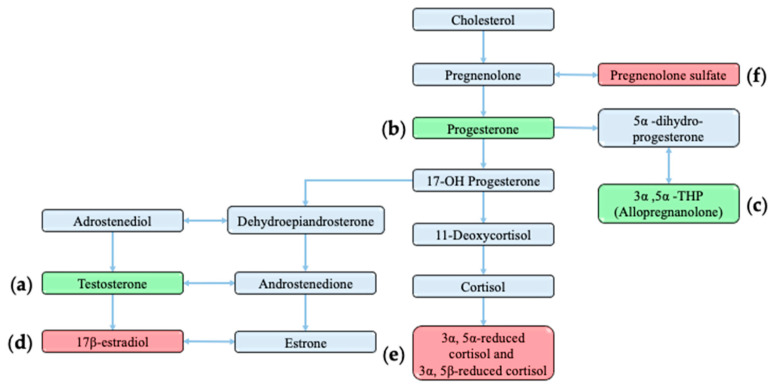
Figure 1
Figure 1
Simplified steroid synthesis pathway. Steroids discussed in this review are highlighted as generally having either excitatory (red) or inhibitory (green) effects on GABAA R. For specific references to (af) panels, please see the main text. Figure modified from [28].
Figure 2
Figure 2
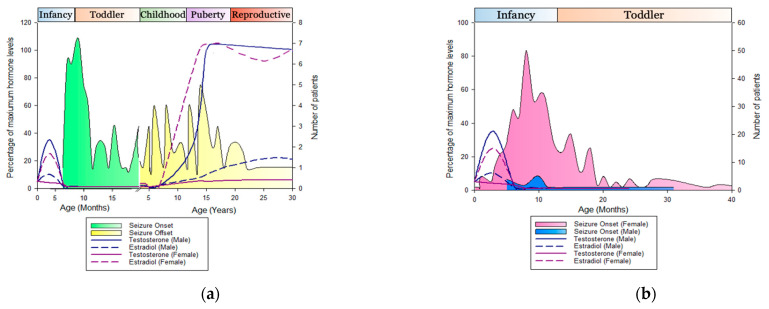
CE seizure onset and offset coincides with fluctuations in sex hormone levels: (a) a total of 54 CE females with recorded age of seizure onset and offset (Table S1) were plotted against average oestradiol and testosterone levels in males and females [29]. CE seizure onset coincided with a decrease in sex hormone levels after minipuberty, while seizure offset coincided with an increase in sex hormone levels during puberty. Figure updated from [25]; (b) age of seizure onset for a total of 395 CE females and 22 mosaic males (Table S2) was plotted against average oestradiol and testosterone levels in males and females during early development. Seizure onset for both CE males and females coincided with a decrease in sex hormone levels.
Figure 3
Figure 3
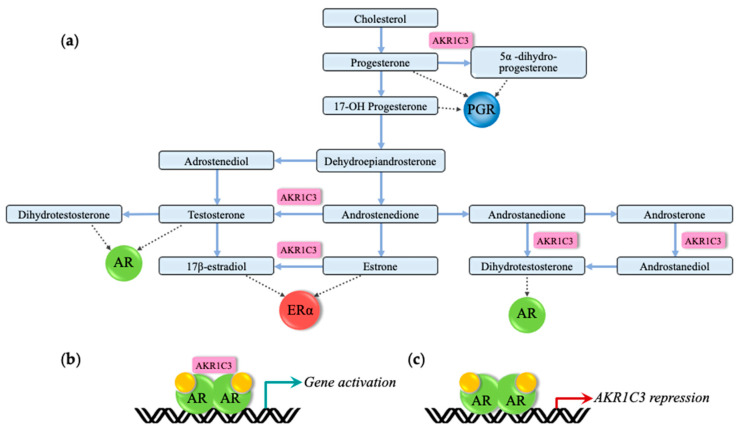
AKR1C3 influence on steroidogenesis and NHR-mediated gene regulation: (a) AKR1C3 influences NHR-mediated gene regulation through converting oestrone into the more potent ERα ligand 17β-oestradiol, progesterone into the weaker PGR ligand 20α-dihydroxyprogesterone, androstenedione into the weaker AR ligand testosterone, and androstanedione into the potent AR ligand DHT. Grey arrows represent the NHR corresponding to each ligand; (b) AKR1C3 regulates AR-mediated gene regulation through acting as a coactivator of AR and production of the AR ligands, testosterone, and DHT; (c) ligand-bound AR represses AKR1C3 gene expression [40].
Figure 4
Figure 4
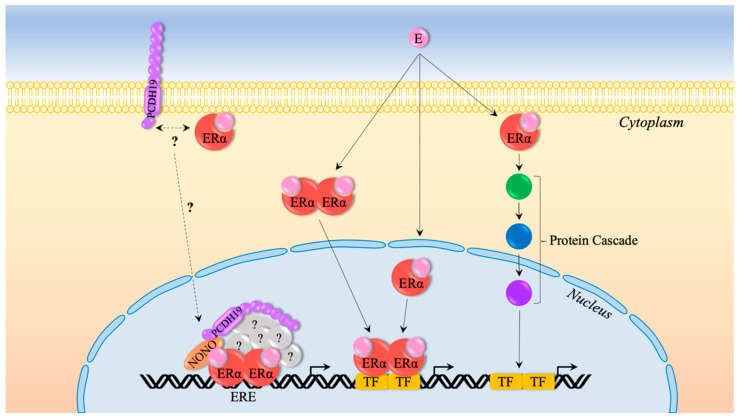
ERα-mediated gene regulation. ERα regulates gene expression through the genomic and nongenomic pathways. Genomic gene regulation involves the binding of oestrogen (E) to cytoplasmic or nuclear localized ERα, resulting in dimerization, a change in receptor confirmation, and, in the case of cytoplasmic ERα, translocation to the nucleus. ERα may recruit corepressors or coactivators (such as PCDH19 and NONO) to regulate gene expression either by directly binding an oestrogen-response element (ERE) or via binding to another transcription factor (TF). The nongenomic pathway involves membrane-bound ERα, rapidly and indirectly influencing gene expression through the cascade activation of DNA binding proteins [35].

References

    1. Kolc K.L., Sadleir L.G., Scheffer I.E., Ivancevic A., Roberts R., Pham D.H., Gecz J. A systematic review and meta-analysis of 271 PCDH19-variant individuals identifies psychiatric comorbidities, and association of seizure onset and disease severity. Mol. Psychiatry. 2019;24:241–251. doi: 10.1038/s41380-018-0066-9. - DOI - PMC - PubMed
    1. Kolc K.L., Sadleir L.G., Depienne C., Marini C., Scheffer I.E., Moller R.S., Trivisano M., Specchio N., Pham D., Kumar R., et al. A standardized patient-centered characterization of the phenotypic spectrum of PCDH19 girls clustering epilepsy. Transl. Psychiatry. 2020;10:127. doi: 10.1038/s41398-020-0803-0. - DOI - PMC - PubMed
    1. Dibbens L.M., Tarpey P.S., Hynes K., Bayly M.A., Scheffer I.E., Smith R., Bomar J., Sutton E., Vandeleur L., Shoubridge C., et al. X-linked protocadherin 19 mutations cause female-limited epilepsy and cognitive impairment. Nat. Genet. 2008;40:776–781. doi: 10.1038/ng.149. - DOI - PMC - PubMed
    1. Depienne C., Bouteiller D., Keren B., Cheuret E., Poirier K., Trouillard O., Benyahia B., Quelin C., Carpentier W., Julia S., et al. Sporadic infantile epileptic encephalopathy caused by mutations in PCDH19 resembles Dravet syndrome but mainly affects females. PLoS Genet. 2009;5:e1000381. - PMC - PubMed
    1. Terracciano A., Trivisano M., Cusmai R., De Palma L., Fusco L., Compagnucci C., Bertini E., Vigevano F., Specchio N. PCDH19-related epilepsy in two mosaic male patients. Epilepsia. 2016;57:e51–e55. doi: 10.1111/epi.13295. - DOI - PubMed